Showing posts with label Panasonic. Show all posts

Friday, January 16, 2026

Panasonic Lumix 35-100mm f/2.8 Mk II is here

 In 2012, I bought the Panasonic GH3 and the Lumix X 35-100mm f/2.8 in order to get started with micro Four-Thirds.  It was a rough start.

The GH3 EVF had the wrong color and the 35-100mm f/2.8 was subject to horrible flare with the lens hood in place and the sun out of the frame.  The OIS also had terrible stutter during video recording, even after a specific firmware update designed to fix the problem.


Besides that, it just didn't measure up to the US$1400 price or my Olympus ZD SHG 35-100mm f/2.0.   $1400 vs $2499 makes it seem as though the Panasonic lens was priced too high.  It took time to come to terms with micro Four-Thirds but I was using the system most days in 2015 and 2016.

Today, January 15, 2026, I received a used Panasonic 35-100mm f/2.8 Mk II.  I spent about US$500 on it.  The Panasonic G97 isn't as big as the GH4 that I was using daily but it has similar capabilities and IBIS (in-body image stabilization) that the GH4 did not have.  With most Panasonic lenses using OIS (optical image stabilization), they will be combined in what Panasonic calls Dual I.S.  I considered the Panasonic 135 Format 70-200mm f/2.8 instead but it's over US$2000.


Ugly flare with sun out of frame 


The second photo was taken with the sun out of frame, similar to the first, but look, there is no ugly flare.  Hopefully, it's not just that it was later in the day.

 I took the lens for walk of about 5 miles.  It feels like the earlier lens and it also felt surprisingly like a brand new lens.  Considering that it was used and coming from a rental company, I feel that my choice was good.


Color cast is non-existant.  I'll see if I can do a video test because I've been told that the OIS stutter still exists, even in the Leica-branded lens.  I hope it's been eliminated. 


Update 2026.01.25: Yesterday, I was at the Korean church and the person who photographs for the church had the Sony body and 70-200mm f/2.8 out on the dinner table.  I took out the G97 and 35-100mm f/2.8 Mk II.  There is a slight difference in size, and yes, I know, it's a lovely photo.  I took zero minutes to arrange things.  I didn't put the lens hood in place and the Sony has the lens hood in place.


Update 2026.03.01: Went out last evening with the G97 and 35-100mm f/2.8 Mk II.  The Dual I.S. performed admirably for such a middle of the range camera body. 

Friday, October 31, 2025

Panasonic G97 is here

I bought a Panasonic G97 and received it yesterday.  Previously, I've had the GH3, GH4, GX8, and GM5 micro Four-Thirds models from Panasonic, plus the Olympus E-M1.  Of all those, I've only kept the GM5.

The GM5 is a tiny marvel of a camera body, but it doesn't have much to offer but its size.  While it is quick and easy, it's sometimes frustrating.  The G97 is a bit like a GH4.5--a hybrid hybrid camera body.

The GH4 was known as the best camera for 4K video under US$10,000 when it was new.  However, it was a bit under-powered and lost focus occasionally when shooting video at 1080p. Add to that the original Lumix X 35-100mm f/2.8 that had a myriad of problems from OIS stutter to severe lens flare and the combination seemed a good reason to throw it far away.

The G97 is more powerful, but has to shoot 4K30p video at a crop.  It can also shoot 1080p video at 120 fps, but it isn't the greatest.  That's a shame.

The 5 stop IBIS is good, especially at the US$849 price point.  When you combine it with a lens that has Mega OIS or Power OIS, things become better, as the Dual I.S. combines the stabilization.  The viewfinder is another surprise at this level.  You can get an OLED display at 0.74x magnification, which is the same as the GH4 has. 

First impressions

After charging some batteries (without the USB cable and AC adapter that they don't include), I took the G97 and some lenses for a walk.   The body is very small, even though the controls are the same size as the GH7 and G9 Mk II.  Then again, I found the GH4 small, and it wasn't quite large enough for a good balance with some of my Four-Thirds Olympus lenses.

Controls on the top are in the same place as the GH4 but controls on the back are not.  Labeling is very different but it seems as Panasonic wanted to push flexibility and allow buttons to be re-mapped.  I tend to use controls as they come from the factory.

The internal structure of the G97 may not be as strong and light as the GH4, but it feels just as sturdy.  Using aluminium and steel instead of magnesium alloy works just as well and costs less.  I was surprised to learn that the G80/G85 and G90/G95 were weather-sealed.  Having photographed in hurricanes and sports events where rain was sudden, I want to feel comfortable that my equipment can handle it.

 There are a couple of settings I change right away.  I turn off the Beep.  I set the photo style to natural and the file to Raw.  I usually set the focus point to pin-point but I set it to Face Detection, although I wonder if it's a combination of two settings to make face detection work.  On the GH4, it was a disaster compared to the Olympus E-M1.  I want to learn if this version of Face Detection works.

Walking at night makes for difficult photography.  Film cameras didn't work well, especially when film was rated at ASA(ISO) 100 or even 400.  Sensors in 2004 weren't that good.  In 2012, I was photographing regularly at  ISO 1600 or even 3200.  In 2025, it's less of a problem.  Sensors have become better and image processing has become much better. Having strong IBIS can save a situation that a tripod can't.  I can hear how hard the IBIS is working to keep things steady.  The EVF can show me things that my eyes (or an optical viewfinder) can't see in the dark.

The camera body didn't let me down.  I'm sure I still have settings to find to fine tune my experience.  However, the G97 is quite capable, and coming from the GH4, etc., it's an easy transition.  Contrast that to my occasional frustration with the S5 Mk II and S-series lenses.  Auto Focus locks quickly and the shutter engages quickly.  In the dark, AF goes down to EV -4, just like the GH4.  There are only 49 AF areas, just like the GH4, but it works well so far in stills mode.  I doubt that DFD on video is any better than it was.

The 12-60mm f/3.5-5.6 Power OIS lens that came as part of the kit seems good. At 5x reach, it's the longest zoom kit lens for micro Four-Thirds.  The FoV is like a 24-120mm lens on a 135 Format camera.  On the S5 Mk II, the kit lens was 20-60mm f/3.5-5.6 without OIS, which seems strange for a lens of around US$600.  The Dual I.S. was activated and I'm sure that I got shots that wouldn't have been usable otherwise.

IBIS on Four-Thirds was not very good.  I had the Olympus E-5 and couldn't tell that the IBIS was working.  My best lenses were heavy.  On micro Four-Thirds, Olympus had IBIS and Panasonic had OIS.  Of course, they would not work together.  If they had, micro Four-Thirds would have been more compelling.  IBIS in the G97 is not Panasonic's finest, being about the same as the GH5 but the Dual I.S. functionality extends that stabilization, much like Sync IS works on Olympus equipment and makes it possible to get shots handheld that were never possible.  Back in the film days, I remember standing against a tree or a wall to get certain shots when light was scarce.

Firmware updates

Naturally, it's a good idea to have your equipment up-to-date and when I was photographing sports most every day, I'd be ready.  Both the body and the 12-60mm f/3.5-5.6 lens needed updates.  As well, I checked my other lenses and my Panasonic/Leica 15mm f/1.7 got an update back in 2022.  It's the lens I use the most on the GM5. 

Update 2025.11.15: It's been about a month since I've had the G97.  Using the lenses I have, it's worked well.  I ordered the Panasonic/Leica 9mm f/1.7 just a couple of weeks before the G97.  Both are on the Amazon 5 payments plan.

I already had the 12-32mm f/3.5-5.6 Mega OIS lens with the GM5.  It's a collapsible kit lens that does an amazing job at a tiny size.  When I bought the GM5, I also bought the 42.5mm f/1.7 Power OIS lens.  The other Panasonic lens was the Panasonic/Leica 15mm f/1.7.  I also have three Olympus lenses: 25mm f/1.8, 40-150mm f/4.0-5.6, and the 8mm f/8 (almost) fisheye lens cap lens.

Since I don't have reach past (135 Format) 300mm, I bought a 2.2x screw-on tele-converter for a 58mm filter thread.  It should be good enough for a while.  I noticed on Amazon that the Panasonic/Leica 100-400mm f/4.0-6.3 Mk II version is available on 5 payments.  That will change by the time I'm ready.  That lens will give me a 135 Format effective 800mm reach, and you can use a tele-converter for even further reach.  However, that tele-converter is a bright light solution.

Update 2026.01.12: I was at the Korean church where I go sometimes and I was trying to photograph something with the Panasonic S5 Mk II and the 70-300mm f/4.5-5.6.  It was quite good, except that the slow aperture indoors was strangely too much for the scene and I didn't feel like pushing the ISO sensitivity so high.  It's strange because I had just photographed the supermoon without a problem.  I couldn't hold it steady and the Dual I.S. just wasn't enough to compensate.

Today, I decided to rectify the problem with a lens for the G97: the Panasonic 35-100mm f/2.8 Mk II.  It's not the Lumix X (blech!) version and not the current Panasonic/Leica version and I got it for about US$500.  Hopefully, Very Good condition means very good. For half of the price of the Panasonic/Leica version, it's very good.

In my opinion, it's a bit too small and relies too much on software corrections.  It has a 58mm filter size vs a 77mm filter size for the Olympus ZD SHG 35-100mm f/2.0 lens.  The Lumix X (1st version) was sufficient in most cases, but when it was bad, it was a POS.  I'm hoping that the revision will be satisfactory.  The G97 will work with it to employ Dual I.S. to get a stabilized shot, even in lower light situations. 

Update 2026.01.20: Doing some spring cleaning, I found two Panasonic batteries that I used for my Panasonic GX8.  They're the same batteries as the G97 uses. Since I haven't used them since 2017, they should still have a decent charge capacity remaining.  Now, I have 3 Panasonic batteries and 2 Wasabi batteries.

I also found some other equipment, but except for my very old Olympus FL-20 flash, nothing else will work with the cameras I have. 


Update 2026.01.25: I was at the Korean church and the person who does the photography had a Sony body and the 70-200mm f/2.8 attached and it was sitting on the dinner table.  I took zero minutes to arrange things and just got out the G97 and 35-100mm f/2.8 Mk II and placed it near the Sony. You may be able to see that the lens hood is reversed on the Panasonic 35-100mm f/2.8 Mk II.


Update 2026.02.28: Discovered something wonderful.  I can transfer raw photos from G97 to iPhone through Lumix Sync app.  It's so much better than expected and as easy as Lumix Lab.

Used the G97 and 35-100mm f/2.8 Mk II.  The Dual I.S. performed admirably for such a middle of the range camera body.  

Thursday, October 16, 2025

Buy...Buy...Buy photographic equipment

 I'm feeling a bit ridiculous.

I've got a Panasonic GM5 from my old days with a P/L15mm f/1.7, O 25mm f/1.8, P 42.5mm f/1.7, O 40-150mm f/4.0-5.6, P 12-32mm f/3.5-5.6, and a 46mm screw-on focal reducer.

 I've also got a Panasonic S5 Mk II with a P 20-60mm f/3.5-5.6, P 70-300mm f/4.5-5.6, P 50mm f/1.8, and a Tamron 180mm f/3.5 macro lens on an EF->L-mount adapter.

For years, I spent many days each week photographing at skate parks or earlier, photographing at high schools.  I photographed many sports.  I'm not quite as active or able, but I'm missing the ability to do more.

Purchases too many?

Purchase number one: 

I've been photographing the night sky and I was looking for a very wide lens and there was a Brightin Star 11mm f/2.8 fisheye lens for US$259 for L-mount, except that the deal was US$40 off, not tariff, taxes, or shipping on my end.

 It's not electronically connected at all.  It's completely manual.  It's also coming from a Chinese brand that I haven't tried, but as long as it focuses to infinity and doesn't fall apart, I'll be okay.  It looks as though the optical quality is quite good, especially for the price.

It arrived today.  Packaging from shipper looked a bit ragged but inside, the box was good.  They even sent me the correct lens mount.  You probably haven't seen how many people complain about getting the wrong one.  I've been holding my breath for a lack of problems. 

  Purchase number two:

I went out with my GM5 the other night and was hoping for something very wide, missing my Olympus 8mm f/1.8 fisheye lens.  I saw an Amazon 5 monthly payments deal and bought a micro Four-Thirds Panasonic/Leica 9mm f/1.7.  It was full price, but for US$99 something each month, it's agreeable.

 It has arrived.  It's as big as the GM5 and currently, it's the only weather-sealed micro Four-Thirds lens I have.  It used to be that all my lenses were weather-sealed. Using Four-Thirds equipment, I photographed outside during hurricanes, so having weather-sealed equipment was important.

Purchase number three:

Amazon has a habit of showing me deals on equipment from 2016.  I've also been looking at (used. new) micro Four-Thirds camera bodies from around that time.  The E-M1 Mk III was interesting to me, but the EVF is low on resolution.  The GH5 Mk II looked interesting, but the lack of PDAF made too much of a compromise and with the tariffs, etc. a new one is just too expensive and good, used ones are difficult to find.

So, Amazon pushed a Panasonic G85 after the lens purchase.   The G85 is a sufficient camera, much like a cut-down version of the GH4 that I owned, but with really good IBIS.  Amazon had a 5 payments deal  but it just wasn't a step up.  I looked at the G97, which is somewhat more advanced, not unlike the 2019 G90/G95/G99.  The EVF and back panel use OLED technology.  The menus are more like my S5 Mk II than the GH4 menus.  In a lot  of ways, it's a better GH4 with IBIS.  The trouble was that there was no 5 payments  plan offered.  12 hours later, there was a 5 payments plan.

The G97 is here.  It only comes one way--with the Panasonic 12-60mm f/3.5-5.6.  Strangely, it didn't come with a USB cable of any kind or an AC adapter.  However, it instructs the user to attach both pieces and connect to an AC outlet to charge it.  The box doesn't have anything to indicate that those two items would be included.  I happened to order a separateUSB-connected battery charger with two batteries.  (Wasabi has been reliable as a third party battery provider.)

I got some of the quick settings changed straightaway.  I moved most of my equipment into an older backpack and went out to get pizza and take a long walk with the camera.

It's a but smaller than the E-M1 and smaller still than the GH4.  I wonder how it would be with larger lenses.  Except for the 12-60mm f/3.5-5.6 kit lens, every micro Four-Thirds lens I have is rather tiny. 

Now, I have three pieces of equipment on the way. 

Wednesday, April 16, 2025

Panasonic Lumix 70-300mm f/4.5-5.6 is here

A couple of days ago, I ordered the Panasonic 70-300mm f/4.5-5.6 OIS macro lens.  At US$300 off US$1099.99, it was a decent deal and 10% from that made it a better deal.  It's native and weather-sealed and with the small aperture, it's lightweight and will do just fine for photographing at a distance.

 It should be better made than my micro Four-Thirds Olympus 40-150mm (80-300mm equivalent) f/4.0-5.6 but the actual exposure won't be much different and that lens isn't weather-sealed.  That was surprisingly good for a refurbished lens at US$99.  The 70-300mm f/4.5-5.6 had better be really good since it's new.

Do you see much of a difference?


I wouldn't mind a travel zoom, but the only one that is weather-sealed and will work is a Canon EF-mount L-series lens for about US$1500.  The Panasonic 28-200mm f/4.0-7.1 has a fair number of "it's okay", which says that I won't like it.

I've been fighting with a Viltrox L-mount to EF-mount adapter and a Tamron 180mm f/3.5 macro lens.  It could be as new as 2014 or as old as 2004.  The combination does not seem to focus to infinity and I'm not sure what is the problem.  It seems quite reasonable otherwise.  As a lens from that time, with an 82mm filter size, it focuses reasonably well, but about as quickly as any macro lens I've used.  When trying to photograph the moon, it will focus the whole distance, much like most PDAF-oriented lenses on CDAF.

I took the 70-300mm f/4.5-5.6 out for a while.  It's not that heavy for what it is.  Coming from micro Four-Thirds, it's heavy.  My Four-Thirds equipment was about the same.  This lens has a 77mm filter size, which is still compact for 135 Format, where 102mm or 105mm filter size is not that surprising.

It seemed to focus quickly, although when photographing a flower that was close, I was not certain about the focus, so I tried a second time.  It could have been my eye sight.  It has Optical Image Stabilization and it's compatible with Dual I.S., which should make it seem super steady.


 Everything turned out very well.  I only changed the photos for size and to export them as JPEG files.  The starry sky photos are a bit difficult to see the detail, but they were photographed handheld, with the Dual I.S. able to handle the shake.  Obviously, the water tower was photographed from two different locations about 300 feet apart and at different focal lengths, but they worked out very well.  I was thinking about my Olympus ZD HG 50-200mm f/2.8-3.5 where I photographed the mechanism of a wind turbine and the part numbers are legible.  That had a maximum equivalent focal length of 400mm.  Trying to find something weather-sealed isn't available at this time for L-mount, unfortunately.

Generally, if you buy the "regular" lenses, you can't expect much.  This "regular" zoom lens wasn't inexpensive, unless you're gauging the cost by Leica standards.  (I really wish that I could buy that 90-280mm f/2.8-4.0 but that's used car territory.) This lens has a good range and you'll need that deeper Depth of Field for photographing at long distances.

 Its macro abilities are okay, but there is no close range switch for the auto focus, just the full range and 3 metres to infinity. I would prefer the 3 settings switch.  I may still fight with that adapted Tamron 180mm f/3.5 macro lens on occasion but for everything else, the 70-300mm f/4.5-5.6 is a winner.

I was looking at a few video reviews from four years ago when the lens was being released.  The one thing that hit hard was the sharpness differences from 70mm and 300mm.  My experience on micro Four-Thirds Panasonic lenses was that they all seem to suffer a bit on the long end.  This one has been good for me, but I'm sure that it is technically a bit weak at 300mm.  Does it matter if I get the shots I want?  No, it doesn't.

Update 2025.05.11: I'm still not impressed with the auto focus.  Whether it's the S5 Mk II or the 70-300mm lens, the combination isn't as good as it should be.  I reviewed the lens on Panasonic's store site, where I bought it, and maybe that review will cause them to look at how it works and how to improve it.  I just don't feel as confident with this lens as I do the 20-60mm f/3.5-5.6 or 50mm f/1.8.  AF is almost instantaneous on those.


Update 2025.05.13: Last night, I went out to photograph the moon.  There were a few difficulties where the lens went through the entire focus range a couple of times.  Can't imagine why the PDAF did not grab focus. Switched to manual focus at one point.  Dual I.S. worked well, though, when I tried to photograph a moving (the still ones don't stay there) plane, it couldn't compensate.


Update 2025.06.29: Went out because someone had been smashing windows and wanted to get some video of that person.  Didn't find him, but I did get a couple shots of the moon. 


Update 2025.12.14: There was a supermoon a few days ago.  I went outside without a tripod, Looked up from the front yard and there it was.  Auto Focus worked surprisingly quickly.  I took four shots and they were all fine.  I was surprised, especially since it worked at almost 300mm.  How it was 298mm or whatever, I'm not sure.

Tuesday, December 17, 2024

Three good reasons to use micro Four-Thirds


I've been using micro Four-Thirds seriously since 2014 and I was dabbling from 2012.

I've been hearing "Full Frame" chants since 2004, even when there weren't any such bodies available.

I have three good reasons to use micro Four-Thirds.

  • Weight
  • Telephoto reach
  • Variety of available lenses
  • Video on Panasonic bodies

Weight is not difficult to understand.  if you have a light system, you can photograph more effectively and travel further with more equipment.  You can find select equipment that is smaller than typical for various sensor sizes, but overall, micro Four-Thirds has the smallest combinations.  Even with the GH7 and G9 MkII, the equipment is fairly light in contrast to APS-C or 135 Format.

Telephoto reach is not difficult, either.  Having a multiplication factor of 1.94x over 135 Format, a telephoto lens with the same reach is smaller.  400mm is effectively 800mm and yes, the Depth of Field is deeper, which is actually preferable when shooting from a distance.

micro Four-Thirds started around 2008, so it has a lot of lenses available over 16 years.  The original lenses were just sufficient.  Since then, some unique lenses such as the Panasonic 10-25mm f/1.7 lens and the Olympus 8mm f/1.8 fisheye lens.

Best photography with micro Four-Thirds

You can do anything with any camera, if you have the determination, the money, and the skill and sometimes, the luck.  However,  If you're in micro Four-Thirds for wide landscape photography, you're in the wrong format.  If you're photographing weddings or doing portraits, there are better sensor sizes.  However, if you're doing video for weddings or practically anything else, micro Four-Thirds, especially Panasonic, has you covered.

Since the GH4, Panasonic put a lot of its professional knowledge into a camera body that was easy to handle.  Up through the GH7, they have added stabilization, waveforms, and more to make it easier to get video recorded consistently.  The 135 Format Panasonic S5 Mk IIx is equivalent to the GH7, but the GH7 has fewer downsides.  I have the regular S5 Mk II, but I'm not doing much video these days.  Even then, I suspect that Panasonic has a few more firmware updates for the series.

Doing video with the GH4 was better than okay but the auto focus wasn't reliable and the body didn't have IBIS (in-body image stabilization).  For someone with a gimbal stabilizer, it would be less of a problem.  Most film makers don't use auto focus, so there isn't a problem for them, either.  The GH7 and G9 Mk II both have hybrid (PDAF + CDAF) auto focus and amazing Dual I.S. when using Panasonic lenses with O.I.S.

Update 2026.01.12: micro Four-Thirds seems to be gaining some interest again.  I've seen a few videos on YouTube pushing that lately, as well.

I'd been on a very narrow set of lenses and a tiny camera body, the GM5.  I picked up the Panasonic/Leica 9mm f/1.7 lens and the G97 body.   Along with the Panasonic/Leica 15mm f/1.7, Olympus 25mm f/1.8, Panasonic 42.5mm f/1.7, it covers a lot.  What I haven't had for a long time is a decent constant maximum aperture zoom lens.  I just ordered a Panasonic 35-100mm f/2.8 Mk II lens.  I had the first version and it was a HUGE disappointment.  I bought this one used since it's been discontinued also, for about US$500.  The current Panasonic/Leica version is going for double that used.

I was thinking about the 70-200mm f/2.8 for Panasonic's 135 Format series, but it's over US$2000 new and not much less for a used lens.  Sigma's lens is less expensive, but I don't believe that the Optical Stabilization is compatible with Dual I.S.   The micro Four-Thirds lens may not be as pure an optical formula but it is quite a match, especially for the price.  The original Lumix X 35-100mm f/2.8 I bought was US$1400, not that much less than my Olympus ZD SHG 35-100mm f/2.0, which was practically perfect.  Having a 58mm filter size vs 77mm tells a lot than the 2.8 vs 2.0 doesn't. 


Update 2026.02.01: I was at the Korean church and the person who does photography for the church had the Sony body and 70-200mm f/2.8 in the dining hall.  I took out the Panasonic G97 and 35-100mm f/2.8 and placed it near the Sony equipment.  I did not extend the hood, so it looks even smaller. 

Thursday, December 12, 2024

Panasonic S5 Mk II with Tamron SP 180mm f/3.5 macro for Canon + adapter

 I've been wanting a telephoto lens of some sort.  Spending another US$1000 or more wasn't happening.  I have too many questions about what will suit me.  On Four-Thirds and micro Four-Thirds, I had a good selection of telephoto zoom lenses, including one that was exceptional for any format I've ever used.  The Olympus ZD SHG 35-100mm f/2.0 is an amazing lens.  Comparing every 70-200mm f/2.8 lens to it makes me think that I'm just not going to get what I want.


Switching to 135 Format, I don't have any telephoto lenses, not even from my old film days.  I took a chance on a Tamron SP 180mm f/3.5 macro lens.  The lens was introduced in 2003 and I'm not sure how old this one is.  Considering how clean it is, without weather-sealing, it's probably quite new.  To use it properly, I bought a Viltrox EF-mount to L-mount Pro adapter, the one that has the electronic connections for AF, IS, and aperture control.  The lens doesn't have any image stabilization, but it does have auto focus, with a clutch on the lens that you pull toward the body to enable manual focus.  Manual focus sounds a little grindy.  I seem to remember reviews complaining about all focusing making some noise.


It didn't arrive with the lens, so I bought a K&F Concept manual adapter in the meantime.  The lens and the camera fit together, and I can focus and shoot, but because there is no aperture ring, it's stuck at the default aperture, and there isn't much else.  It worked but defaulted to ISO 6400, which probably wasn't that bad.  The adapter seems sturdy enough and I was interested in their quality for an inexpensive circular polarizing filter, as well.

The Viltrox adapter arrived today, after Adorama sent a second one since the first one was lost at the UPS facility.  Getting it about a week late is no joke.  2nd Day Air usually works better.  I appreciate that Adorama went out of its way for me.  I'm just glad I wasn't counting on the mount adapter for a job, like in the old days.

 The adapter has electronic connections, a switch on the side to indicate to the camera to notice the combination of lens and adapter as a native lens or to let the adapter be seen by itself.  Unfortunately, the switch is hidden by the handgrip and it's safer to remove the lens, set the switch, and reattach the adapter.

The Viltrox adapter also has a USB type-C port for software updates.  I took a look at the website and it mentioned lens updates and strangely, didn't even mention this adapter.  It was surprising that they had an electronic adapter.  They've been selling lenses lately, but not for L-mount.  They had some adapters for micro Four-Thirds and probably wanted to show Panasonic that they were still out there.

What's pretty amazing about this mount adapter is that it has an extra collar to tighten the lens to the mount.  It's a little tricky to get everything right, but you don't want an expensive lens jiggling and losing contact just when that perfect photo is about to be captured.

It's raining outside (neither are weather-sealed) but the little bit of testing I did with the Viltrox adapter shows it to be good.  The AF of the lens was never incredibly fast, so I think it's as good as it would be on a Canon dSLR body.  Maybe, it's even better because there probably isn't a calibration problem, as we used to have where the lens was just a bit too close or too far for focus to be exact.

 Now, if Viltrox will put out their new 135mm f/1.8 LAB lens for L-Mount, I'll be set.  I'm fairly certain that Samyang's 35-150mm f/2.0-2.8 would be a better choice, though.


Update 2024.12.15: It's a bit less rainy today and I noticed that the local park has an added duck pond.  After shopping, I went there to take a few photos.  I need to adjust for the weight, as the IBIS isn't good for long distances.

The photo of the tree seems to be more in focus.  The water and ducks seem just out of focus, but on the edge.  I probably should have chosen more carefully but it was below 50 degrees F and I don't handle cooler temperatures all that well after having frostbite years ago.  I just exported a JPEG version of the raw files to add here.  Color is good.  At one point, the auto focus went the whole range to figure out where it needed to be.  Macro lenses have the oddest AF.

For a fixed focal length of 180, it feels heavy enough to be a 70-200mm f/2.8 lens.  Maybe, I'm just out of practice.


Update 2025.01.03: The moon and one planet were out and it was so clear last night as I was walking to the store.  I hesitated but kept going.  Tonight, it's a bit hazy, unforunately, but I tried.  I had to give up on AF because it just wouldn't lock onto anything.  Manual focus makes a lot of noise, as if there is something wrong, but I seem to remember these lenses doing that even when they were new.


Update 2025.03.14: Blood moon tonight.  Not sure this is ready.  I got something early but when I went out at midnight, I could not see anything.

Tuesday, December 3, 2024

Panasonic Lumix S-series Telephoto Lenses.

 The one thing that isn't good about 135 Format is the telephoto lens selection and Panasonic only has one that ends at 300mm, a 70-300 f/4.5-5.6 and it's about US$1100. It took Panasonic a while on micro Four-Thirds to get any good telephoto lenses and that format is much better for reach because of the sensor size.

I've been looking for a 135mm f/2.0 lens, like what Rokinon/Samyang had, even if it's manual.  There is a Sigma 135mm f/1.8 but it appears to be going away.  For US$1400, it's not bad, but it has the hypersonic motors that were being introduced in the dSLR days for faster auto focus.  In my experience, they are not great for photographing video with AF and stepping motors work much better with mirrorless cameras and hybrid AF.  It's possible that we'll see the version change from HSM to HLA in the near future, as some of their lenses have already made the transition.

As an aside, my first 135 Format film camera came with a 55mm f/2.2 Fujinon kit lens and I later bought a Vivitar 135mm f/2.8 lens for something like US$45.00 when a 50mm f/1.4 would have been US$350 and a 50mm f/1.2 would have been US$500.  Back then, Vivitar was a good brand and had the first push-pull zoom mechanism.  Working in the camera department of a department store a bit later, I had the opportunity to test the equipment, so that I could give an accurate opinion.  Sadly, we didn't have any Medium Format equipment.

Have you noticed all of the long telephoto zoom lenses?  I haven't, either.  Sigma has the 60-600mm f/4.5-6.3, which is the latest rendition of what we used to call Bigma.  For US$2000, it's a deal, but it's over 5 pounds at 88 ounces or 2.49 kg.  You'll need to hire a photo assistant and have a tripod ready.  Panasonic has a 70-300 f/4.5-5.6 and it's about US$1100.  These are weather-sealed lenses.  If you're photographing sports, you're going to be ready.

 In the meantime, I opted for something used, a Canon 180mm f/3.5 macro lens substitute from Tamron for US$243.00 + a Viltrox (Pro) adapter for US$163.50.  They actually had a Canon L-series lens but it was missing parts and I didn't want to pay extra and not have all of the parts.  Besides, the L-series lenses were sometimes good, sometimes not.  I used to see a sizeable number of refurbished L-series lenses.

180mm isn't terribly long, but the 70-200mm f/2.8 isn't much longer, and I'm not sure I'm wanting to pay for that 70-300mm f/4.5-5.6, even though the Dual I.S. will make it steadier.  Neither the Canon or Tamron lenses seemed to have image stabilization.  The IBIS in the S5 Mk II probably won't be completely effective at 180mm, which is partly why I already have a Smallrig CT-20 tripod/monopod.

Update 2024.12.23: I mentioned something about the lack of a Panasonic 85mm f/1.4 on L-Rumors and someone mentioned that the Sigma lens was amazing.  As great as that is, where is Panasonic's lens?

Next month, they have an announcement at CES, which is not exactly the place for professional equipment, but maybe, just maybe, they're announcing replacements for the S1, S1H, and S1R, plus some lenses.

Update 2025.02.03: At CES, Panasonic talked about everything else but the plan for their photographic business.  Supposedly, they have an announcement in February.  CP+ in Yokohama will start February 27th, I believe.  Hopefully, we'll get some good news.  Has it really been five years since they started making L-mount equipment under the Panasonic Lumix name?

Update 2025.04.12: Panasonic has still not mentioned any new lenses.  Sigma announced a 300-600mm f/4.0 Sports line lens and a 16-300mm f/3.5-6.7 Contemporary line lens.

They sent me an e-mail about a week ago to accentuate the S1R Mk II with their telephoto lenses and to announce 10% off.  I thought about getting a used lens.  I've been using a Tamron lens that probably was released in 2004 and retired in 2014.  It's in good condition, so it was probably made later in the life cycle of the lens.  However, using it through an adapter isn't optimal.  I was trying to get photos of the blood moon and tried early and got something interesting but focusing to infinity, even with manual focus doesn't work reliably.

 Therefore, a little while ago, I ordered the Panasonic 70-300mm f/4.5-5.6 OIS macro lens.  At US$300 off US$1099.99, it was a decent deal and 10% from that made it a better deal.  It's native and weather-sealed and with the small aperture, it's lightweight and will do just fine for photographing at a distance.

 It should be better made than my micro Four-Thirds Olympus 40-150mm f/4.0-5.6 but the actual exposure won't be much different and that lens isn't weather-sealed.  That was surprisingly good for a refurbished lens at US$99.  The 70-300mm f/4.5-5.6 had better be really good since it's new.

I wouldn't mind a travel zoom, but the only one that is weather-sealed and will work is a Canon EF-mount L-series lens for about US$1500.  The Panasonic 28-200mm f/4.0-7.1 has a fair number of "it's okay", which says that I won't like it. 

Update 2025.05.01: I've had the Panasonic 70-300mm f/4.5-5.6 for a couple of weeks.  It's a good lens, but not a Pro lens.  It's more than good enough but it seems like the Canon EF-mount lens that is US$599, which is about half the price.  It has some weather-sealing, but they have a warning on the lens page, so I wouldn't be using it out in a storm.

I got some star photos, but auto focus still seems to be a problem for the S5 Mk II.  Panasonic really needs to step it up.  I understand that the pandemic disrupted everyone, but it's been over for a while.  The G9 Mk II doesn't seem to have any auto focus issues and that's the way it should be with the S-series bodies and lenses. 

Update 2025.09.09: The Panasonic travel zoom, 28-200mm f/4.0-7.1 has competition.  Sigma introduced a 20-200mm f/3.5-6.3 zoom lens.  Since it's a Contemporary line lens, it's not got OS, but they do claim dust and water resistance.  At US$999, it's expensive, but not out of line for L-mount lenses.  Then again, I noticed a used micro Four-Thirds camera body with 12-100mm f/4.0 zoom lens for just under double that price.  The two of them probably weigh about half the 20-200mm and my S5 Mk II weigh.

Update 2025.09.24: They've just announced the Panasonic 100-500mm f/5.0-7.1 lens. It's dust-, splash-, and freeze-resistant for US$2099, and it isn't an S-Pro lens.

 Considering that the alternatives are the Sigma Contemporary 100-400 f/5.0-6.3 or Leica 100-400mm f/5.0-6.3 for US$2455, does US$2099 seem so bad?  I'm wondering if the Leica OIS will work with the Panasonic IBIS in Dual I.S. mode.  At those prices, I should consider the "inexpensive" Leica lens. 

Thursday, November 28, 2024

Been mostly mirrorless for ten years

 It's been about ten years since I was mostly using mirrorless cameras.

I had the Olympus OM-D E-M1 in the summer of 2014 and the Panasonic GH4 in December.  I'd been using the Olympus E-1 since April 2004 and the E-5 since 2012, along with the Panasonic GH3.


I photographed sports with the E-1 for quite a while.  When I got the E-5, I also got the ZD SHG 35-100mm f/2.0, which was amazing for swimming and basketball photography.  You could practically hammer nails and dunk the equipment and it would still work.

The GH3 was a bad choice for me.  I didn't do video and it excelled at video and didn't do quite that well for stills photography.  The EVF had a purple tint.  The Panasonic X 35-100mm f/2.8 was 2/3 the price of the Olympus 35-100mm f/2.0 but it was 1/10 the lens.  The latest Leica-branded 35-100mm f/2.8 seems to be much better.

In late 2013, I got a call from Olympus and they invited me to see some unannounced camera.  That camera was the E-M1.  It was supposed to take my lenses and make them work as well as on my Four-Thirds equipment.  That didn't work as expected.  I had my backpack with two SHG lenses and more HG lenses.  They worked but the E-5 was much faster to focus.  I declined to promise that I would buy one but that I would keep quiet about my experience.  I hoped that a production model would be much better.

In early summer 2014, I was frustrated with the GH3 and traded it for an E-M1.  It was better than the GH3.  The color of the viewfinder was more like real life.  The GH3 was purple-tinted.  The E-M1 responded like a real camera, not just a video camera with a modification for still photography.

I moved to California and my first week, I was photographing at skate parks.  My timing plus a fast burst mode got me a lot of winners.  I still used the dSLR and did just fine.  Having just the Olympus 12-40mm f/2.8 and the Panasonic X 35-100mm f/2.8, I didn't have as much lens versatility as I did with the dSLR.  I had an adapter but the speed just wasn't good enough.  It was better to use the dSLR and get the shots than to miss them.

When the GH4 was available in December, I started recording video.  It was cumbersome because the GH4 had no In-Body Image Stabilization and the Lumix X 35-100mm f/2.8 had Optical Image Stabilization that made video worse.  The Olympus 12-40mm f/2.8 didn't have any problem but it was too wide for what I needed.  That Olympus Pro 12-100mm f/4.0 would have been ideal, if they'd only had it sooner.

In the last week, I've seen quite a few videos on the E-M1.  The latest OM-1 Mk II seems very much like the original E-M1 but better.  To me, the E-M1 was the reason to have a mirrorless camera.  I remember trying the Fujifilm X-T1 but it wasn't very good and the mirrorless camera bodies from Sony were worse.  Photographing sports, I didn't spend 45 minutes photographing a flower.  I also didn't spent a lot of time in post processing.  I had a certain look and that took a little while for each, and I could put some samples up and wait for orders.

 When you look for cameras now, you'll see many more mirrorless cameras and lenses than you will dSLRs.  The dSLRs still exist and a number of them are being sold, but most of the old is being retired.  You can thank Panasonic and Olympus for this revolution.

I have continued with the Panasonic S5 Mk II, which is 135 Format and heavier than I've had for a while.  That Olympus E-5 in the photo was rather heavy and so was the 35-100mm f/2.0.

Update 2024.12.01: I was thinking about how much has changed.  They were trying to find a good way to identify mirrorless camera systems. ILC, MILC, CSC, and more were used.  I remember going to a store in Dayton, Ohio.  I'd been to one of the same company's stores in Cincinnati, Ohio and they had a decent selection and no brand fanatics.  A salesperson greeted me and asked how she could help.  I said that I was looking for micro Four-Thirds equipment and she took me to the Sony equipment.  I said "no, I want to see micro Four-Thirds equipment.  Olympus and Panasonic are the brands." and she replied "It's all micro Four-Thirds." and I walked out of the store.

Many people back then couldn't differentiate between mirrorless cameras as a category and micro Four-Thirds as a sub-category since Panasonic and Olympus developed the idea and made it a reality.

Update 2025.05.01: Nikon has recently released the Z5 Mk II and the Z50 Mk II.  Both Nikon and Canon have come to the point with their mirrorless bodies that they feel as micro Four-Thirds felt in 2014.  Fujifilm has been there for years.  Pentax is still selling dSLRs.

Update 2025.10.31: Got a Panasonic G97, so that I can make use of my micro Four-Thirds lenses much better than I can with the GM5 because of IBIS.e 

Wednesday, November 20, 2024

Panasonic micro Four-Thirds to Panasonic 135 Format

 I've recently made the jump to the Panasonic Lumix S5 Mk II after quite a while with Four-Thirds and micro Four-Thirds using Panasonic and Olympus equipment.

I've heard people going on about "Full Frame" for the last 20 years, even if they didn't have any of the products. I used 135 Format back in my film days. I couldn't wait to get rid of film after spending 6 hours at a time repairing scanned photos and/or negatives.
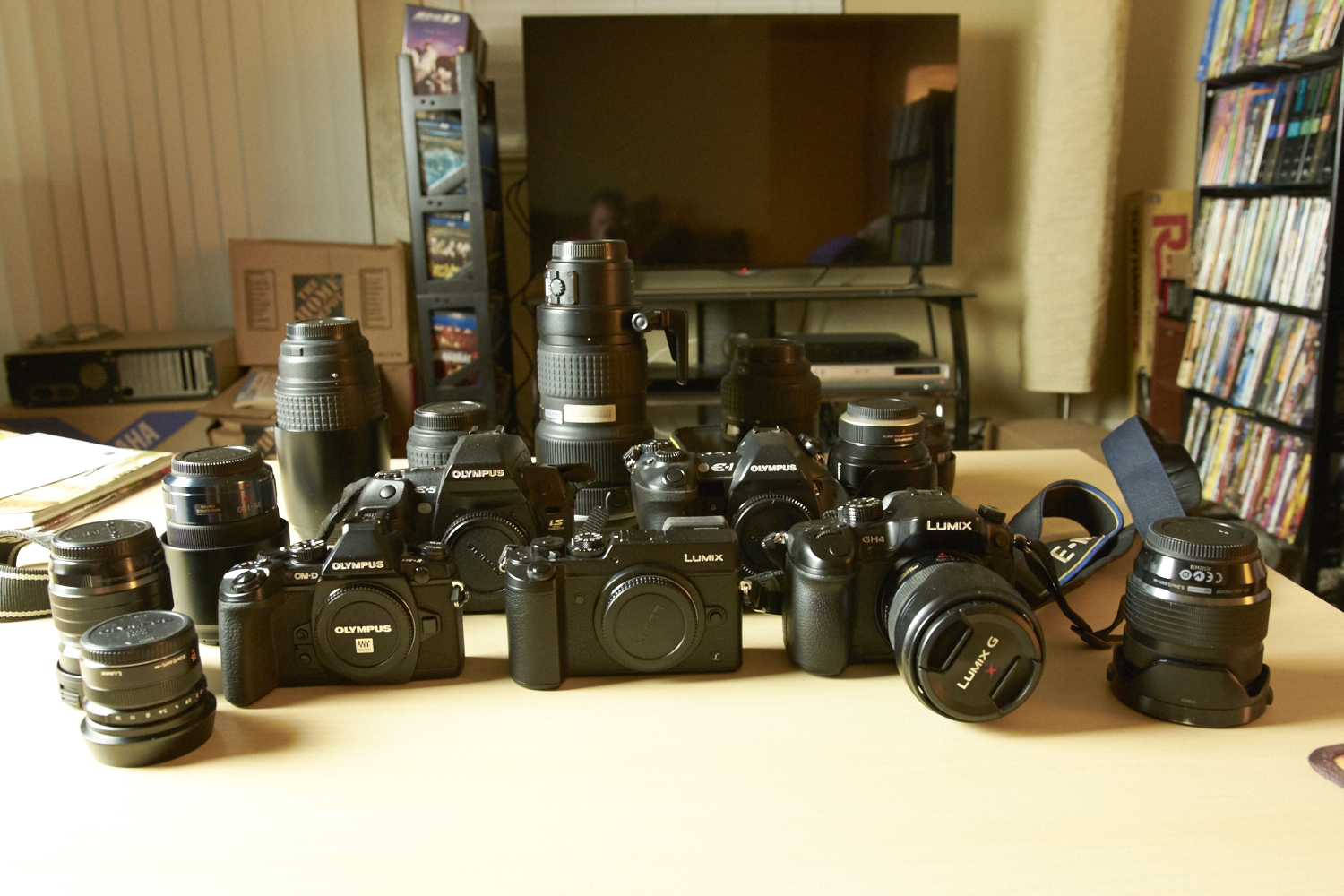
I got into Four-Thirds in 2004 and into micro Four-Thirds in 2012. I got into video in late 2014 with the Panasonic GH4, even though the GH3 was fully capable of 1080p recording.

For US$1699, the GH4 was an overachiever. It's still impressive but the goals have changed, and 4K is more easily achievable with a 4K TV in many homes. Fast forward to 2024 when I saw a deal for the Panasonic S5 Mk II with 50mm f/1.8 and 20-60mm f/3.5-5.6 lenses for US$2247.99. The S5 Mk II body itself really isn't much more expensive than the GH4 was in 2014.

I almost bought the G9 Mk II because there was an incredible trade-in deal and I would have saved a lot of money, and wouldn't be looking for lenses. However, I wanted something different, and I wanted to keep my Panasonic GM5.  (What I didn't know is that the GM5 is worth more than the original GM5 + kit lens.  I was going to take the US$600 trade-in value.)

Still, I wanted two things from a new camera body: PDAF and IBIS.

The G9 Mk II and the S5 Mk II have both and they're the best that Panasonic has done. I could have bought an older, used body without the PDAF but I struggled on occasion with the GH4 and the GX8. I recorded video on the GH4 quite a bit. I was photographing a scooter tournament at Woodward West with the GH4 taking video and the Olympus E-M1 taking still photos--the best tools for the job. At a later date, I went back to photograph during a free day there and took a Nikon D7200, as well. It could not keep up.  I looked at the Z50 and the Z5 and the Z6, but didn't think that they were quite right.

I've had the S5 Mk II for a couple of weeks. It's a handful. Getting it set like the GH4 has been an incremental process. It's worked beautifully during the day and struggled at night. For all those people chanting "Full Frame", telling me that micro Four-Thirds wasn't getting enough light, each sensor needs the same exposure to light. The Panasonic 50mm f/1.8 on 135 Format is more difficult at night than my Leica/Panasonic 25mm f/1.4 was. Depth of Field doesn't matter if you can't get the shot. Image quality doesn't matter if you can't get the shot.

The difference between the Panasonic 50mm f/1.8 and the 50mm f/1.4 Pro lenses is about US$1500. Holy !@#$ I might as well go another thousand or four for the Leica lens. I really miss my designed-by-Leica-hand-assembled-by-Panasonic 25mm f/1.4 that was a Four-Thirds lens designed for the Leica Digilux 3. I was so afraid to take it out in bad weather, though. There was no weather-sealing at all.  Knowing that lens, I'm certain that the Panasonic 50mm f/1.4 Pro is an extremely capable lens.

Converting from the GH4, I am reminded that the video is going to be an easier transition than the still photography will be. I haven't worked with a 3:2 ratio since 135 Format film. Four-Thirds and micro Four-Thirds used 4:3 ratio, just like Medium Format. Kodak, the maker of the original sensors, was big in Medium Format.

Now, the big deal is the weight of the lenses. If you look back at the family portrait photo at the beginning, you'll notice the rather big lens. That was an Olympus SHG ZD 35-100mm f/2.0 lens. I would say that it's the finest lens I've used on any equipment. It has a 77mm filter size and it is heavy. The rest were quite easy to hand hold without IBIS or OIS but I handheld the 35-100mm f/2.0 on an Olympus E-5 to photograph swimming and basketball. I did not handhold it with any micro Four-Thirds body, including the E-M1 that was supposed to support all of the SHG lenses but was far too small for reasonable balance.
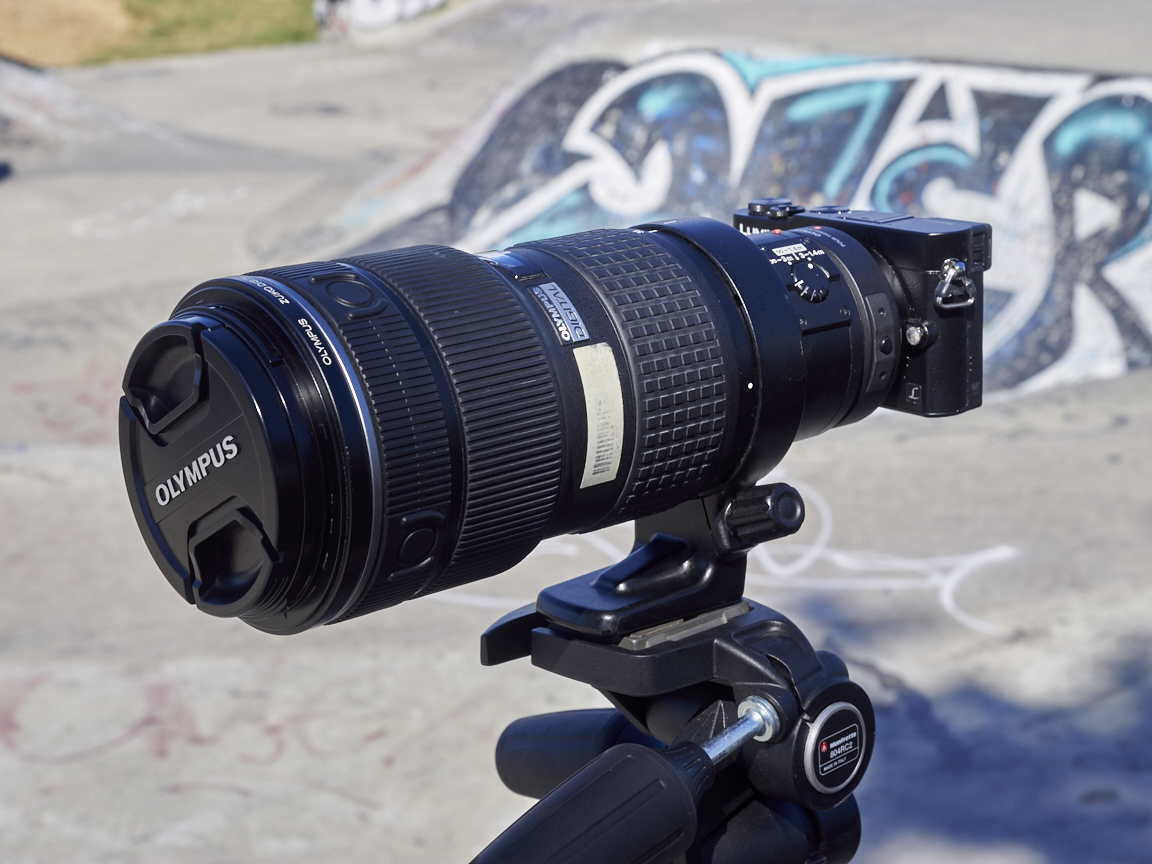
The Panasonic 50mm f/1.8 and 20-60mm f/3.5-5.6 are big and heavy for their apertures. They're weather-sealed and have Auto Focus, but they are shamefully large compared to lenses from the 1970s. Find a 50mm f/1.2 from Nikon, Olympus, or Canon and you'll find them rather small. Obviously, there were no electronic connections, no AF, no weather-sealing, but the optics were good, not great. A maximum aperture of f/1.2 meant that f/2.0 was good; f/1.4 meant that f/2.8 would be good, and it wouldn't be until later that there were amazing, regardless of the price.

Panasonic seems to be pushing daytime performance. The usual f/1.4 lenses aren't there, except for the 50mm f/1.4. As well, the telephoto zooms are few, although that's not unusual for Panasonic. I like that they all work with Dual I.S. so that the lens OIS works in conjunction with the IBIS and you can get a sharp image because of stabilization.

One thing I might do is to buy an adapter and use Canon or Nikon dSLR lenses. With micro Four-Thirds, you could buy an adapter with a focal reducer for increased effective apertures. No such tricks exist from 135 Format to 135 Format.

There are a few Chinese brands such as 7artisans, TTartisan, and Meike that are starting to make manual lenses for L-mount. Meike I trust. I had a 7artisans 55mm f/1.4 for micro Four-Thirds and it was good but heavy. The lens reviews I've seen for 7artisans and TTartisan seem evenly good and bad. Some seem to mention "falling apart", which doesn't give me confidence. Samyang has a 35-150mm f/2.0-2.8 that is appealing, if I can work with the weight. It also has auto focus, but I'll probably need a tripod or monopod to use it.

Update 2024.11.30: I was watching some video where a person had gone from Fujifilm X-T3, X-T4, X-T5 to one of the Nikon Z mirrorless bodies and then, to Fujifilm GFX 100.  He was feeling unhappy about not having any recent telephoto shots.  Instead of going back to a Fujifilm X-T5 with a better chance for better reach, he was going back to a Nikon Z body.  Does that make sense?  Why not stay with a brand you like?

On the adapters, Adorama had a deal on a Canon EF to L-mount adapter.  They also had a used Zeiss 85mm f/1.4 lens (not Milvus) for a bit under US$500.  That would have been about US$800 with tax and shipping.  The lens was rated Excellent but didn't include the lens hood.  Zeiss is not a brand I'd ever considered, but on their own, they're good and sometimes, great.  Partnering with Sony, as Panasonic and Leica are partnered, I lost some respect for them.  As well, Leica has some interesting fixed focal length lenses, but I wouldn't buy one of their zoom lenses.

TTartisan and 7artisans both have 135 Format fisheye lenses, 11mm f/2.8 and 10mm f/2.8 respectively.  The 7artisans lens is a redesign.  The company does that a lot, as if they make and sell a lot of mistakes with the first release.  They're both under US$300 and they're both manual lenses.  I miss my Olympus 8mm f/1.8 Pro for micro Four-Thirds.  That should have gone to the grave with me.

Update 2024.12.03: Watching another video from an S5 Mk II user trying a G9 Mk II, he states that the f-stop is really a f/5.6 for a 135 Format f/2.8.  It isn't.  The Depth of Field is like that, though.  However, it requires the same exposure calculation for any format.  If it really did take less light for the 135 Format sensor, Medium Format would have crushed 135 Format and 135 Format would have crushed APS-C and micro Four-Thirds.  I'm a bit shocked that such misinformation is still happening.  My Intro to Photography professor would have been surprised.

I've ordered a Tamron SP 180mm f/3.5 macro lens.  It isn't something new, as they don't really have any current dSLR lenses on their website any longer.  I ordered it with a Viltrox brand Canon EF-mount to L-mount Pro adapter.  Hopefully, it's enough so I stop whining/whinging about the lack of a telephoto lens.  It's heavy enough that I will be whining/whinging about carrying the extra weight in my backpack.

The latest video review I saw about it was in 2017 and I saw that the lens was introduced in 2003, but I'm hoping for the best and it was a rather expensive lens at one time.  Can't see spending money on one of the Panasonic telephoto zooms at this moment.

Update 2024.12.08: It's amazing how many videos I've seen on the S5 Mk II.  A few of them are people saying that they've switched from Sony equipment, just because support for video is so much better on Panasonic.  Some of what they're claiming are technologies that Panasonic incorporated to the GH* series of micro Four-Thirds bodies a few years ago.

By the way, I'm still waiting on my EF-mount to L-mount adapter that includes support for auto focus.  UPS failed me again.  I suspect that they misplaced the item after receiving it 12 hours after the lens.  I ordered a manual mount adapter which really isn't any good with a lens that doesn't include an aperture ring.  Guess what the Tamron lens doesn't have?

I need to photograph more.  I may need to work out to carry the new combination.

Update 2025.01.20: I got the adapter once Adorama sent another one, and the lens combination works reasonably well.  The weather is generally okay for walking to the store, but it's not really warm enough for me to be out photographing.  Eight years ago, I would have been out most every day and many nights.

I'm waiting for new Panasonic equipment to be announced.  I'd like to see some lenses and bodies (that I will not being buying) that replace the S1, S1R, and S1H with versions that include PDAF.

I'm really hoping for firmware to fix the night-time auto focusing issues.  It's not nearly as reliable as it should be.

Update 2025.01.23: Firmware update is out, and there are updates for Lumix Lab, Lumix Sync, and the Panasonic Image App.  For some reason, Lumix Lab did not see the firmware update, but I downloaded it and put in on the SD Card as I did 10 years ago.  It's night, so I haven't been out to try anything.

There were updates for vehicle recognition, and much more.


Update 2025.02.03: Vehicle recognition seems to work well.  I believe that the auto focus worked well for everything this afternoon. Someone posted about a pink moon on April 22nd.  I'm not sure it's a joke or real yet.  That would be interesting to photograph.  Took a few shots at night and it seems to be improved when focusing.  I didn't use the same lens during the evening but the detail looks good at 100%.

The latest firmware update seems to be a winner.


 Update 2025.02.26: Panasonic has introduced the S1R Mk II, which is a 44 MP still photo-centric camera body with video capabilities, including 8K30.  It's like a higher resolution version of the G9 Mk II.  They added PDAF (Phase Detection Auto Focus) and more, after five years.  There should be another, video-oriented body in April.  I wonder if they'll update the box camera bodies in micro Four-Thirds and 135 Format.

Update 2025.05.14: Panasonic has introduced the S1 Mk II and S1E Mk II.  I guess the S1H replacement is in there.  I guess a few people will be happy for the partially-stacked sensor and others won't like it, similar to the opinions about the Nikon Z6 Mk III.  I'm just happy that Panasonic has refreshed their lineup.  Having 5-6 year old models wasn't helping them.  There still aren't a bunch of good lenses, but they introduced a 24-60mm f/2.8, which is like a better version of the 20-60mm f/3.5-5.6.  It's not inexpensive, but it's about half the price of the Pro 24-70mm f/2.8 lens.


Now that they have all of their currently-sold (except S5D) 135 Format bodies using PDAF, they can make it more accurate.  It generally works on the S5 Mk II but it can be a pain to get it to lock focus.  I've been fighting with it using the Panasonic 70-300mm f/4.5-5.6.  Maybe that lens needs a firmware update.

Update 2025.09.06: Things are still going and there has been another firmware update but the system is far from perfect.  I generally get the shots I want but it takes more work than micro Four-Thirds did, mainly because of the auto focus.  It seems disagreeable with the 70-300mm f/4.5-5.6, 20-60mm f/3.5-5.6, and the 50mm f/1.8.  I noticed a setting for quick AF and that had previously helped, but maybe I'm missing another setting or two, or I'm just shooting as a sports photographer.  I see comments from many that they're not having a problem, but I'm not a person to spend 45 minutes to photograph a flower. 


Update 2025.12.14: I photographed the supermoon about 10 days ago with the 70-300mm f/4.5-5.6 and auto focus worked first time, without a problem.  That's the first time in months that I didn't have to fight with it. 

The S5 Mk II can work very well.  In my case, we don't always get along.  I keep searching for settings to make it work more like the GH4 since I used that much longer.  I'm sure there will be a moment when I adapt to it better. 

Monday, October 14, 2024

135 Format on the way

From my history of photography 

Over the years, I've handled a lot of different camera bodies in various formats.  The first camera I used was a 6x6 box camera using roll film.  I've used very technical cameras since then and with the digital age, I started again.  Since 2004, I've been using Four-Thirds and micro Four-Thirds, both Olympus and Panasonic.  I tried Nikon for a bit, but it was a pain, moreso than during the film era.  Fujifilm made my favorite film cameras, along with Olympus and Mamiya.

I've photographed sports with Four-Thirds and micro Four-Thirds equipment starting with the Olympus E-1 in 2004.  Back then, it was hard to believe that digital cameras would be good enough.  Now, it's difficult to believe that young people are using film cameras or that Pentax and Rollei have developed new film cameras for sale recently.

Back to the present

I just ordered a Panasonic S5 Mk II with 20-60mm f/3.5-5.6 and 50mm f/1.8.  The Amazon 5 payments thing got my attention.  Getting it the next day was surprising.  I guess they didn't want me to have time to think about canceling the order.

It's new for me, but this body has been out long enough to have firmware version 3.1.  Panasonic finally admitted that they needed to provide Phase Detection AF, instead of their hit-or-miss Depth from Defocus technology that was introduced on the GH4.  I didn't like DFD then, and while it's become better, it will never be good enough.

I was looking at another micro Four-Thirds body, an Olympus E-M1 Mk III, which was good and then, there was a Panasonic G9 Mk II trade-in special that was incredible, marking it down US$600 and then, adding your trade-in value.  The G9 Mk II also has PDAF.  They did the same with the GH7.

The problem with micro Four-Thirds is that we don't know when it will end.  135 Format is claiming a lot of the market finally, as mirrorless bodies have taken over in a big way.  I got involved with micro Four-Thirds back in 2012 with the GH3.  At one point, I was taking an Olympus E-M1, Panasonic GH4, GX8, and GM5 to skate parks with me.  Now, I only have the GM5.

Panasonic to Panasonic

The S5 Mk II is about the same size as the GH4.  It's not huge, but it is bigger than the undersized Sony bodies that are difficult to hold but becoming better.  It's certainly bigger than most of the 135 Format film bodies from the 1970s, except for the Nikon F2.

The lenses seem small, but again, they're bigger than equivalent lenses in the 1970s.  However, nothing back then was weather-sealed and not much had auto focus.  The Polaroid SX70 was the first camera I sold (I was in camera sales for a while) with auto focus, and auto exposure was just coming to cameras later in that decade.

I'm charging the S5 Mk II battery right now.  Instead of a separate charger, they have a USB type-A to type-C cable, and a power adapter for AC current.  The light atop the body signals that it is being charged.  That is also the light that signals a connection to the phone app.

The menus are familiar but much has been added since the GH4 or GX8.  It's going to take a while to get the settings right.  I need to set up the custom settings, so that it uses Natural, instead of Standard, and Raw instead of JPEG.  I also need to set a video mode, 1920x1080 at 60p.  While I have computers to handle 3840x2160 or 4096x2160, I don't want to record 4K video.  I found that you must set file format MP4 for 1080p, unlike what I did with the GH4.  MOV format is reserved for 4K and C4K.

I need to order an SD Card for storage.  I have a few around here somewhere, but they're older.  This body uses UHS II cards for speed.  There are two slots but I don't need to fill both.  I'm also considering third party batteries.  There is a brand called Wasabi with a charger and two batteries for US$39.99.  I can't imagine that they'll last a year, but for my casual use, that shouldn't be a problem.  My official Panasonic GH4 batteries were still going after three years.

How much does anyone need?

I've watched a few videos about the S5 Mk II and how it compares to Sony and Canon.  Why don't they compare it to Nikon?  I'm not sure.

24 Megapixels isn't a lot in 2024, especially with Fujifilm's APS-C sensor having 40 MP.  I don't need more and I suspect few people need more, unless they're working professionally.  In that case, they should be using Medium Format.  Lower pixel counts require you to be more careful.  I've been working mostly with 16 MP and occasionally with 20 MP.  I'm sure 24 MP will be fine for me, especially with a dual-gain sensor.  I was using ISO 3200 as my upper limit of acceptable photos for micro Four-Thirds, ISO 4000 for the Nikon D7200, and I expect ISO 6400 will be the reasonable limit for this sensor, but I might push it to ISO 12800.

Thinking about APS-C, there is such a mode, similar to what Nikon does from FX to DX.  It likely works with L-mount lenses that are connected electronically, rather than with manual lenses.  I was thinking about one of the fisheye lenses that are available.  They're mostly the same as the micro Four-Thirds lenses but with a different mount, meaning that there are no electronics.  I suspect that an older, electronically-connected lens from Sigma or Canon with an adapter would be preferable.  Having had the Olympus 8mm f/1.8 fisheye lens makes any other lens less appealing.

I keep thinking about the day in April 2004 when I bought the Olympus E-1, 50-200mm f/2.8-3.5, and 14-54mm f/2.8-3.5.  I spent about US$3000 and this S5 Mk II kit cost about US$2249.  I didn't get a telephoto zoom of any kind with the S5 Mk II, unfortunately.  That would have cost at least an extra US$1000 right now for a Panasonic lens.  Having two lenses that overlap isn't great, but night shooting is possible.

I'm thinking about a Samyang 35-150mm f/2.0-2.8 as a zoom lens to cover a decent range at a big aperture.  There really aren't many telephoto lenses although Sigma's 60-600mm lens (like Bigma, 50-500mm), covers quite a bit, if you have a strong heart and a strong tripod.  The reviews say that there is a problem with the Samyang lens, but you can update the firmware.  Apparently, the lens firmware is updated the way we used to do with the micro Four-Thirds lenses on Panasonic bodies by putting the update on the SD Card.  If the firmware corrects the problem, US$1399 is a decent price for a good, maybe great, lens.

Update 2024.10.20: Yesterday, I took the S5 Mk II out for a few night photos.  I regularly did the same with the GH4 years ago, so I hoped for good results.  However, I might not have had things set properly.  Having a camera for about a week and going for the first try, I might still not have been ready.  Besides, I'm not as steady as I used to be.


This one was taken with Auto ISO.  Later photos were taken with ISO 4000 to ensure that it activated the higher ISO gain but this one looks just fine.  I could see a long spider web thread.

What made the GH4 so impressive is that it could focus in "starlight" EV -4.  The GH3 had that enhancement added via a firmware update. 

I had taken out the GM5 earlier in the afternoon and I wonder if I did better with it.  After eight years, the AF is generally tried and true.

Update 2024.10.24: I went out tonight with the 20-60mm f/3.5-5.6 which seemed like a bad idea.  It wasn't perceptibly worse than going out with the 50mm f/1.8 lens.  Most of the shots had a shutter speed of 1.3 seconds.  I even managed to hold most of them steady.  One thing that seems a bit odd to me is that the 20-60mm doesn't have any OIS (optical image stabilization), whereas the micro Four-Thirds standard kit lenses (14-45mm, 14-42mm) did.  I'm trying to think back to the Four-Thirds Leica/Lumix D lenses and I believe that the standard zoom lenses also had OIS.  The Leica-designed normal 25mm f/1.4 did not.

Thankfully, the IBIS is as effective as that of Olympus.  They started out on the same sized sensor but the 36x24mm vs 17.3x13mm makes for some addition stress.  Getting 96 MP out of high resolution mode is impressive.  Panasonic did a lot of work to make that happen.

Update 2024.11.18: I'm still adjusting.  I bought a tripod.  It's a Smallrig CT-20, which can be converted into a monopod.  The instructions aren't good, so I'm figuring it out.  It was quite a bit less expensive that my Manfrotto tripod, which was a bit over US$200 back in 2012.  US$80 in 2024 doesn't seem much, especially coming from a company that designs and builds cages for cameras in the video industry.  Supposedly, it can support about 33 pounds/15 kg but I saw a lower figure for the ball head.  In any case, the S5 Mk II and most lenses will not add up to anywhere near that heavy.  Even that Samyang 35-150mm f/2.0-2.8.

I actually wanted to get some shots of the supermoon but the tripod didn't arrive in time and my Panasonic GM5 and Olympus 40-150mm f/4.0-5.6 doesn't have OIS.  Having a proper telephoto zoom for the S5 Mk II might be a while, especially as slowly as Panasonic is designing and producing them.

Update 2025.07.08: I have three native Panasonic lenses now.  The 70-300mm f/4.5-5.6 is good.  I've been able to photograph the moon and the Dual I.S. works well.  I'd never used that on micro Four-Thirds since my GH4 was too early and I'd only used the Sync I.S. on  my Olympus E-M1 once, with the 12-100mm f/4.0.  It's a lot of stabilization, no matter the system.

 Since I have the 70-300mm, the effective reach is about the same as the 40-150mm on micro Four-Thirds.


Panasonic  has introduced the S1 Mk II, S1R Mk II, and the S1E, which is more like an upgraded S5 Mk II or IIx. The S1H Mk II may be introduced soon.

 I've been watching videos for any information regarding the sluggish low light auto focus.  Enabling the Fast AF functionality has helped.  It's unusual that such has to be done.