Showing posts with label GH4. Show all posts

Friday, October 31, 2025

Panasonic G97 is here

I bought a Panasonic G97 and received it yesterday.  Previously, I've had the GH3, GH4, GX8, and GM5 micro Four-Thirds models from Panasonic, plus the Olympus E-M1.  Of all those, I've only kept the GM5.

The GM5 is a tiny marvel of a camera body, but it doesn't have much to offer but its size.  While it is quick and easy, it's sometimes frustrating.  The G97 is a bit like a GH4.5--a hybrid hybrid camera body.

The GH4 was known as the best camera for 4K video under US$10,000 when it was new.  However, it was a bit under-powered and lost focus occasionally when shooting video at 1080p. Add to that the original Lumix X 35-100mm f/2.8 that had a myriad of problems from OIS stutter to severe lens flare and the combination seemed a good reason to throw it far away.

The G97 is more powerful, but has to shoot 4K30p video at a crop.  It can also shoot 1080p video at 120 fps, but it isn't the greatest.  That's a shame.

The 5 stop IBIS is good, especially at the US$849 price point.  When you combine it with a lens that has Mega OIS or Power OIS, things become better, as the Dual I.S. combines the stabilization.  The viewfinder is another surprise at this level.  You can get an OLED display at 0.74x magnification, which is the same as the GH4 has. 

First impressions

After charging some batteries (without the USB cable and AC adapter that they don't include), I took the G97 and some lenses for a walk.   The body is very small, even though the controls are the same size as the GH7 and G9 Mk II.  Then again, I found the GH4 small, and it wasn't quite large enough for a good balance with some of my Four-Thirds Olympus lenses.

Controls on the top are in the same place as the GH4 but controls on the back are not.  Labeling is very different but it seems as Panasonic wanted to push flexibility and allow buttons to be re-mapped.  I tend to use controls as they come from the factory.

The internal structure of the G97 may not be as strong and light as the GH4, but it feels just as sturdy.  Using aluminium and steel instead of magnesium alloy works just as well and costs less.  I was surprised to learn that the G80/G85 and G90/G95 were weather-sealed.  Having photographed in hurricanes and sports events where rain was sudden, I want to feel comfortable that my equipment can handle it.

 There are a couple of settings I change right away.  I turn off the Beep.  I set the photo style to natural and the file to Raw.  I usually set the focus point to pin-point but I set it to Face Detection, although I wonder if it's a combination of two settings to make face detection work.  On the GH4, it was a disaster compared to the Olympus E-M1.  I want to learn if this version of Face Detection works.

Walking at night makes for difficult photography.  Film cameras didn't work well, especially when film was rated at ASA(ISO) 100 or even 400.  Sensors in 2004 weren't that good.  In 2012, I was photographing regularly at  ISO 1600 or even 3200.  In 2025, it's less of a problem.  Sensors have become better and image processing has become much better. Having strong IBIS can save a situation that a tripod can't.  I can hear how hard the IBIS is working to keep things steady.  The EVF can show me things that my eyes (or an optical viewfinder) can't see in the dark.

The camera body didn't let me down.  I'm sure I still have settings to find to fine tune my experience.  However, the G97 is quite capable, and coming from the GH4, etc., it's an easy transition.  Contrast that to my occasional frustration with the S5 Mk II and S-series lenses.  Auto Focus locks quickly and the shutter engages quickly.  In the dark, AF goes down to EV -4, just like the GH4.  There are only 49 AF areas, just like the GH4, but it works well so far in stills mode.  I doubt that DFD on video is any better than it was.

The 12-60mm f/3.5-5.6 Power OIS lens that came as part of the kit seems good. At 5x reach, it's the longest zoom kit lens for micro Four-Thirds.  The FoV is like a 24-120mm lens on a 135 Format camera.  On the S5 Mk II, the kit lens was 20-60mm f/3.5-5.6 without OIS, which seems strange for a lens of around US$600.  The Dual I.S. was activated and I'm sure that I got shots that wouldn't have been usable otherwise.

IBIS on Four-Thirds was not very good.  I had the Olympus E-5 and couldn't tell that the IBIS was working.  My best lenses were heavy.  On micro Four-Thirds, Olympus had IBIS and Panasonic had OIS.  Of course, they would not work together.  If they had, micro Four-Thirds would have been more compelling.  IBIS in the G97 is not Panasonic's finest, being about the same as the GH5 but the Dual I.S. functionality extends that stabilization, much like Sync IS works on Olympus equipment and makes it possible to get shots handheld that were never possible.  Back in the film days, I remember standing against a tree or a wall to get certain shots when light was scarce.

Firmware updates

Naturally, it's a good idea to have your equipment up-to-date and when I was photographing sports most every day, I'd be ready.  Both the body and the 12-60mm f/3.5-5.6 lens needed updates.  As well, I checked my other lenses and my Panasonic/Leica 15mm f/1.7 got an update back in 2022.  It's the lens I use the most on the GM5. 

Update 2025.11.15: It's been about a month since I've had the G97.  Using the lenses I have, it's worked well.  I ordered the Panasonic/Leica 9mm f/1.7 just a couple of weeks before the G97.  Both are on the Amazon 5 payments plan.

I already had the 12-32mm f/3.5-5.6 Mega OIS lens with the GM5.  It's a collapsible kit lens that does an amazing job at a tiny size.  When I bought the GM5, I also bought the 42.5mm f/1.7 Power OIS lens.  The other Panasonic lens was the Panasonic/Leica 15mm f/1.7.  I also have three Olympus lenses: 25mm f/1.8, 40-150mm f/4.0-5.6, and the 8mm f/8 (almost) fisheye lens cap lens.

Since I don't have reach past (135 Format) 300mm, I bought a 2.2x screw-on tele-converter for a 58mm filter thread.  It should be good enough for a while.  I noticed on Amazon that the Panasonic/Leica 100-400mm f/4.0-6.3 Mk II version is available on 5 payments.  That will change by the time I'm ready.  That lens will give me a 135 Format effective 800mm reach, and you can use a tele-converter for even further reach.  However, that tele-converter is a bright light solution.

Update 2026.01.12: I was at the Korean church where I go sometimes and I was trying to photograph something with the Panasonic S5 Mk II and the 70-300mm f/4.5-5.6.  It was quite good, except that the slow aperture indoors was strangely too much for the scene and I didn't feel like pushing the ISO sensitivity so high.  It's strange because I had just photographed the supermoon without a problem.  I couldn't hold it steady and the Dual I.S. just wasn't enough to compensate.

Today, I decided to rectify the problem with a lens for the G97: the Panasonic 35-100mm f/2.8 Mk II.  It's not the Lumix X (blech!) version and not the current Panasonic/Leica version and I got it for about US$500.  Hopefully, Very Good condition means very good. For half of the price of the Panasonic/Leica version, it's very good.

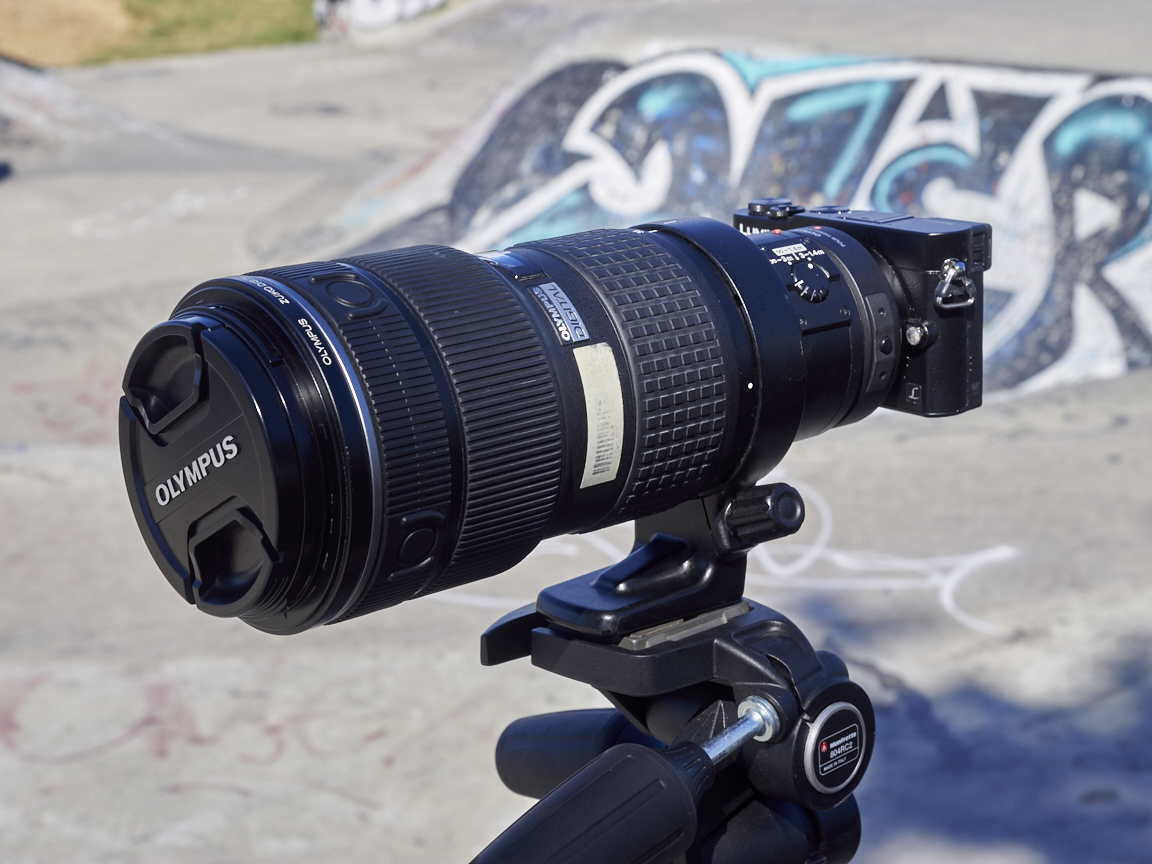
In my opinion, it's a bit too small and relies too much on software corrections.  It has a 58mm filter size vs a 77mm filter size for the Olympus ZD SHG 35-100mm f/2.0 lens.  The Lumix X (1st version) was sufficient in most cases, but when it was bad, it was a POS.  I'm hoping that the revision will be satisfactory.  The G97 will work with it to employ Dual I.S. to get a stabilized shot, even in lower light situations. 

Update 2026.01.20: Doing some spring cleaning, I found two Panasonic batteries that I used for my Panasonic GX8.  They're the same batteries as the G97 uses. Since I haven't used them since 2017, they should still have a decent charge capacity remaining.  Now, I have 3 Panasonic batteries and 2 Wasabi batteries.

I also found some other equipment, but except for my very old Olympus FL-20 flash, nothing else will work with the cameras I have. 


Update 2026.01.25: I was at the Korean church and the person who does the photography had a Sony body and the 70-200mm f/2.8 attached and it was sitting on the dinner table.  I took zero minutes to arrange things and just got out the G97 and 35-100mm f/2.8 Mk II and placed it near the Sony. You may be able to see that the lens hood is reversed on the Panasonic 35-100mm f/2.8 Mk II.


Update 2026.02.28: Discovered something wonderful.  I can transfer raw photos from G97 to iPhone through Lumix Sync app.  It's so much better than expected and as easy as Lumix Lab.

Used the G97 and 35-100mm f/2.8 Mk II.  The Dual I.S. performed admirably for such a middle of the range camera body.  

Thursday, November 28, 2024

Been mostly mirrorless for ten years

 It's been about ten years since I was mostly using mirrorless cameras.

I had the Olympus OM-D E-M1 in the summer of 2014 and the Panasonic GH4 in December.  I'd been using the Olympus E-1 since April 2004 and the E-5 since 2012, along with the Panasonic GH3.


I photographed sports with the E-1 for quite a while.  When I got the E-5, I also got the ZD SHG 35-100mm f/2.0, which was amazing for swimming and basketball photography.  You could practically hammer nails and dunk the equipment and it would still work.

The GH3 was a bad choice for me.  I didn't do video and it excelled at video and didn't do quite that well for stills photography.  The EVF had a purple tint.  The Panasonic X 35-100mm f/2.8 was 2/3 the price of the Olympus 35-100mm f/2.0 but it was 1/10 the lens.  The latest Leica-branded 35-100mm f/2.8 seems to be much better.

In late 2013, I got a call from Olympus and they invited me to see some unannounced camera.  That camera was the E-M1.  It was supposed to take my lenses and make them work as well as on my Four-Thirds equipment.  That didn't work as expected.  I had my backpack with two SHG lenses and more HG lenses.  They worked but the E-5 was much faster to focus.  I declined to promise that I would buy one but that I would keep quiet about my experience.  I hoped that a production model would be much better.

In early summer 2014, I was frustrated with the GH3 and traded it for an E-M1.  It was better than the GH3.  The color of the viewfinder was more like real life.  The GH3 was purple-tinted.  The E-M1 responded like a real camera, not just a video camera with a modification for still photography.

I moved to California and my first week, I was photographing at skate parks.  My timing plus a fast burst mode got me a lot of winners.  I still used the dSLR and did just fine.  Having just the Olympus 12-40mm f/2.8 and the Panasonic X 35-100mm f/2.8, I didn't have as much lens versatility as I did with the dSLR.  I had an adapter but the speed just wasn't good enough.  It was better to use the dSLR and get the shots than to miss them.

When the GH4 was available in December, I started recording video.  It was cumbersome because the GH4 had no In-Body Image Stabilization and the Lumix X 35-100mm f/2.8 had Optical Image Stabilization that made video worse.  The Olympus 12-40mm f/2.8 didn't have any problem but it was too wide for what I needed.  That Olympus Pro 12-100mm f/4.0 would have been ideal, if they'd only had it sooner.

In the last week, I've seen quite a few videos on the E-M1.  The latest OM-1 Mk II seems very much like the original E-M1 but better.  To me, the E-M1 was the reason to have a mirrorless camera.  I remember trying the Fujifilm X-T1 but it wasn't very good and the mirrorless camera bodies from Sony were worse.  Photographing sports, I didn't spend 45 minutes photographing a flower.  I also didn't spent a lot of time in post processing.  I had a certain look and that took a little while for each, and I could put some samples up and wait for orders.

 When you look for cameras now, you'll see many more mirrorless cameras and lenses than you will dSLRs.  The dSLRs still exist and a number of them are being sold, but most of the old is being retired.  You can thank Panasonic and Olympus for this revolution.

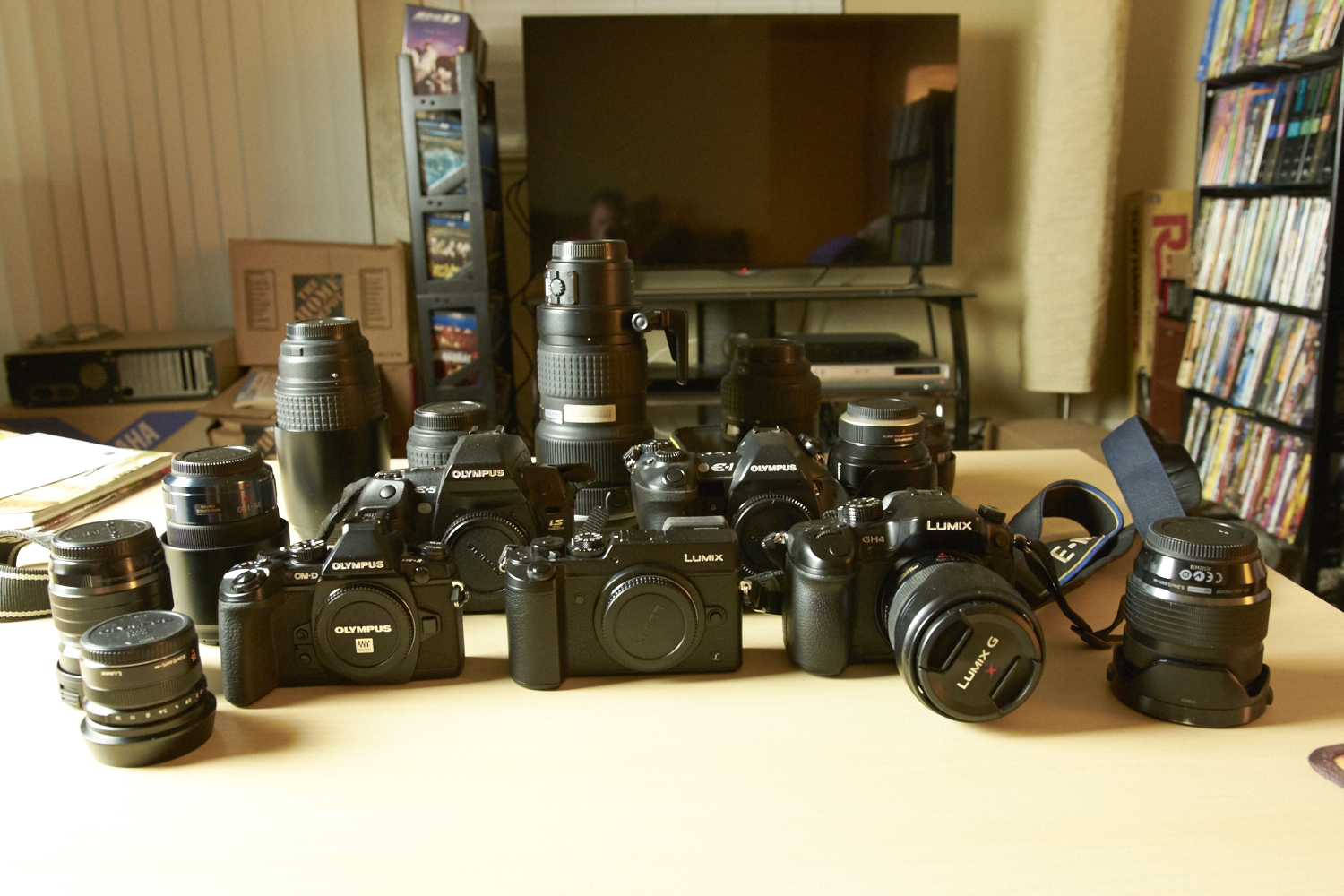
I have continued with the Panasonic S5 Mk II, which is 135 Format and heavier than I've had for a while.  That Olympus E-5 in the photo was rather heavy and so was the 35-100mm f/2.0.

Update 2024.12.01: I was thinking about how much has changed.  They were trying to find a good way to identify mirrorless camera systems. ILC, MILC, CSC, and more were used.  I remember going to a store in Dayton, Ohio.  I'd been to one of the same company's stores in Cincinnati, Ohio and they had a decent selection and no brand fanatics.  A salesperson greeted me and asked how she could help.  I said that I was looking for micro Four-Thirds equipment and she took me to the Sony equipment.  I said "no, I want to see micro Four-Thirds equipment.  Olympus and Panasonic are the brands." and she replied "It's all micro Four-Thirds." and I walked out of the store.

Many people back then couldn't differentiate between mirrorless cameras as a category and micro Four-Thirds as a sub-category since Panasonic and Olympus developed the idea and made it a reality.

Update 2025.05.01: Nikon has recently released the Z5 Mk II and the Z50 Mk II.  Both Nikon and Canon have come to the point with their mirrorless bodies that they feel as micro Four-Thirds felt in 2014.  Fujifilm has been there for years.  Pentax is still selling dSLRs.

Update 2025.10.31: Got a Panasonic G97, so that I can make use of my micro Four-Thirds lenses much better than I can with the GM5 because of IBIS.e 

Wednesday, November 20, 2024

Panasonic micro Four-Thirds to Panasonic 135 Format

 I've recently made the jump to the Panasonic Lumix S5 Mk II after quite a while with Four-Thirds and micro Four-Thirds using Panasonic and Olympus equipment.

I've heard people going on about "Full Frame" for the last 20 years, even if they didn't have any of the products. I used 135 Format back in my film days. I couldn't wait to get rid of film after spending 6 hours at a time repairing scanned photos and/or negatives.

I got into Four-Thirds in 2004 and into micro Four-Thirds in 2012. I got into video in late 2014 with the Panasonic GH4, even though the GH3 was fully capable of 1080p recording.

For US$1699, the GH4 was an overachiever. It's still impressive but the goals have changed, and 4K is more easily achievable with a 4K TV in many homes. Fast forward to 2024 when I saw a deal for the Panasonic S5 Mk II with 50mm f/1.8 and 20-60mm f/3.5-5.6 lenses for US$2247.99. The S5 Mk II body itself really isn't much more expensive than the GH4 was in 2014.

I almost bought the G9 Mk II because there was an incredible trade-in deal and I would have saved a lot of money, and wouldn't be looking for lenses. However, I wanted something different, and I wanted to keep my Panasonic GM5.  (What I didn't know is that the GM5 is worth more than the original GM5 + kit lens.  I was going to take the US$600 trade-in value.)

Still, I wanted two things from a new camera body: PDAF and IBIS.

The G9 Mk II and the S5 Mk II have both and they're the best that Panasonic has done. I could have bought an older, used body without the PDAF but I struggled on occasion with the GH4 and the GX8. I recorded video on the GH4 quite a bit. I was photographing a scooter tournament at Woodward West with the GH4 taking video and the Olympus E-M1 taking still photos--the best tools for the job. At a later date, I went back to photograph during a free day there and took a Nikon D7200, as well. It could not keep up.  I looked at the Z50 and the Z5 and the Z6, but didn't think that they were quite right.

I've had the S5 Mk II for a couple of weeks. It's a handful. Getting it set like the GH4 has been an incremental process. It's worked beautifully during the day and struggled at night. For all those people chanting "Full Frame", telling me that micro Four-Thirds wasn't getting enough light, each sensor needs the same exposure to light. The Panasonic 50mm f/1.8 on 135 Format is more difficult at night than my Leica/Panasonic 25mm f/1.4 was. Depth of Field doesn't matter if you can't get the shot. Image quality doesn't matter if you can't get the shot.

The difference between the Panasonic 50mm f/1.8 and the 50mm f/1.4 Pro lenses is about US$1500. Holy !@#$ I might as well go another thousand or four for the Leica lens. I really miss my designed-by-Leica-hand-assembled-by-Panasonic 25mm f/1.4 that was a Four-Thirds lens designed for the Leica Digilux 3. I was so afraid to take it out in bad weather, though. There was no weather-sealing at all.  Knowing that lens, I'm certain that the Panasonic 50mm f/1.4 Pro is an extremely capable lens.

Converting from the GH4, I am reminded that the video is going to be an easier transition than the still photography will be. I haven't worked with a 3:2 ratio since 135 Format film. Four-Thirds and micro Four-Thirds used 4:3 ratio, just like Medium Format. Kodak, the maker of the original sensors, was big in Medium Format.

Now, the big deal is the weight of the lenses. If you look back at the family portrait photo at the beginning, you'll notice the rather big lens. That was an Olympus SHG ZD 35-100mm f/2.0 lens. I would say that it's the finest lens I've used on any equipment. It has a 77mm filter size and it is heavy. The rest were quite easy to hand hold without IBIS or OIS but I handheld the 35-100mm f/2.0 on an Olympus E-5 to photograph swimming and basketball. I did not handhold it with any micro Four-Thirds body, including the E-M1 that was supposed to support all of the SHG lenses but was far too small for reasonable balance.

The Panasonic 50mm f/1.8 and 20-60mm f/3.5-5.6 are big and heavy for their apertures. They're weather-sealed and have Auto Focus, but they are shamefully large compared to lenses from the 1970s. Find a 50mm f/1.2 from Nikon, Olympus, or Canon and you'll find them rather small. Obviously, there were no electronic connections, no AF, no weather-sealing, but the optics were good, not great. A maximum aperture of f/1.2 meant that f/2.0 was good; f/1.4 meant that f/2.8 would be good, and it wouldn't be until later that there were amazing, regardless of the price.

Panasonic seems to be pushing daytime performance. The usual f/1.4 lenses aren't there, except for the 50mm f/1.4. As well, the telephoto zooms are few, although that's not unusual for Panasonic. I like that they all work with Dual I.S. so that the lens OIS works in conjunction with the IBIS and you can get a sharp image because of stabilization.

One thing I might do is to buy an adapter and use Canon or Nikon dSLR lenses. With micro Four-Thirds, you could buy an adapter with a focal reducer for increased effective apertures. No such tricks exist from 135 Format to 135 Format.

There are a few Chinese brands such as 7artisans, TTartisan, and Meike that are starting to make manual lenses for L-mount. Meike I trust. I had a 7artisans 55mm f/1.4 for micro Four-Thirds and it was good but heavy. The lens reviews I've seen for 7artisans and TTartisan seem evenly good and bad. Some seem to mention "falling apart", which doesn't give me confidence. Samyang has a 35-150mm f/2.0-2.8 that is appealing, if I can work with the weight. It also has auto focus, but I'll probably need a tripod or monopod to use it.

Update 2024.11.30: I was watching some video where a person had gone from Fujifilm X-T3, X-T4, X-T5 to one of the Nikon Z mirrorless bodies and then, to Fujifilm GFX 100.  He was feeling unhappy about not having any recent telephoto shots.  Instead of going back to a Fujifilm X-T5 with a better chance for better reach, he was going back to a Nikon Z body.  Does that make sense?  Why not stay with a brand you like?

On the adapters, Adorama had a deal on a Canon EF to L-mount adapter.  They also had a used Zeiss 85mm f/1.4 lens (not Milvus) for a bit under US$500.  That would have been about US$800 with tax and shipping.  The lens was rated Excellent but didn't include the lens hood.  Zeiss is not a brand I'd ever considered, but on their own, they're good and sometimes, great.  Partnering with Sony, as Panasonic and Leica are partnered, I lost some respect for them.  As well, Leica has some interesting fixed focal length lenses, but I wouldn't buy one of their zoom lenses.

TTartisan and 7artisans both have 135 Format fisheye lenses, 11mm f/2.8 and 10mm f/2.8 respectively.  The 7artisans lens is a redesign.  The company does that a lot, as if they make and sell a lot of mistakes with the first release.  They're both under US$300 and they're both manual lenses.  I miss my Olympus 8mm f/1.8 Pro for micro Four-Thirds.  That should have gone to the grave with me.

Update 2024.12.03: Watching another video from an S5 Mk II user trying a G9 Mk II, he states that the f-stop is really a f/5.6 for a 135 Format f/2.8.  It isn't.  The Depth of Field is like that, though.  However, it requires the same exposure calculation for any format.  If it really did take less light for the 135 Format sensor, Medium Format would have crushed 135 Format and 135 Format would have crushed APS-C and micro Four-Thirds.  I'm a bit shocked that such misinformation is still happening.  My Intro to Photography professor would have been surprised.

I've ordered a Tamron SP 180mm f/3.5 macro lens.  It isn't something new, as they don't really have any current dSLR lenses on their website any longer.  I ordered it with a Viltrox brand Canon EF-mount to L-mount Pro adapter.  Hopefully, it's enough so I stop whining/whinging about the lack of a telephoto lens.  It's heavy enough that I will be whining/whinging about carrying the extra weight in my backpack.

The latest video review I saw about it was in 2017 and I saw that the lens was introduced in 2003, but I'm hoping for the best and it was a rather expensive lens at one time.  Can't see spending money on one of the Panasonic telephoto zooms at this moment.

Update 2024.12.08: It's amazing how many videos I've seen on the S5 Mk II.  A few of them are people saying that they've switched from Sony equipment, just because support for video is so much better on Panasonic.  Some of what they're claiming are technologies that Panasonic incorporated to the GH* series of micro Four-Thirds bodies a few years ago.

By the way, I'm still waiting on my EF-mount to L-mount adapter that includes support for auto focus.  UPS failed me again.  I suspect that they misplaced the item after receiving it 12 hours after the lens.  I ordered a manual mount adapter which really isn't any good with a lens that doesn't include an aperture ring.  Guess what the Tamron lens doesn't have?

I need to photograph more.  I may need to work out to carry the new combination.

Update 2025.01.20: I got the adapter once Adorama sent another one, and the lens combination works reasonably well.  The weather is generally okay for walking to the store, but it's not really warm enough for me to be out photographing.  Eight years ago, I would have been out most every day and many nights.

I'm waiting for new Panasonic equipment to be announced.  I'd like to see some lenses and bodies (that I will not being buying) that replace the S1, S1R, and S1H with versions that include PDAF.

I'm really hoping for firmware to fix the night-time auto focusing issues.  It's not nearly as reliable as it should be.

Update 2025.01.23: Firmware update is out, and there are updates for Lumix Lab, Lumix Sync, and the Panasonic Image App.  For some reason, Lumix Lab did not see the firmware update, but I downloaded it and put in on the SD Card as I did 10 years ago.  It's night, so I haven't been out to try anything.

There were updates for vehicle recognition, and much more.


Update 2025.02.03: Vehicle recognition seems to work well.  I believe that the auto focus worked well for everything this afternoon. Someone posted about a pink moon on April 22nd.  I'm not sure it's a joke or real yet.  That would be interesting to photograph.  Took a few shots at night and it seems to be improved when focusing.  I didn't use the same lens during the evening but the detail looks good at 100%.

The latest firmware update seems to be a winner.


 Update 2025.02.26: Panasonic has introduced the S1R Mk II, which is a 44 MP still photo-centric camera body with video capabilities, including 8K30.  It's like a higher resolution version of the G9 Mk II.  They added PDAF (Phase Detection Auto Focus) and more, after five years.  There should be another, video-oriented body in April.  I wonder if they'll update the box camera bodies in micro Four-Thirds and 135 Format.

Update 2025.05.14: Panasonic has introduced the S1 Mk II and S1E Mk II.  I guess the S1H replacement is in there.  I guess a few people will be happy for the partially-stacked sensor and others won't like it, similar to the opinions about the Nikon Z6 Mk III.  I'm just happy that Panasonic has refreshed their lineup.  Having 5-6 year old models wasn't helping them.  There still aren't a bunch of good lenses, but they introduced a 24-60mm f/2.8, which is like a better version of the 20-60mm f/3.5-5.6.  It's not inexpensive, but it's about half the price of the Pro 24-70mm f/2.8 lens.


Now that they have all of their currently-sold (except S5D) 135 Format bodies using PDAF, they can make it more accurate.  It generally works on the S5 Mk II but it can be a pain to get it to lock focus.  I've been fighting with it using the Panasonic 70-300mm f/4.5-5.6.  Maybe that lens needs a firmware update.

Update 2025.09.06: Things are still going and there has been another firmware update but the system is far from perfect.  I generally get the shots I want but it takes more work than micro Four-Thirds did, mainly because of the auto focus.  It seems disagreeable with the 70-300mm f/4.5-5.6, 20-60mm f/3.5-5.6, and the 50mm f/1.8.  I noticed a setting for quick AF and that had previously helped, but maybe I'm missing another setting or two, or I'm just shooting as a sports photographer.  I see comments from many that they're not having a problem, but I'm not a person to spend 45 minutes to photograph a flower. 


Update 2025.12.14: I photographed the supermoon about 10 days ago with the 70-300mm f/4.5-5.6 and auto focus worked first time, without a problem.  That's the first time in months that I didn't have to fight with it. 

The S5 Mk II can work very well.  In my case, we don't always get along.  I keep searching for settings to make it work more like the GH4 since I used that much longer.  I'm sure there will be a moment when I adapt to it better. 

Monday, October 14, 2024

135 Format on the way

From my history of photography 

Over the years, I've handled a lot of different camera bodies in various formats.  The first camera I used was a 6x6 box camera using roll film.  I've used very technical cameras since then and with the digital age, I started again.  Since 2004, I've been using Four-Thirds and micro Four-Thirds, both Olympus and Panasonic.  I tried Nikon for a bit, but it was a pain, moreso than during the film era.  Fujifilm made my favorite film cameras, along with Olympus and Mamiya.

I've photographed sports with Four-Thirds and micro Four-Thirds equipment starting with the Olympus E-1 in 2004.  Back then, it was hard to believe that digital cameras would be good enough.  Now, it's difficult to believe that young people are using film cameras or that Pentax and Rollei have developed new film cameras for sale recently.

Back to the present

I just ordered a Panasonic S5 Mk II with 20-60mm f/3.5-5.6 and 50mm f/1.8.  The Amazon 5 payments thing got my attention.  Getting it the next day was surprising.  I guess they didn't want me to have time to think about canceling the order.

It's new for me, but this body has been out long enough to have firmware version 3.1.  Panasonic finally admitted that they needed to provide Phase Detection AF, instead of their hit-or-miss Depth from Defocus technology that was introduced on the GH4.  I didn't like DFD then, and while it's become better, it will never be good enough.

I was looking at another micro Four-Thirds body, an Olympus E-M1 Mk III, which was good and then, there was a Panasonic G9 Mk II trade-in special that was incredible, marking it down US$600 and then, adding your trade-in value.  The G9 Mk II also has PDAF.  They did the same with the GH7.

The problem with micro Four-Thirds is that we don't know when it will end.  135 Format is claiming a lot of the market finally, as mirrorless bodies have taken over in a big way.  I got involved with micro Four-Thirds back in 2012 with the GH3.  At one point, I was taking an Olympus E-M1, Panasonic GH4, GX8, and GM5 to skate parks with me.  Now, I only have the GM5.

Panasonic to Panasonic

The S5 Mk II is about the same size as the GH4.  It's not huge, but it is bigger than the undersized Sony bodies that are difficult to hold but becoming better.  It's certainly bigger than most of the 135 Format film bodies from the 1970s, except for the Nikon F2.

The lenses seem small, but again, they're bigger than equivalent lenses in the 1970s.  However, nothing back then was weather-sealed and not much had auto focus.  The Polaroid SX70 was the first camera I sold (I was in camera sales for a while) with auto focus, and auto exposure was just coming to cameras later in that decade.

I'm charging the S5 Mk II battery right now.  Instead of a separate charger, they have a USB type-A to type-C cable, and a power adapter for AC current.  The light atop the body signals that it is being charged.  That is also the light that signals a connection to the phone app.

The menus are familiar but much has been added since the GH4 or GX8.  It's going to take a while to get the settings right.  I need to set up the custom settings, so that it uses Natural, instead of Standard, and Raw instead of JPEG.  I also need to set a video mode, 1920x1080 at 60p.  While I have computers to handle 3840x2160 or 4096x2160, I don't want to record 4K video.  I found that you must set file format MP4 for 1080p, unlike what I did with the GH4.  MOV format is reserved for 4K and C4K.

I need to order an SD Card for storage.  I have a few around here somewhere, but they're older.  This body uses UHS II cards for speed.  There are two slots but I don't need to fill both.  I'm also considering third party batteries.  There is a brand called Wasabi with a charger and two batteries for US$39.99.  I can't imagine that they'll last a year, but for my casual use, that shouldn't be a problem.  My official Panasonic GH4 batteries were still going after three years.

How much does anyone need?

I've watched a few videos about the S5 Mk II and how it compares to Sony and Canon.  Why don't they compare it to Nikon?  I'm not sure.

24 Megapixels isn't a lot in 2024, especially with Fujifilm's APS-C sensor having 40 MP.  I don't need more and I suspect few people need more, unless they're working professionally.  In that case, they should be using Medium Format.  Lower pixel counts require you to be more careful.  I've been working mostly with 16 MP and occasionally with 20 MP.  I'm sure 24 MP will be fine for me, especially with a dual-gain sensor.  I was using ISO 3200 as my upper limit of acceptable photos for micro Four-Thirds, ISO 4000 for the Nikon D7200, and I expect ISO 6400 will be the reasonable limit for this sensor, but I might push it to ISO 12800.

Thinking about APS-C, there is such a mode, similar to what Nikon does from FX to DX.  It likely works with L-mount lenses that are connected electronically, rather than with manual lenses.  I was thinking about one of the fisheye lenses that are available.  They're mostly the same as the micro Four-Thirds lenses but with a different mount, meaning that there are no electronics.  I suspect that an older, electronically-connected lens from Sigma or Canon with an adapter would be preferable.  Having had the Olympus 8mm f/1.8 fisheye lens makes any other lens less appealing.

I keep thinking about the day in April 2004 when I bought the Olympus E-1, 50-200mm f/2.8-3.5, and 14-54mm f/2.8-3.5.  I spent about US$3000 and this S5 Mk II kit cost about US$2249.  I didn't get a telephoto zoom of any kind with the S5 Mk II, unfortunately.  That would have cost at least an extra US$1000 right now for a Panasonic lens.  Having two lenses that overlap isn't great, but night shooting is possible.

I'm thinking about a Samyang 35-150mm f/2.0-2.8 as a zoom lens to cover a decent range at a big aperture.  There really aren't many telephoto lenses although Sigma's 60-600mm lens (like Bigma, 50-500mm), covers quite a bit, if you have a strong heart and a strong tripod.  The reviews say that there is a problem with the Samyang lens, but you can update the firmware.  Apparently, the lens firmware is updated the way we used to do with the micro Four-Thirds lenses on Panasonic bodies by putting the update on the SD Card.  If the firmware corrects the problem, US$1399 is a decent price for a good, maybe great, lens.

Update 2024.10.20: Yesterday, I took the S5 Mk II out for a few night photos.  I regularly did the same with the GH4 years ago, so I hoped for good results.  However, I might not have had things set properly.  Having a camera for about a week and going for the first try, I might still not have been ready.  Besides, I'm not as steady as I used to be.


This one was taken with Auto ISO.  Later photos were taken with ISO 4000 to ensure that it activated the higher ISO gain but this one looks just fine.  I could see a long spider web thread.

What made the GH4 so impressive is that it could focus in "starlight" EV -4.  The GH3 had that enhancement added via a firmware update. 

I had taken out the GM5 earlier in the afternoon and I wonder if I did better with it.  After eight years, the AF is generally tried and true.

Update 2024.10.24: I went out tonight with the 20-60mm f/3.5-5.6 which seemed like a bad idea.  It wasn't perceptibly worse than going out with the 50mm f/1.8 lens.  Most of the shots had a shutter speed of 1.3 seconds.  I even managed to hold most of them steady.  One thing that seems a bit odd to me is that the 20-60mm doesn't have any OIS (optical image stabilization), whereas the micro Four-Thirds standard kit lenses (14-45mm, 14-42mm) did.  I'm trying to think back to the Four-Thirds Leica/Lumix D lenses and I believe that the standard zoom lenses also had OIS.  The Leica-designed normal 25mm f/1.4 did not.

Thankfully, the IBIS is as effective as that of Olympus.  They started out on the same sized sensor but the 36x24mm vs 17.3x13mm makes for some addition stress.  Getting 96 MP out of high resolution mode is impressive.  Panasonic did a lot of work to make that happen.

Update 2024.11.18: I'm still adjusting.  I bought a tripod.  It's a Smallrig CT-20, which can be converted into a monopod.  The instructions aren't good, so I'm figuring it out.  It was quite a bit less expensive that my Manfrotto tripod, which was a bit over US$200 back in 2012.  US$80 in 2024 doesn't seem much, especially coming from a company that designs and builds cages for cameras in the video industry.  Supposedly, it can support about 33 pounds/15 kg but I saw a lower figure for the ball head.  In any case, the S5 Mk II and most lenses will not add up to anywhere near that heavy.  Even that Samyang 35-150mm f/2.0-2.8.

I actually wanted to get some shots of the supermoon but the tripod didn't arrive in time and my Panasonic GM5 and Olympus 40-150mm f/4.0-5.6 doesn't have OIS.  Having a proper telephoto zoom for the S5 Mk II might be a while, especially as slowly as Panasonic is designing and producing them.

Update 2025.07.08: I have three native Panasonic lenses now.  The 70-300mm f/4.5-5.6 is good.  I've been able to photograph the moon and the Dual I.S. works well.  I'd never used that on micro Four-Thirds since my GH4 was too early and I'd only used the Sync I.S. on  my Olympus E-M1 once, with the 12-100mm f/4.0.  It's a lot of stabilization, no matter the system.

 Since I have the 70-300mm, the effective reach is about the same as the 40-150mm on micro Four-Thirds.


Panasonic  has introduced the S1 Mk II, S1R Mk II, and the S1E, which is more like an upgraded S5 Mk II or IIx. The S1H Mk II may be introduced soon.

 I've been watching videos for any information regarding the sluggish low light auto focus.  Enabling the Fast AF functionality has helped.  It's unusual that such has to be done. 

Saturday, July 27, 2019

7artisans 55mm f/1.4 Is Here

After my interesting time with the Zhong Yi Mitakon 25mm f/0.95 for micro Four-Thirds, I didn't think that I would ever pick another Chinese lens.  It seemed that they were more worried about the case than they were the lens.

Flare was a weird problem, and the lens didn't really do better at f/0.95 because, as expected, it was quite weird there.  It worked, and for situations where no other aperture would do, it was capable.

That lens was US$349.00.  Quality control should have been better.  I could not, as others might tell you, focus to Infinity.

So, now I've ordered this 55mm f/1.4 for US$119.99.  I don't expect a Zeiss Otus 55mm f/1.4 for that price, but I hope that the mechanism works better than the Zhong Yi lens did.  I'd only heard of 7artisans a few months ago when I was reading about alternatives to Fujifilm lenses.

It has arrived.

Maybe obviously, the lens isn't very big at all, even for an aperture of f/1.4.  The filter size is 49mm, which seems about right for the 1970s, when most lenses didn't have auto focus or auto exposure or anything more than very, very basic electronics, if any.  This one seems a nice, third-party lens from the 1970s with modern lens coatings.

It feels about the same weight as the Panasonic GM5--the micro micro Four-Thirds body but it's probably heavier.  At least, the weight feels proportional to the size.  The Mitakon 25mm f/0.95 seemed overly heavy, and yes, I know that the optics play a great role, but it was ever so tiny and rather heavy.

This 55mm f/1.4 lens seems geared toward portraiture.  The focus ring moves very little between 5 meters and infinity, making focusing on distant subjects a bit problematic.  Practice will help.  The Panasonic GM5 doesn't have the best of image processors, due to the size, so hopefully, the GH4 will be more helpful.


 Photographing at sunset is a bit difficult and my eyes aren't as good as they might be, especially in the last two weeks, due to heart problems.  Practically everything was registering ISO 2000-ISO 3200.  That doesn't help.

In the afternoon, given that it's about 100 degrees F right now, things are a bit better.  The detent-less aperture ring tends to make things more interesting than they might be but as with everything else about this lens (and most new lenses), it takes time to learn.


I'm mostly pleased with the performance, but focusing to infinity seems to not work correctly.  I pointed at a tree and focus peaking told me that the tree was in focus at the infinity setting, despite it only being about 50 meters away.  Trying to get the moon in clear focus was impossible.

Tuesday, January 3, 2017

GH5 soon? GH4 with me for over two years

I was thinking that I'd only had the GH4 for a little more than 1 year, but it has been 2.  Strange how time seems to pass.  It's been almost 5 years since I started with micro Four-Thirds, with the GH3 and 35-100mm f/2.8 lens.

In about 36 hours, Panasonic will announce the GH5.  So far, the rumors have indicated very little.  It's getting a higher resolution sensor.  It's getting a higher resolution EVF and a higher resolution rear display.  It will be able to record at higher bit rates, including 4K at 60p, and possibly 120 fps or 180 fps for 1080p.  There is a new hotshoe-mounted interface device.

The 12-35mm f/2.8 and 35-100mm f/2.8 lenses are to be revised.  Hopefully, they'll fix the pathetic OIS unit in the 35-100mm f/2.8.  The stutter in video was just as bad after the firmware fix.

Speculation is everything now.

I have one big wish--that the AF be tremendously improved.  Whether I'm recording video clips and the AF suddenly goes away or I'm trying to take a still photograph of someone and it locks onto the fence or wall behind the person, I need improvement.  Supposedly, they've divided the AF areas to provide a more granular set but it didn't feel as the number of CDAF areas were the problem.  It was that the camera body became too busy to be bothered with AF.

It's odd that I can be sitting and I point the GH4 in a slightly different direction and I can hear it working on AF, but if I need it to take care of it while doing the half-press on the shutter release button, it's off in lala land just enough to be a problem.

I've still had problems with the EVF blacking out while I'm wearing non-polarized sunglasses but that isn't really a problem for me.  Muscle memory helps me get my shots.

Since Sony and Canon have stepped up their game, Panasonic must arrive with much better technology and I'm not enough of a brand fanatic to believe that they have.  I believe whatever Venus Engine processor they use will be better but it always comes up a bit short.  They've become better at removing chroma noise, but not enough to make anything over ISO 3200 usable for me.

To me, they should have the same sensor with 121 cross-type AF PDAF and CDAF points that the E-M1 Mk II has.  This would solve many problems, if used correctly.  Panasonic told us that they didn't need PDAF and that using pixels for PDAF degraded image quality.  I suspect that they didn't use the best technology.

Whatever comes, they will likely underestimate demand and eek out a few units, so that people will wait months for their camera body to arrive, even if they receive a boatload of pre-orders.

I hope that Panasonic overwhelms us with good news about the GH5 and the 35-100mm f/2.8 replacement.

What, no PDAF?  Are they stupid, cheap, or both?  For the price, PDAF should be included.

I'm underwhelmed.  Yes, it's better than the GH4, but it would be difficult to not improve on the GH4.  Apparently, the sensor outputs at 1.7x the speed, they say, but isn't 480 2.0x 240?  Hopefully, the replacements for the 12-35mm f/2.8 and 35-100mm f/2.8 are up to full speed instead of lagging.  They aren't--the same 240 fps that the originals did.  I'm wondering if they fixed the OIS in the 35-100mm f/2.8 or just re-did the exterior, as with the 20mm f/1.7 lens.  At least, they reduced the price from the maximum of the original.

I was unimpressed with the 35-100mm when I used it on the E-M1 instead of the GH3 because it was so much slower.  It's slow on the GX8 also, but of course, not on the GH4.  In the revised version, they say 240 fps, which seems the original figure, but it never seemed to work well, for me, on anything but the GH3 or GH4.  It was slow on the GX8 and E-M1, for me.

At least, the GH5 finally has 5 axis image stabilization, and hopefully, the new routines in the Venus Engine 10 image processor will help them keep up.  Its speed improvement was less than impressive, considering that the GH4 was overwhelmed at times and didn't keep up.  It almost feels as though the new processor was good enough for the GH4.

It's both brilliant for the film maker, and brilliantly flawed for the rest of us.

Update 2019.04.01: It's been over two years and a lot has happened.  The GH5 is still there, but there are also the G9 and the GH5s.  For film makers, the GH5s is a great way to get things done, but for the extra expense.  It's definitely not for a stills photographer, as it has 10.28 MP and costs more than the GH5, but without in-body image stabilization.  That camera body is the G9 with IBIS and 20 MP and much better auto focus.

The G85 is actually quite good, as a GH4 alternative and shortly, its successor should be available, if the rumors are true.  20 MP, 4K video, and a small-ish body.  That might be worth it, just to get an enhanced version, even if it is small.  Since the G85 already has the Dual IS to make the joined stabilization stronger than either lens OIS or IBIS, it could be an alternative, especially if the price drops due to its replacement.

Tuesday, September 20, 2016

Olympus E-M1 Mk II: Take my money now

I've been an Olympus user since around 1990, starting with an OM-1N.  I'd also had an IS-20DLX, D-300L (one of the first two Olympus digital cameras), C-2500L, E-1, E-5, and most recently, the E-M1.  I've shot a lot of high school sports with the E-1, E-5, and GH3 and skate park sports with the E-M1, Panasonic GH4, and GX8.

I attended an event to try a pre-production E-M1 and various lenses.  I wasn't happy with the compromise.  If you used the E-5 and was suddenly pushed to use the E-M1, you wouldn't be happy, either.  Thankfully, these things are optional.

The E-M1 has a tiny battery capacity--far less than the E-1/E-5's or GH3/GH4's capacity.  Add to that an electronic viewfinder that is always enabled, and the rear display that is accidentally activated too easily, and you have a requirement for several batteries per day.  I have 3 batteries for the E-M1 versus 2 batteries for the GH4.

The E-M1 Mk II has a larger capacity battery and a reworked grip, since that is where the battery resides.  (The external battery grip supposedly takes only one battery.)  This has a lot to do with 4K video recording but also with the enhanced auto focus processing.

The enhanced AF processing is important.  They're dedicating a quad core processor for auto focus.  They also claim 121 cross-type phase detection points and 121 contrast detection points.  That could help greatly.  Will that be as good as a dSLR?  Olympus will try to make it work.  I changed my methods to get focused shots, instead of depending on continuous/predictive AF and tracking that didn't really work.

On the other hand, Panasonic claimed that they didn't need phase detection pixels at all for the GH4, but their AF is a headache for me.  When I think I've got something in focus (sports don't slow down), I end up with something much larger in the background in focus far too often.

The E-M1 viewfinder was fairly good at 0.71x of 135 Format.  The Mark II viewfinder is supposedly sized at 1.48x and runs at 120 fps, which seems to be double the refresh rate.  The magnification is incredibly big, but the camera body isn't out and we may find that it isn't quite like that in real life.  Update: it's actually 0.74x apparently--slightly larger and/or more magnified than the original E-M1 viewfinder.

Increasing the mechanical shutter's maximum burst rate from 10 fps to 15 fps seems exceptional, but for me, the 200,000 shutter actuations (as good as the GH4) hits home.  I exceeded the 150,000 actuations with my E-M1 and had to have the shutter replaced.  At 10 fps, photos can be created very quickly and at 16MP, they take quite a bit of space.  At 15 fps and 20MP, that just makes things more intense.

The enhanced in-body image stabilization is rated at 5.5 stops, which allows the hi-rez 50 MP mode, good for still scenes.  Supposedly, the mode can handle some gentle motion.  Hopefully, it's as good as that of the latest Pentax bodies.

It looks like they've addressed most of my concerns, including the single SD Card slot, to make the E-M1 Mk II more like the E-5 successor that I expected three years earlier.  Then again, the E-5 was about 3 years late.

Of course, the Panasonic GH5 is equally compelling but for different reasons.  I wish I could replace my E-M1 and GH4 right now.

Update 2016.09.24: All of the previews I've seen so far seem as though the E-M1 Mk II is better than anything else near its size or specifications.  Don't put the marketingspeak in front of me, though.  I doubt salespeople from a company.  I'd love for it to be so amazing, but it has to work that way in my hands for me to believe it.

Update 2016.11.01: Okay, at US$1999.99, I'm not quite as ready.  If it had been $1699.99, as I had expected--E-1, E-5 price--it wouldn't have been quite as off-putting.

I'm sure that they can't get the image quality out of it that is worthy of that price.  That said, if I was still making money and needed one, I would pay for it at full price, perhaps with a little resentment.

Is the newer sensor with 121 AF points that good that it is worth the extra US$300?

Of course, I can just wait to see what happens--anyone can--and I believe at this price that a lot of anyones will be waiting to see.

Update 2016.11.10: I'm amused to see some comments about the body.  I swear that you could take photos from a Nikon D810, a Sony A7R Mk II, and a Canon 1Dx Mk II, crop them to a 4:3 ratio and some people would complain about the photos' quality because of the "tiny/toy sensor".

I suspect a lot of people know very little and judge only on hearsay.  Did Ansel Adams brag about the size of his film?

About 10 years ago, I asked people why they only considered Nikon or Canon--they responded with something like "oh, my mother's ex-roommate's brother's friend's uncle uses one." and I would laugh because they didn't try anything and they didn't research anything but it was "clearly the best".

A lot of the comments I see relate to slow and casual photography--flowers and such.  Yes, a used Sony A7 will probably outdo the E-M1 Mk II, with the correct lens.

However, working at 10 or 12 fps, micro Four-Thirds excels.  I will admit that my heart defect gets in the way now, but it's very easy to use the E-M1 or GH4 to get good, and occasionally great, skate park shots.   When I could move easily, there wasn't anything else that could keep up with me.  The speed of the focusing has a lot to do with it and the stepper motors used are often extremely fast, especially in the fixed maximum aperture lenses.  This also helps with video, of course.

From what I've seen of samples, the E-M1 Mk II outputs much better ISO 3200 shots--the maximum I use.  I tried the Nikon D7200 ISO 51,200 and 102,400 and they were useful in getting shots that I couldn't get any other way.  It looks like the E-M1 Mk II does a decent job at ISO 6400 but not enough that I would regularly use those photos.  However, other people have told me with the original E-M5 that they went all the way to ISO 12,800 and the output was fine.  YMMV.

As far as the Sony A7 Mk II goes, I see it like this: the A7 Mk II is great for photographing flowers but the E-M1 Mk II will be great for photographing flowers travelling on a lorry going 100 km/h.

Update 2016.11.19: I got to handle the E-M1 Mk II and 12-100mm f/4.0 lens today.

The lens was quite good--surprisingly good for an 8.3x superzoom.

Handling the E-M1 Mk II, I wasn't happy.  Yes, it has a bigger battery but the grip is not great, for me anyway.  The battery looked odd, as if it was pulled out of a dumpster and re-purposed.  I saw some comment that the grip looked misplaced on a retro-styled camera body.  I agree.  They should have gone with an E-1 or E-5 style body but they would have to introduce a 3rd line of micro Four-Thirds camera bodies.

Usage didn't seem any different, but there is more customization--such as swapping the power switch and the multi-function lever.

The dual card slot was on the far edge of the rear of the camera behind a door similar to the one in the current body.  It seemed an extreme position.

In fact, a lot of the E-M1 replacement looks as haphazard as the original--or any of the micro Four-Thirds Olympus models.  I have no idea what they're thinking.  I appreciate the internals though.  I still like the E-1 dSLR best but it was technologically out-of-step even two years after it was introduced and the company took too long to introduce a new flagship.

Actually, they can take my money for a lens instead.

Update 2016.11.30: The reviews are looking fairly good, as expected.  The nasty comments are also expected.  People with other systems aren't happy that Olympus gets a lot of attention.  They don't know anything of the 1970s when Olympus was bigger and better than Canon.

It's comforting to know that the C-AF mode can keep up.  I wouldn't be using it since I had already modified my technique years ago when I started using the Panasonic GH3.  Imaging Resource did a good job of working with the E-M1 Mk II, giving a little insight into actual use and the pitfalls.

Update 2017.02.13: Apparently, the E-M1 Mk II is very picky about UHS-II cards, not working with many of them.  Then again, I see posts about some cards being recalled.  There probably have been too many made with sub-standard components, in order to make extra profit.  That doesn't excuse Olympus for their failure to be compatible, though.

I've seen a lot of comments of how the E-M1 Mk II doesn't work as well as it should.  The production models don't seem to be as agreeable as the test models.  I can understand that.  Before the E-M1 was available, I was using some, with a group, and when I got mine, it seemed that things that had worked well on the pre-production versions weren't working so well on mine.  Firmware updates have solved a lot.

Update 2024.07.12: I never did get the E-M1 Mk II, but I'm looking at the E-M1 Mk III finally, as a good used camera body.  The True-Pic IX imaging processor should be much better than that of the version in the E-M1.  However, I'm also interested in the Panasonic G9, which is quite good.  Most of my equipment is gone and I only have a Panasonic GM5 at this point with a few lenses.

The interesting thing is that Nikon and Canon have gone mirrorless and they've been going through the same growing pains that Olympus and Panasonic endured.  Much of the industry is going mirrorless and it's much better for everyone, I suspect.

Tuesday, June 28, 2016

More Panasonic equipment--GM5 + 42.5mm f/1.7

The week just past, Mike's Camera had a tent sale at two locations in Northern California.  Sadly, they were rather painful locations for me.  I don't understand why the company avoids the southern part of the San Francisco Bay Area.  There is a great deal of money there.

I went to a location between there and the state capital, at Pleasant Hill.  The store is similar in size to the store in Dublin I frequent but is more likely to have equipment, as is the store in the state capital.  Best Buy is ramping up their efforts to sell equipment and have some very useful areas in some stores.  If you were ever in a Circuit City, you know how they really liked to display all of the equipment well, rather than hide it.

Further, the tent sale actually had a tent, but ahead of that they had popcorn and friendly greeters, including someone from the store I visit.  She told me that the salesperson I knew was there and pointed toward him.

Is a sale better with pleasant feelings?  Do you feel more willing to spend money?

They had a lot of equipment, some of which was very inexpensive.  The Olympus E-M10 (not Mk II) was surprisingly inexpensive, not that I would want it since it is rather redundant.  The Panasonic GM5 was there, for US$399.99.  Compared to the original (still on the Panasonic web site) price, that was US$500.00 off.  I've been wanting the body for a while.  It's a great way to get photos indoors fairly easily without attracting much attention.  I have used my phone but the quality isn't acceptable as the light is insufficient.  Yes, the Four-Thirds sensor isn't huge but it is quite a bit larger than a sensor in a phone and it is larger than the 1 inch sensor of similar sized cameras.  I couldn't care less if there is a GM7 coming to replace it.

They had a lens that I wanted--the 42.5mm f/1.7 Power OIS--with an instant rebate of US$100, rather than the US$50 that Adorama was giving.  Photographing at skate parks, bad light is often an issue.  I prefer to use zoom lenses, but there are few lenses that could fit.  Even the Sigma 18-35mm f/1.8 doesn't work reliably for me for sports.  It's a very good lens, but it is part of the Art line, not the Sport line and hasn't been quick in general, and doesn't always respond in situations with lower light.

The 42.5mm f/1.7 lens seems quite good, and a lot of metal is involved (similar to the 15mm f/1.7), unlike other lenses at this price point.  The thing that concerns me is that there are no switches for auto focus or the image stabilization.  Each body has an AF control but I've never seen a menu item for OIS.

AF is more than sufficient.  The filter size is smaller than the 25mm f/1.7 lens or the 15mm f/1.7, at 37mm instead of 46mm.  It is the same size as that of the 12-32mm f/3.5-5.6 kit lens that comes with the GM5.  That is my first kit lens for micro Four-Thirds or Four-Thirds, unless you count the ZD 14-54mm f/2.8-3.5 that I bought with my Olympus E-1 in 2004.

No, this isn't the 42.5mm f/1.7

GM5 + SHG ZD 35-100mm f/2.0

Can you find the Panasonic GM5?

I've had a chance to use it a bit.  It's reasonable, especially for the size.

With the 42.5mm f/1.7, 12-32mm f/3.5-5.6, and 15mm f/1.7, it has been good.  I tried it briefly with the Four-Thirds ZD 35-100mm f/2.0, but didn't really give it the full treatment.  It was sufficient, but I wouldn't count on it with Four-Thirds lenses.  The balance between those lenses I have and the GM5 is quite far from good.  However, with the aforementioned micro Four-Thirds lenses, it is definitely balanced.

GM1 with Four-Thirds Leica/Panasonic 25mm f/1.4

GM1 with Panasonic/Leica 15mm f/1.7
When I first saw the GM1 size comparison, I called it micro micro Four-Thirds.  I've recently started calling a lot of the equipment pico Four-Thirds because it is so tiny as to require huge compromises to get the best image quality.  Forgive my attempt at arrogance, but it isn't for everyone.

25mm f/1.7, GM5 with 42.5mm f/1.7, 15mm f/1.7,  12-32mm

I still like a dSLR and I have three at the moment, plus the Panasonic GH4, GX8, and Olympus E-M1.  The latter feels too small, and the batteries of the last two are low on capacity.  Then again, the E-M1 is much bigger than the GM5 and the battery is just shy of 4 times the capacity.

Why would I buy the GM5?  For certain settings, not drawing attention is a good thing.  A camera that can provide very good image quality in a tiny package is useful.  It can be used for 1080p video clips that I can integrate with the GH4 and GX8 video clips.

Having the mode dial furthest right felt odd.  However, I'm beginning to understand the desire to attain balance through careful placement of controls.  The shutter release being further into the top deck means that my hand has to press against the side of the body more firmly.  Since Panasonic didn't have any legacy of film cameras, design is modern and functional without styling cues that can often cause unusual handling problems.

While the GX8 is fairly similar to the GH4, the GM5 is very different.  The controls are very small but I have been able to work them with fingers and thumbs.  A couple of the buttons are recessed but they work as you would expect.  Considering what I've seen from Sony and FujiFilm, I've been pleasantly surprised at how well Panasonic have made this body work.

Thursday, May 26, 2016

Using the Olympus E-5 as an E-M1 substitute

I've been using Olympus equipment since 1990.  It always felt like the best combination of technologies came together.

I bought a couple of the early Olympus digital cameras and wasn't incredibly happy.  They worked but the time just wasn't right.  When I bought the E-1 in April 2004, nothing else felt right or seemed to produce the right photos, especially the Nikon and Canon alternatives in the price range.  I was annoyed about the 4:3 ratio that Olympus chose, but that mimicked 6x4.5 format cameras and I understood that.  It just didn't make sense to people using 3:2 ratio film.  Kodak may have been instrumental in pushing the shape, as they were in shaping Medium Format digital sensors.

I finally added the E-5 in 2011.  It wasn't the quantum leap forward I had hoped.  It seemed more like the Nikon D300 from 2007, instead of a body introduced in 2010.  It was better than the E-1 but not what I was hoping.  It worked better in so many ways but as I've already mentioned, it felt like a body from 2007.

Later, in 2012, I bought a Panasonic GH3 and 35-100mm f/2.8 lens.  It was somewhat better in lower light, with very good AF functionality down to EV -3 and later EV -4.  The ISO sensitivity seemed better but I suspect that the numbers weren't as accurate.

While waiting for the GH4 to replace it, I traded the GH3 for the E-M1.  I'd already used the E-M1 and it was better than okay, but didn't seem a replacement for the E-5, even though Olympus said that it was.

I've tried it with Four-Thirds lenses on occasion and stop fairly quickly.  It is more likely a easy way to re-use current components than to be a replacement for the E-5.  The size and the functionality is not oriented toward Four-Thirds equipment.  Having phase detect pixels was more a patch than a solution.

Yesterday, I wanted to photograph a graduation for a friend.  I brought the ZD 50-200mm f/2.8-3.5 which was my most-used lens.  I tried it with the E-M1 and this resulted in a lot of frustration.  It hunted and hunted and hunted.  I'd had more success with the E-M1 previously, and also with the GH4.  I retrieved my E-5 and it worked quite well.  So much for the E-M1's world's fastest AF--that doesn't apply to adapted lenses.  The E-5's predecessor was another with "world's fastest AF", but these things fade quickly, don't they?

75+ yards, not bad but dynamic range could be better

At the graduation, the E-5 was heavier but wonderful.  Sure, the older technology isn't quite as able to provide great photos I've been getting from newer sensors but getting the shot was important, especially from almost the other end of the football field, the 25 yard line.

I'm pleased to use the correct tool for the job.  Using equipment to advantage always helps.  It's just too bad we can't have a 16MP Sony sensor put into the E-5 to get the best of both worlds.

Wednesday, April 27, 2016

Nikon D7200 vs Panasonic GX8 vs Olympus E-M1 vs GH4

I consider the market for cameras between US$1000.00 and US$1999.99 to be the most active for active photographers.  Sure, there are people who take photos with equipment under US$1000.00 but many of them have one lens--the kit lens.  From my experience, they may take good photos but they don't really work their equipment.  I push my equipment past those limits, such as when I was out photographing in three hurricanes, or when I'm photographing at skate parks.

For many people US$1199.99 is a premium price point.  To me, it's roughly the minimum for a weather-sealed camera body.  True, you can get the Pentax K-50 still, and it is an excellent bargain at around US$400.  Even with the kit lens, it's a capable camera.  For me, the lenses I wanted weren't available for Pentax, and an adapter to use such lenses on micro Four-Thirds bodies wasn't all that capable.  I switched to the Nikon D7200, especially because it has two high ISO (51,200 and 102,400) sensitivities that work in a black & white mode.

Yes, my equipment must work in a variety of ways, especially when I'm photographing sports.

Since I bought my Olympus E-1 in 2004, I've had Four-Thirds equipment and now, those lenses can be used on my micro Four-Thirds bodies, the Olympus E-M1, Panasonic GH4, and now, Panasonic GX8.

That gives me four modern camera bodies:
  • Olympus E-M1
  • Panasonic GH4
  • Nikon D7200
  • Panasonic GX8

For reasons explained in the sections to follow, I rate them in the following order:

  1. Panasonic GH4
  2. Olympus E-M1
  3. Panasonic GX8
  4. Nikon D7200

Sure, you can get any of them to do general photography well, but when pushing the limits, this is how they work out for me:

Stills

For still photography, they're not as different as I had thought or had hoped.

By sheer physics and pixel density, the D7200 should be comfortably better with a larger sensor.  (I've been told for years that I couldn't work without a larger sensor.)  At this point, it isn't working out that way.  I suspect that Nikon needs to fix things with firmware.  e.g., photographing indoors at Woodward West (training camp and skate park), I found that the Panasonic GH4 was setting itself at ISO 200 and 400, while the D7200 was setting itself at ISO 14,400.  Image quality was degraded.  However, this is a very, very new body.  (Strangely, since using the Nikkor 10.5mm fisheye lens on the D7200, it seems to work better with all lenses.  Also, the firmware update didn't change much for me.  ISO 4000 is pretty much my usable limit in contrast to ISO 3200 for micro Four-Thirds with the GH4, E-M1, or GX8.)

In daylight, things are more equal.  The E-M1's face detection is amazing and for portrait work, I'm finding it and the Olympus 12-40mm f/2.8 amazing, even up against the D7200 and Sigma 18-35mm f/1.8 combination.  (Yes, I know that the Sigma and in general, larger lenses have the possibility to be better, but it isn't always so in real life.  I could get better results with the Olympus ZD 14-35mm f/2.0 though.)  In Live View, I believe that the D7200 can use face detection but Live View degrades performance greatly, and since the optical viewfinder is useless in this mode, you sort of have to use the D7200 as a heavy compact camera.  I would suggest a monopod or tripod.  This is the case with almost all dSLRs (the Olympus E-330 is the exception) but never the case with mirror-less bodies since they're always using Live View.

The GH4 could be great but I have trouble with the auto focus and face detection being slow and/or inaccurate.  I occasionally find when photographing people participating in sports that the focus is a bit off.  The GH4, like the GH3, will focus on a wall or fence behind a person, even though only a single focus point is selected, and focus has been locked supposedly with single point focus mode.  With face detection, it tends to work better, if I have time to wait.  The E-M1's face detection is much faster than that of the GH4.  Face detection on the GH4 and GX8 default to splatter mode using all AF points, if it doesn't lock onto a face.

The GX8 has similar auto focus behavior, quite naturally, although it seems somewhat improved and bit quicker.  I haven't noticed any degradation with the increased pixel density, nor is it noticeably better in any way, compared to the GH4 or E-M1.  I'm sure that you can measure the differences in a laboratory, but I don't photograph in a laboratory.

For Auto Focus consistency:
  1. E-M1
  2. D7200
  3. GX8
  4. GH4
However, there is more to photographing sports for me, anyway.  The camera must be responsive, comfortable, and keep up with the action.

The D7200 is a huge improvement over the D7100 in terms of the image buffer depth.  At 6 frames per second, the D7200 does fairly well.  Unfortunately, it's not enough for skate park shooting.  Also, a lot depends on the lenses, more than on micro Four-Thirds bodies, it seems.  I've been reminded that big glass takes time, but I had no problem working with the slower Olympus E-5 and SHG lenses with 77mm filter size.

Keeping up is only slightly easier with the GX8 and its 8 frames per second.  It is more responsive than the GH4 in some ways but overall, it is not quite as able to do the job.

The E-M1 is extremely responsive, and seems to anticipate my needs.  Equally, the GH4 single AF is predictive and looking ahead before I half-press the shutter release.

For overall stills shooting:
  1. E-M1
  2. GH4
  3. GX8
  4. D7200

Street shooting

For casual photographers who want to go out and just photograph street scenes, the E-M1 and GX8 would be great.  The GX8 and Leica/Panasonic 15mm f/1.7 lens are great together.  The in-body image stabilization of the GX8 should make it somewhat more effective than most Panasonic bodies, although I haven't seen much evidence of it yet.  I have also used the 15mm f/1.7 lens on the E-M1 and find it to be very useful.  I'm sure there are people who would prefer the less expensive Olympus 17mm f/1.8 but I believe the 15mm's image quality is excellent and it works well when I'm shooting video.

I've heard a lot of people complain that an articulated rear display, such as what the GX8 and GH4 have, is not very useful, probably because it draws too much attention.  (I question what people are doing that they need to remain hidden.)  The sliding display of the E-M1 is preferred by these people, apparently.  This is where the GX8's tilting EVF shows its advantage.  It's so easy to use and you don't have to have you eye placed so close to actually use it.  I don't use it so much but it can be extremely useful in brightly-lit conditions where the articulated or a sliding display would be engulfed in sunlight.

Obviously, the D7200 is too big to be inconspicuous but also the GH4 even though it isn't terribly big.  People are calling the GX8 huge, so possibly the world is full of small, male hands.

  1. E-M1
  2. GX8
  3. GH4
  4. D7200

Video

When video comes into play, the Panasonic bodies overwhelm the others.

While the D7200 is better than the D7100 is, it's still not as good as the Panasonic GH3 for video, let alone the GH4 or GX8.  The lens mount may count for more than the sensor size here.  There are a lot of lenses for Nikon, even if it you have to choose very carefully.  The lack of an articulated rear display really hampers use of the D7200 but it has more options than the E-M1.  If you're trying to get product shots with the D7200 on a tripod, you're set.  I think you'd do better with the D5500, and save money to use toward a macro lens.  At skate parks on a handle, either Nikon body would do fine but the D5500 has an articulated rear display but is limited to 1/4000th of a second shutter speed.

The E-M1 has been sufficient to record video but is not very good, nor very versatile.  It might as well be a point-and-shoot camera for video, even though the quality is sufficient.  Firmware version 4.0 has added some options making it less unsuitable for video, including image stabilization help.  The sliding rear display is not particularly helpful for video.  It might as well be a fixed display.

Perhaps obviously, with 4K video, the GX8 and the GH4 are good at video.  Panasonic seems to have given the video capabilities more work than those for still photography.   I appreciate that I can use 1080p clips from both and they match very well.  I have yet to make real use of 4K video.  4K TVs have yet to make real use of 4K video--except for the demos they display in stores.  I've had my latest 1080p skate park video displayed on 4K TVs at an electronics store and it looked good.  Sony's upscaling worked the smoothest, over Samsung and LG.  When I've taken 4K video for testing, it tends to overwhelm the TV's processors.

The Panasonic video options are amazing, and cater to the video professional/film maker.  After months with the D7200, I have not even tried Live View mode, so I have not tried video.  It has some updates to help it do video better than the D7100 did.  Since I can't look through the viewfinder to see the video being recorded and I can't tilt the rear display, the D7200 is useless to me for video.  The D5500 would be more useful for video than the D7200, as the display is articulated.  However, these are typical problems with using dSLRs for video, instead of mirrorless models.

  1. GH4
  2. GX8
  3. E-M1
  4. D7200

Battery Life

I would hope that mirror-less models would have more battery capacity than dSLRs but that hasn't been the case for me.  The D7200 has a 1900 mAh battery and the GH4, a 1860 mAh battery.  The GX8 and E-M1 each have batteries around 1200 mAh.  Needless to say, I have 3 batteries each for the GX8 and E-M1, with 2 each for the D7200 and GH4.

For stills, I've shot several hours on the GH4 with one battery, but it doesn't last quite so long with video.  I'm sure that the D7200 should last the longest for stills.  Using the Olympus E-1 during wrestling tournaments, 4 1500 mAh batteries would handle a 14 hour day.  The E-5 uses similar batteries and I've never had a serious problem with battery life.

The E-M1 seems to want to turn on the rear display for almost anything, which is possibly the reason that the battery can be depleted so quickly.  The 5 axis image stabilization probably contributes quite a bit as well, as the loss in converting electrical energy to motion is higher than it should be.  The GX8 hasn't shown me that it is great on battery life, even though the rear display can be hidden.

  1. D7200
  2. GH4
  3. GX8
  4. E-M1

Viewfinder/Rear Display

I love an optical viewfinder.  I never thought I'd be able to use some electronic thingee instead.  When I got the Panasonic GH3, I didn't feel much different about EVFs.  The EVF in the GH3 isn't awful, but the EVF in concert with the eye cup didn't work well for me.  Then, I traded it for the E-M1.

The Olympus E-M1, FujiFilm X-T1, and Panasonic GH4 can all claim the greatest EVF title.  They're big, bright, and useful.  The X-T1's EVF rearranges the information in portrait mode, which could be helpful.  I like the X-T1 a lot, but it isn't right for me, shooting sports and all.  The GX8 has apparently been given the GH4 viewfinder, which is a big step up from the GX7 and the rainbow tearing effect.

For me, the E-M1, GH4, and GX8 have viewfinders that make daytime use great and nighttime use better than an optical viewfinder can provide.  It's also good to have a preview of the photo where you don't have to guess much as to the result.

Even when auto focus doesn't lock to a target, you can see fairly well.  Naturally, refresh time is degraded at night but it works well enough.  Version 4.0 of the E-M1 firmware has a simulated optical viewfinder mode.  I haven't really tested this new mode but I suspect it speeds up processing by not having to represent a realistic preview.

 I suppose being able to get the most out of an optical viewfinder is using your experience to extrapolate from what you see to the final photo.  Using the Olympus E-1 and E-5, I was able to get what I wanted from the photo with only an optical viewfinder.  The D7200's viewfinder is very good and if you really need more, you can switch to Live View using the fixed rear display.  However, you have to be patient with Live View.  Even with the E-5, patience was required and Olympus, along with Panasonic made Live View a big deal.  The E-330 worked better because it had two sensors to keep Live View quick.

As I've mentioned, the GX8 and GH4 have articulated displays, which are very useful in architectural shooting and even when you need to check the image when the camera is on the tripod, as the display can be folded out and completely reversed.  The E-M1's rear display slides down and slides up, making it possible to shoot from low angles or over crowds.

GX8
GH4
E-M1
D7200

Settings

Here is another point where the old ways don't really work.  For a few years, Olympus has been using an interactive settings display called Super Control Panel.  On the E-5 (from 2010), it was an easy way to switch ISO sensitivity, White Balance, Auto Focus, Burst Mode, even the card slot.

The D7200 has an informational display on the rear display.  You can see but you cannot touch--there is no interaction.  For someone unaccustomed to the menu system, forget about making quick adjustments without a well-traveled mentor at your side.

The Super Control Panel on the E-M1 is very useful.  The Quick Menu on the Panasonic bodies is useful but takes some acclimation with the up/down motion to select items to be changed.

I know that people complain about Olympus' (so many little gear selections!) menus, and they have become much more complex since the E-1 but every company seems to have complex and/or confusing menus.  I can say, as a new digital Nikon user, that I have been confused by the menus, even with help from searching the manual.  Had Nikon implemented an interactive settings display, it would have helped greatly to expedite changes.  Looking at the now available D500, things should be sped up by replacing the mode dial with ISO and other buttons, so you don't have to negotiate the multiple, near identical buttons to the left of the rear display.
  1. E-M1
  2. GH4
  3. GX8
  4. D7200

Ease of use

Having used Olympus products since the days of film, it's difficult to believe that I reach for a Panasonic product first.

In my opinion, the GH4 is a better successor to the Olympus E-5 than the E-M1 is.  The controls work the way I expect, for the most part from the start.  Of course, things were set with the GH3.  The GH4 makes a big difference by omitting a top panel display but having a mode dial, a drive dial, and various buttons for settings such as exposure compensation.  This is all rather convenient and works quickly in practice.  Something else that makes the GH4 (and GX8) quick are three physical spots on the command dial for custom settings and the C3 spot includes a total of three settings.  The only problem is that I forget about the drive dial to the left of the EVF.  If they had combined the mode and drive dials in a stack, it would have been useful.

The E-M1 has a mode dial but there are no positions for custom settings.  There are buttons for HDR, drive mode, auto focus, and exposure mode on the top plate.  There is also a button for the exposure curve and another for video recording.  Unfortunately, the E-M1 is never quite that intuitive.  The first time I tried one, I spent a lot of time trying to change exposure compensation back to zero.  The front dial is set to exposure compensation by default, which is totally different than the E-5--not a good thing to do with the replacement.

The GX8 seems sparse on the top panel.  It has a mode dial like that of the GH4 with an extra position for panoramic photos.  There is an extra dial below the command dial for exposure compensation, probably to appeal to FujiFilm users who find the X-T1 so interesting.  The lack of the GH4's rear wheel makes the replacement more point-and-shoot camera like that I would have expected.  The four buttons have separate functions, which is useful.

The D7200 has a mode dial to the left of the viewfinder, along with a drive dial below the command dial.  The command dial has two positions for custom settings.  Strangely, like the other three, there is a full automatic position on the command dial, along with Scene and Effects.  Do the users labeled Enthusiasts use these sorts of modes?  There are also buttons for exposure compensation, exposure mode, and video recording on the top panel, but they are out of the way of the top display.  The auto focus controls are at the bottom of the lens mount collar.

Thankfully, the custom settings positions on the command dial helps switch a lot of settings quickly.  While the E-M1 has no such positions on the command dial, they have a two way switch on the back that allows the buttons to take on different meanings.

While the E-M1 is easiest to make a lot of changes quickly through the Super Control Panel, if I want to change to manual focus with an Olympus lens, I reach for a physical switch that isn't there.  Someone will question this, as many Olympus lenses have the push-pull clutch AF/MF mechanism, but with the 8mm fisheye lens, there is no such physical switch.

The GH4 is the body closest to perfection.  It isn't horribly small and there are plenty of physical buttons and switches.  I get a lot done and it works well with longer lenses, even those not intended for the micro Four-Thirds system.  I've found that I can even work the video recording button while wearing gloves.

The GX8 isn't quite as intuitive, but it shares a lot of great traits with the GH4.  Unfortunately, the video recording button is tiny and difficult, even without gloves.  The most serious problem with using the GX8 is the location of the SD Card slot, next to the battery.  It isn't made for my fingers.  however, the GX8 can take a 128 GB card, rather than the 64 GB card that the GH4 can handle.

I like the D7200 a lot.  It's big enough to balance some very big lenses.  The top panel LCD makes checking settings very easy.  The dual SD Card slots mean that I can keep shooting, rather than scrambling for another card in my bag, although the larger files tend to balance that a bit.  I suspect if I was still photographing high school sports for 14 hours in a day, I would be pleased to use the D7200, especially since the battery has so much capacity.  The D7200 is a wonderful workhorse.  If you have everything set and don't need to make changes often, it is a desirable body.  It is not easy to change settings, but it is made for a lot of work when you're ready

GH4
E-M1
GX8
D7200

Conclusion

If these bodies didn't work for me, I wouldn't have any of them.  Switching between them during a shoot can be interesting.

The D7200 is a great tool for landscape work (compared to micro Four-Thirds) with 14-bit raw files for extra dynamic range and a larger sensor for wider work.  While the body is somewhat big and weather-sealed, the construction does not feel as strong as the others.  I've bought an Easy Cover silicone case to protect the body from bumps, since it doesn't seem as strong as the others.  The body doesn't seem to work as well as the others when there isn't much light.

The GX8 is a great second video body.  It is big enough to be comfortable but could use better battery capacity.  The promise of Dual Image Stabilization will eventually make it formidable.  Having 4K video puts it ahead of other bodies around its price.  Being able to easily mix video with video from the GH4 makes it extremely useful.  The lack of numbers on the function buttons makes setup interesting.

The E-M1 is a very good stills body.  Face detection makes it quick for portraits and sports.  The 5-axis image stabilization makes any lens better at twilight.  If Olympus implements Dual Image Stabilization, it will be even more powerful.  Battery life is a serious problem and the camera's grip isn't comfortable to me.  While it is a stop gap compromise to replace the E-5, to me, it's more compromise than replacement.  If you ignore its ability to work with Four-Thirds lenses, it becomes a much better solution, though I'm still not sure about micro Four-Thirds lenses.

The GH4 is slightly small compared to dSLRs, but still comfortable.  I almost don't have to think to use it.  It's rare that I have to stop to make changes.  I can switch between stills and video quickly, especially with 4K photo mode.  As with the GX8, the video versatility is a lesson to other brands.  Of course, the GH4 exceeds the GX8 by quite a bit in versatility, covering many bit rates.

Alternatives are available, such as the FujiFilm X-T1 and Pentax K-3 Mk II.  For me, the X-T1 is too slow to respond for skate park sports.  I considered the K-3 Mk II but while I had the K-50, I couldn't get the lenses I wanted.  Pentax is working on that.

Update 2016.07.21: I gave away the Nikon D7200 and associated equipment, including four lenses.  It was good equipment but it wasn't for me, even though I used to love using a dSLR.

Right now, if I wanted to replace it with a similar sensor, I'd order the FujiFilm X-T2 and a lens or two.  For the sake of reality, I didn't see enough difference from 24MP and APS-C to make me think that it would be necessary.  Where I limit my micro Four-Thirds photos to ISO 3200, I limited my D7200 photos to ISO 4000.  You might make it to ISO 6400 with the Nikon D500, but I would be skeptical.

The Pentax K-1 might be a useful alternative, but finding lenses that take advantage of the body at this moment is a difficult process.  The K-mount has been around since the late 1970s, when I was selling equipment, but the lenses didn't really distinguish themselves back then.  The standouts were Nikon and Olympus, at least, using 135 Format film.  FujiFilm, as Fujica, had a good showing with screw-mount lenses but switched to the K-mount with the AZ-1.

I'd still like to see a Panasonic body with Olympus' AF, including Face Detection.  I still find the GH4 to be an amazing camera body with so much value in a small package.