Showing posts with label 135 format. Show all posts

Wednesday, April 16, 2025

Panasonic Lumix 70-300mm f/4.5-5.6 is here

A couple of days ago, I ordered the Panasonic 70-300mm f/4.5-5.6 OIS macro lens.  At US$300 off US$1099.99, it was a decent deal and 10% from that made it a better deal.  It's native and weather-sealed and with the small aperture, it's lightweight and will do just fine for photographing at a distance.

 It should be better made than my micro Four-Thirds Olympus 40-150mm (80-300mm equivalent) f/4.0-5.6 but the actual exposure won't be much different and that lens isn't weather-sealed.  That was surprisingly good for a refurbished lens at US$99.  The 70-300mm f/4.5-5.6 had better be really good since it's new.

Do you see much of a difference?


I wouldn't mind a travel zoom, but the only one that is weather-sealed and will work is a Canon EF-mount L-series lens for about US$1500.  The Panasonic 28-200mm f/4.0-7.1 has a fair number of "it's okay", which says that I won't like it.

I've been fighting with a Viltrox L-mount to EF-mount adapter and a Tamron 180mm f/3.5 macro lens.  It could be as new as 2014 or as old as 2004.  The combination does not seem to focus to infinity and I'm not sure what is the problem.  It seems quite reasonable otherwise.  As a lens from that time, with an 82mm filter size, it focuses reasonably well, but about as quickly as any macro lens I've used.  When trying to photograph the moon, it will focus the whole distance, much like most PDAF-oriented lenses on CDAF.

I took the 70-300mm f/4.5-5.6 out for a while.  It's not that heavy for what it is.  Coming from micro Four-Thirds, it's heavy.  My Four-Thirds equipment was about the same.  This lens has a 77mm filter size, which is still compact for 135 Format, where 102mm or 105mm filter size is not that surprising.

It seemed to focus quickly, although when photographing a flower that was close, I was not certain about the focus, so I tried a second time.  It could have been my eye sight.  It has Optical Image Stabilization and it's compatible with Dual I.S., which should make it seem super steady.


 Everything turned out very well.  I only changed the photos for size and to export them as JPEG files.  The starry sky photos are a bit difficult to see the detail, but they were photographed handheld, with the Dual I.S. able to handle the shake.  Obviously, the water tower was photographed from two different locations about 300 feet apart and at different focal lengths, but they worked out very well.  I was thinking about my Olympus ZD HG 50-200mm f/2.8-3.5 where I photographed the mechanism of a wind turbine and the part numbers are legible.  That had a maximum equivalent focal length of 400mm.  Trying to find something weather-sealed isn't available at this time for L-mount, unfortunately.

Generally, if you buy the "regular" lenses, you can't expect much.  This "regular" zoom lens wasn't inexpensive, unless you're gauging the cost by Leica standards.  (I really wish that I could buy that 90-280mm f/2.8-4.0 but that's used car territory.) This lens has a good range and you'll need that deeper Depth of Field for photographing at long distances.

 Its macro abilities are okay, but there is no close range switch for the auto focus, just the full range and 3 metres to infinity. I would prefer the 3 settings switch.  I may still fight with that adapted Tamron 180mm f/3.5 macro lens on occasion but for everything else, the 70-300mm f/4.5-5.6 is a winner.

I was looking at a few video reviews from four years ago when the lens was being released.  The one thing that hit hard was the sharpness differences from 70mm and 300mm.  My experience on micro Four-Thirds Panasonic lenses was that they all seem to suffer a bit on the long end.  This one has been good for me, but I'm sure that it is technically a bit weak at 300mm.  Does it matter if I get the shots I want?  No, it doesn't.

Update 2025.05.11: I'm still not impressed with the auto focus.  Whether it's the S5 Mk II or the 70-300mm lens, the combination isn't as good as it should be.  I reviewed the lens on Panasonic's store site, where I bought it, and maybe that review will cause them to look at how it works and how to improve it.  I just don't feel as confident with this lens as I do the 20-60mm f/3.5-5.6 or 50mm f/1.8.  AF is almost instantaneous on those.


Update 2025.05.13: Last night, I went out to photograph the moon.  There were a few difficulties where the lens went through the entire focus range a couple of times.  Can't imagine why the PDAF did not grab focus. Switched to manual focus at one point.  Dual I.S. worked well, though, when I tried to photograph a moving (the still ones don't stay there) plane, it couldn't compensate.


Update 2025.06.29: Went out because someone had been smashing windows and wanted to get some video of that person.  Didn't find him, but I did get a couple shots of the moon. 


Update 2025.12.14: There was a supermoon a few days ago.  I went outside without a tripod, Looked up from the front yard and there it was.  Auto Focus worked surprisingly quickly.  I took four shots and they were all fine.  I was surprised, especially since it worked at almost 300mm.  How it was 298mm or whatever, I'm not sure.

Wednesday, November 20, 2024

Panasonic micro Four-Thirds to Panasonic 135 Format

 I've recently made the jump to the Panasonic Lumix S5 Mk II after quite a while with Four-Thirds and micro Four-Thirds using Panasonic and Olympus equipment.

I've heard people going on about "Full Frame" for the last 20 years, even if they didn't have any of the products. I used 135 Format back in my film days. I couldn't wait to get rid of film after spending 6 hours at a time repairing scanned photos and/or negatives.
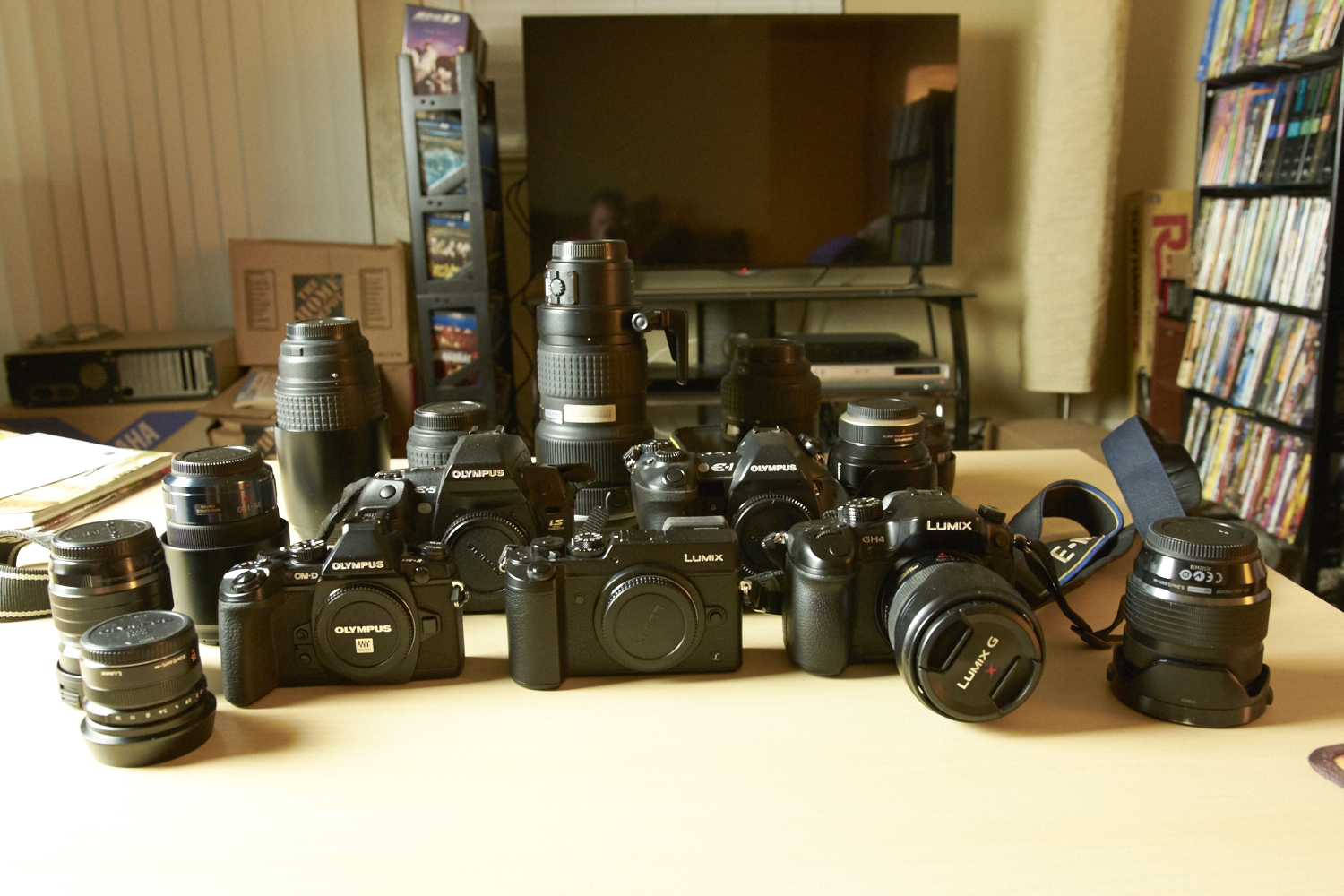
I got into Four-Thirds in 2004 and into micro Four-Thirds in 2012. I got into video in late 2014 with the Panasonic GH4, even though the GH3 was fully capable of 1080p recording.

For US$1699, the GH4 was an overachiever. It's still impressive but the goals have changed, and 4K is more easily achievable with a 4K TV in many homes. Fast forward to 2024 when I saw a deal for the Panasonic S5 Mk II with 50mm f/1.8 and 20-60mm f/3.5-5.6 lenses for US$2247.99. The S5 Mk II body itself really isn't much more expensive than the GH4 was in 2014.

I almost bought the G9 Mk II because there was an incredible trade-in deal and I would have saved a lot of money, and wouldn't be looking for lenses. However, I wanted something different, and I wanted to keep my Panasonic GM5.  (What I didn't know is that the GM5 is worth more than the original GM5 + kit lens.  I was going to take the US$600 trade-in value.)

Still, I wanted two things from a new camera body: PDAF and IBIS.

The G9 Mk II and the S5 Mk II have both and they're the best that Panasonic has done. I could have bought an older, used body without the PDAF but I struggled on occasion with the GH4 and the GX8. I recorded video on the GH4 quite a bit. I was photographing a scooter tournament at Woodward West with the GH4 taking video and the Olympus E-M1 taking still photos--the best tools for the job. At a later date, I went back to photograph during a free day there and took a Nikon D7200, as well. It could not keep up.  I looked at the Z50 and the Z5 and the Z6, but didn't think that they were quite right.

I've had the S5 Mk II for a couple of weeks. It's a handful. Getting it set like the GH4 has been an incremental process. It's worked beautifully during the day and struggled at night. For all those people chanting "Full Frame", telling me that micro Four-Thirds wasn't getting enough light, each sensor needs the same exposure to light. The Panasonic 50mm f/1.8 on 135 Format is more difficult at night than my Leica/Panasonic 25mm f/1.4 was. Depth of Field doesn't matter if you can't get the shot. Image quality doesn't matter if you can't get the shot.

The difference between the Panasonic 50mm f/1.8 and the 50mm f/1.4 Pro lenses is about US$1500. Holy !@#$ I might as well go another thousand or four for the Leica lens. I really miss my designed-by-Leica-hand-assembled-by-Panasonic 25mm f/1.4 that was a Four-Thirds lens designed for the Leica Digilux 3. I was so afraid to take it out in bad weather, though. There was no weather-sealing at all.  Knowing that lens, I'm certain that the Panasonic 50mm f/1.4 Pro is an extremely capable lens.

Converting from the GH4, I am reminded that the video is going to be an easier transition than the still photography will be. I haven't worked with a 3:2 ratio since 135 Format film. Four-Thirds and micro Four-Thirds used 4:3 ratio, just like Medium Format. Kodak, the maker of the original sensors, was big in Medium Format.

Now, the big deal is the weight of the lenses. If you look back at the family portrait photo at the beginning, you'll notice the rather big lens. That was an Olympus SHG ZD 35-100mm f/2.0 lens. I would say that it's the finest lens I've used on any equipment. It has a 77mm filter size and it is heavy. The rest were quite easy to hand hold without IBIS or OIS but I handheld the 35-100mm f/2.0 on an Olympus E-5 to photograph swimming and basketball. I did not handhold it with any micro Four-Thirds body, including the E-M1 that was supposed to support all of the SHG lenses but was far too small for reasonable balance.
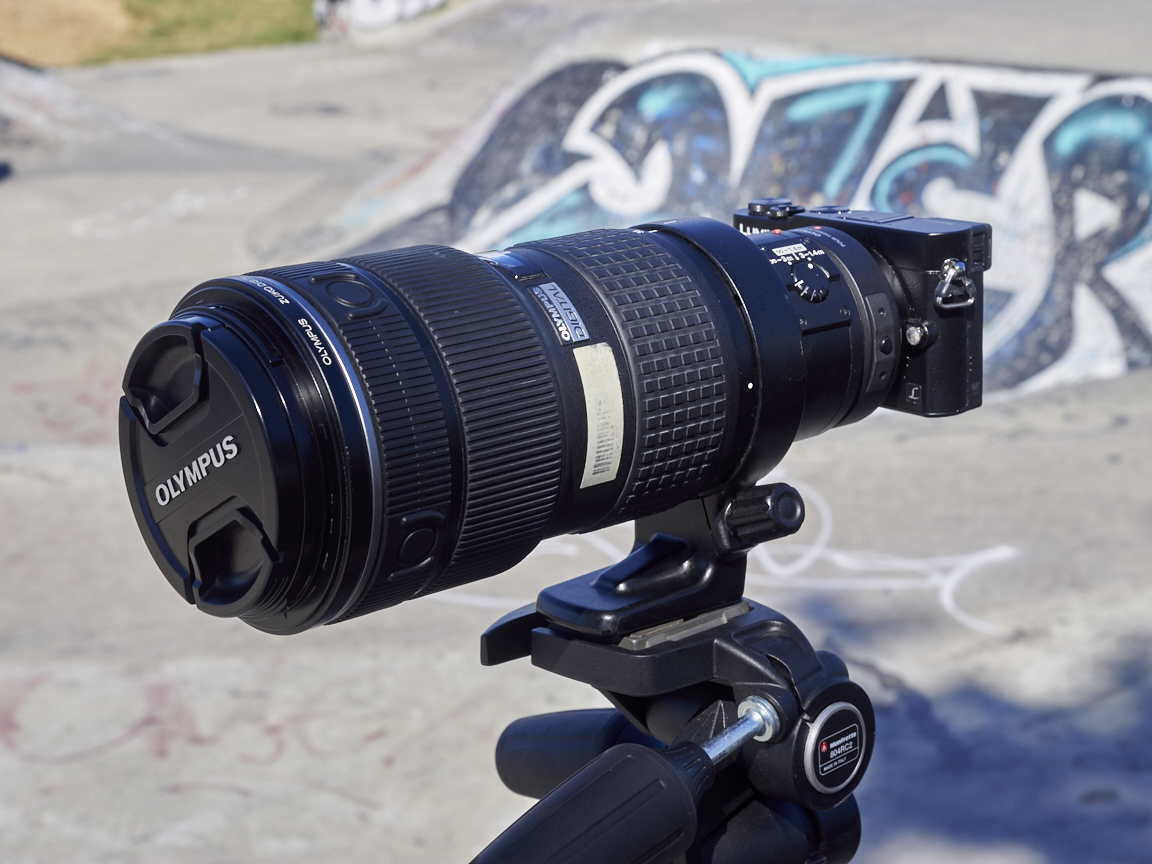
The Panasonic 50mm f/1.8 and 20-60mm f/3.5-5.6 are big and heavy for their apertures. They're weather-sealed and have Auto Focus, but they are shamefully large compared to lenses from the 1970s. Find a 50mm f/1.2 from Nikon, Olympus, or Canon and you'll find them rather small. Obviously, there were no electronic connections, no AF, no weather-sealing, but the optics were good, not great. A maximum aperture of f/1.2 meant that f/2.0 was good; f/1.4 meant that f/2.8 would be good, and it wouldn't be until later that there were amazing, regardless of the price.

Panasonic seems to be pushing daytime performance. The usual f/1.4 lenses aren't there, except for the 50mm f/1.4. As well, the telephoto zooms are few, although that's not unusual for Panasonic. I like that they all work with Dual I.S. so that the lens OIS works in conjunction with the IBIS and you can get a sharp image because of stabilization.

One thing I might do is to buy an adapter and use Canon or Nikon dSLR lenses. With micro Four-Thirds, you could buy an adapter with a focal reducer for increased effective apertures. No such tricks exist from 135 Format to 135 Format.

There are a few Chinese brands such as 7artisans, TTartisan, and Meike that are starting to make manual lenses for L-mount. Meike I trust. I had a 7artisans 55mm f/1.4 for micro Four-Thirds and it was good but heavy. The lens reviews I've seen for 7artisans and TTartisan seem evenly good and bad. Some seem to mention "falling apart", which doesn't give me confidence. Samyang has a 35-150mm f/2.0-2.8 that is appealing, if I can work with the weight. It also has auto focus, but I'll probably need a tripod or monopod to use it.

Update 2024.11.30: I was watching some video where a person had gone from Fujifilm X-T3, X-T4, X-T5 to one of the Nikon Z mirrorless bodies and then, to Fujifilm GFX 100.  He was feeling unhappy about not having any recent telephoto shots.  Instead of going back to a Fujifilm X-T5 with a better chance for better reach, he was going back to a Nikon Z body.  Does that make sense?  Why not stay with a brand you like?

On the adapters, Adorama had a deal on a Canon EF to L-mount adapter.  They also had a used Zeiss 85mm f/1.4 lens (not Milvus) for a bit under US$500.  That would have been about US$800 with tax and shipping.  The lens was rated Excellent but didn't include the lens hood.  Zeiss is not a brand I'd ever considered, but on their own, they're good and sometimes, great.  Partnering with Sony, as Panasonic and Leica are partnered, I lost some respect for them.  As well, Leica has some interesting fixed focal length lenses, but I wouldn't buy one of their zoom lenses.

TTartisan and 7artisans both have 135 Format fisheye lenses, 11mm f/2.8 and 10mm f/2.8 respectively.  The 7artisans lens is a redesign.  The company does that a lot, as if they make and sell a lot of mistakes with the first release.  They're both under US$300 and they're both manual lenses.  I miss my Olympus 8mm f/1.8 Pro for micro Four-Thirds.  That should have gone to the grave with me.

Update 2024.12.03: Watching another video from an S5 Mk II user trying a G9 Mk II, he states that the f-stop is really a f/5.6 for a 135 Format f/2.8.  It isn't.  The Depth of Field is like that, though.  However, it requires the same exposure calculation for any format.  If it really did take less light for the 135 Format sensor, Medium Format would have crushed 135 Format and 135 Format would have crushed APS-C and micro Four-Thirds.  I'm a bit shocked that such misinformation is still happening.  My Intro to Photography professor would have been surprised.

I've ordered a Tamron SP 180mm f/3.5 macro lens.  It isn't something new, as they don't really have any current dSLR lenses on their website any longer.  I ordered it with a Viltrox brand Canon EF-mount to L-mount Pro adapter.  Hopefully, it's enough so I stop whining/whinging about the lack of a telephoto lens.  It's heavy enough that I will be whining/whinging about carrying the extra weight in my backpack.

The latest video review I saw about it was in 2017 and I saw that the lens was introduced in 2003, but I'm hoping for the best and it was a rather expensive lens at one time.  Can't see spending money on one of the Panasonic telephoto zooms at this moment.

Update 2024.12.08: It's amazing how many videos I've seen on the S5 Mk II.  A few of them are people saying that they've switched from Sony equipment, just because support for video is so much better on Panasonic.  Some of what they're claiming are technologies that Panasonic incorporated to the GH* series of micro Four-Thirds bodies a few years ago.

By the way, I'm still waiting on my EF-mount to L-mount adapter that includes support for auto focus.  UPS failed me again.  I suspect that they misplaced the item after receiving it 12 hours after the lens.  I ordered a manual mount adapter which really isn't any good with a lens that doesn't include an aperture ring.  Guess what the Tamron lens doesn't have?

I need to photograph more.  I may need to work out to carry the new combination.

Update 2025.01.20: I got the adapter once Adorama sent another one, and the lens combination works reasonably well.  The weather is generally okay for walking to the store, but it's not really warm enough for me to be out photographing.  Eight years ago, I would have been out most every day and many nights.

I'm waiting for new Panasonic equipment to be announced.  I'd like to see some lenses and bodies (that I will not being buying) that replace the S1, S1R, and S1H with versions that include PDAF.

I'm really hoping for firmware to fix the night-time auto focusing issues.  It's not nearly as reliable as it should be.

Update 2025.01.23: Firmware update is out, and there are updates for Lumix Lab, Lumix Sync, and the Panasonic Image App.  For some reason, Lumix Lab did not see the firmware update, but I downloaded it and put in on the SD Card as I did 10 years ago.  It's night, so I haven't been out to try anything.

There were updates for vehicle recognition, and much more.


Update 2025.02.03: Vehicle recognition seems to work well.  I believe that the auto focus worked well for everything this afternoon. Someone posted about a pink moon on April 22nd.  I'm not sure it's a joke or real yet.  That would be interesting to photograph.  Took a few shots at night and it seems to be improved when focusing.  I didn't use the same lens during the evening but the detail looks good at 100%.

The latest firmware update seems to be a winner.


 Update 2025.02.26: Panasonic has introduced the S1R Mk II, which is a 44 MP still photo-centric camera body with video capabilities, including 8K30.  It's like a higher resolution version of the G9 Mk II.  They added PDAF (Phase Detection Auto Focus) and more, after five years.  There should be another, video-oriented body in April.  I wonder if they'll update the box camera bodies in micro Four-Thirds and 135 Format.

Update 2025.05.14: Panasonic has introduced the S1 Mk II and S1E Mk II.  I guess the S1H replacement is in there.  I guess a few people will be happy for the partially-stacked sensor and others won't like it, similar to the opinions about the Nikon Z6 Mk III.  I'm just happy that Panasonic has refreshed their lineup.  Having 5-6 year old models wasn't helping them.  There still aren't a bunch of good lenses, but they introduced a 24-60mm f/2.8, which is like a better version of the 20-60mm f/3.5-5.6.  It's not inexpensive, but it's about half the price of the Pro 24-70mm f/2.8 lens.


Now that they have all of their currently-sold (except S5D) 135 Format bodies using PDAF, they can make it more accurate.  It generally works on the S5 Mk II but it can be a pain to get it to lock focus.  I've been fighting with it using the Panasonic 70-300mm f/4.5-5.6.  Maybe that lens needs a firmware update.

Update 2025.09.06: Things are still going and there has been another firmware update but the system is far from perfect.  I generally get the shots I want but it takes more work than micro Four-Thirds did, mainly because of the auto focus.  It seems disagreeable with the 70-300mm f/4.5-5.6, 20-60mm f/3.5-5.6, and the 50mm f/1.8.  I noticed a setting for quick AF and that had previously helped, but maybe I'm missing another setting or two, or I'm just shooting as a sports photographer.  I see comments from many that they're not having a problem, but I'm not a person to spend 45 minutes to photograph a flower. 


Update 2025.12.14: I photographed the supermoon about 10 days ago with the 70-300mm f/4.5-5.6 and auto focus worked first time, without a problem.  That's the first time in months that I didn't have to fight with it. 

The S5 Mk II can work very well.  In my case, we don't always get along.  I keep searching for settings to make it work more like the GH4 since I used that much longer.  I'm sure there will be a moment when I adapt to it better. 

Monday, October 14, 2024

135 Format on the way

From my history of photography 

Over the years, I've handled a lot of different camera bodies in various formats.  The first camera I used was a 6x6 box camera using roll film.  I've used very technical cameras since then and with the digital age, I started again.  Since 2004, I've been using Four-Thirds and micro Four-Thirds, both Olympus and Panasonic.  I tried Nikon for a bit, but it was a pain, moreso than during the film era.  Fujifilm made my favorite film cameras, along with Olympus and Mamiya.

I've photographed sports with Four-Thirds and micro Four-Thirds equipment starting with the Olympus E-1 in 2004.  Back then, it was hard to believe that digital cameras would be good enough.  Now, it's difficult to believe that young people are using film cameras or that Pentax and Rollei have developed new film cameras for sale recently.

Back to the present

I just ordered a Panasonic S5 Mk II with 20-60mm f/3.5-5.6 and 50mm f/1.8.  The Amazon 5 payments thing got my attention.  Getting it the next day was surprising.  I guess they didn't want me to have time to think about canceling the order.

It's new for me, but this body has been out long enough to have firmware version 3.1.  Panasonic finally admitted that they needed to provide Phase Detection AF, instead of their hit-or-miss Depth from Defocus technology that was introduced on the GH4.  I didn't like DFD then, and while it's become better, it will never be good enough.

I was looking at another micro Four-Thirds body, an Olympus E-M1 Mk III, which was good and then, there was a Panasonic G9 Mk II trade-in special that was incredible, marking it down US$600 and then, adding your trade-in value.  The G9 Mk II also has PDAF.  They did the same with the GH7.

The problem with micro Four-Thirds is that we don't know when it will end.  135 Format is claiming a lot of the market finally, as mirrorless bodies have taken over in a big way.  I got involved with micro Four-Thirds back in 2012 with the GH3.  At one point, I was taking an Olympus E-M1, Panasonic GH4, GX8, and GM5 to skate parks with me.  Now, I only have the GM5.

Panasonic to Panasonic

The S5 Mk II is about the same size as the GH4.  It's not huge, but it is bigger than the undersized Sony bodies that are difficult to hold but becoming better.  It's certainly bigger than most of the 135 Format film bodies from the 1970s, except for the Nikon F2.

The lenses seem small, but again, they're bigger than equivalent lenses in the 1970s.  However, nothing back then was weather-sealed and not much had auto focus.  The Polaroid SX70 was the first camera I sold (I was in camera sales for a while) with auto focus, and auto exposure was just coming to cameras later in that decade.

I'm charging the S5 Mk II battery right now.  Instead of a separate charger, they have a USB type-A to type-C cable, and a power adapter for AC current.  The light atop the body signals that it is being charged.  That is also the light that signals a connection to the phone app.

The menus are familiar but much has been added since the GH4 or GX8.  It's going to take a while to get the settings right.  I need to set up the custom settings, so that it uses Natural, instead of Standard, and Raw instead of JPEG.  I also need to set a video mode, 1920x1080 at 60p.  While I have computers to handle 3840x2160 or 4096x2160, I don't want to record 4K video.  I found that you must set file format MP4 for 1080p, unlike what I did with the GH4.  MOV format is reserved for 4K and C4K.

I need to order an SD Card for storage.  I have a few around here somewhere, but they're older.  This body uses UHS II cards for speed.  There are two slots but I don't need to fill both.  I'm also considering third party batteries.  There is a brand called Wasabi with a charger and two batteries for US$39.99.  I can't imagine that they'll last a year, but for my casual use, that shouldn't be a problem.  My official Panasonic GH4 batteries were still going after three years.

How much does anyone need?

I've watched a few videos about the S5 Mk II and how it compares to Sony and Canon.  Why don't they compare it to Nikon?  I'm not sure.

24 Megapixels isn't a lot in 2024, especially with Fujifilm's APS-C sensor having 40 MP.  I don't need more and I suspect few people need more, unless they're working professionally.  In that case, they should be using Medium Format.  Lower pixel counts require you to be more careful.  I've been working mostly with 16 MP and occasionally with 20 MP.  I'm sure 24 MP will be fine for me, especially with a dual-gain sensor.  I was using ISO 3200 as my upper limit of acceptable photos for micro Four-Thirds, ISO 4000 for the Nikon D7200, and I expect ISO 6400 will be the reasonable limit for this sensor, but I might push it to ISO 12800.

Thinking about APS-C, there is such a mode, similar to what Nikon does from FX to DX.  It likely works with L-mount lenses that are connected electronically, rather than with manual lenses.  I was thinking about one of the fisheye lenses that are available.  They're mostly the same as the micro Four-Thirds lenses but with a different mount, meaning that there are no electronics.  I suspect that an older, electronically-connected lens from Sigma or Canon with an adapter would be preferable.  Having had the Olympus 8mm f/1.8 fisheye lens makes any other lens less appealing.

I keep thinking about the day in April 2004 when I bought the Olympus E-1, 50-200mm f/2.8-3.5, and 14-54mm f/2.8-3.5.  I spent about US$3000 and this S5 Mk II kit cost about US$2249.  I didn't get a telephoto zoom of any kind with the S5 Mk II, unfortunately.  That would have cost at least an extra US$1000 right now for a Panasonic lens.  Having two lenses that overlap isn't great, but night shooting is possible.

I'm thinking about a Samyang 35-150mm f/2.0-2.8 as a zoom lens to cover a decent range at a big aperture.  There really aren't many telephoto lenses although Sigma's 60-600mm lens (like Bigma, 50-500mm), covers quite a bit, if you have a strong heart and a strong tripod.  The reviews say that there is a problem with the Samyang lens, but you can update the firmware.  Apparently, the lens firmware is updated the way we used to do with the micro Four-Thirds lenses on Panasonic bodies by putting the update on the SD Card.  If the firmware corrects the problem, US$1399 is a decent price for a good, maybe great, lens.

Update 2024.10.20: Yesterday, I took the S5 Mk II out for a few night photos.  I regularly did the same with the GH4 years ago, so I hoped for good results.  However, I might not have had things set properly.  Having a camera for about a week and going for the first try, I might still not have been ready.  Besides, I'm not as steady as I used to be.


This one was taken with Auto ISO.  Later photos were taken with ISO 4000 to ensure that it activated the higher ISO gain but this one looks just fine.  I could see a long spider web thread.

What made the GH4 so impressive is that it could focus in "starlight" EV -4.  The GH3 had that enhancement added via a firmware update. 

I had taken out the GM5 earlier in the afternoon and I wonder if I did better with it.  After eight years, the AF is generally tried and true.

Update 2024.10.24: I went out tonight with the 20-60mm f/3.5-5.6 which seemed like a bad idea.  It wasn't perceptibly worse than going out with the 50mm f/1.8 lens.  Most of the shots had a shutter speed of 1.3 seconds.  I even managed to hold most of them steady.  One thing that seems a bit odd to me is that the 20-60mm doesn't have any OIS (optical image stabilization), whereas the micro Four-Thirds standard kit lenses (14-45mm, 14-42mm) did.  I'm trying to think back to the Four-Thirds Leica/Lumix D lenses and I believe that the standard zoom lenses also had OIS.  The Leica-designed normal 25mm f/1.4 did not.

Thankfully, the IBIS is as effective as that of Olympus.  They started out on the same sized sensor but the 36x24mm vs 17.3x13mm makes for some addition stress.  Getting 96 MP out of high resolution mode is impressive.  Panasonic did a lot of work to make that happen.

Update 2024.11.18: I'm still adjusting.  I bought a tripod.  It's a Smallrig CT-20, which can be converted into a monopod.  The instructions aren't good, so I'm figuring it out.  It was quite a bit less expensive that my Manfrotto tripod, which was a bit over US$200 back in 2012.  US$80 in 2024 doesn't seem much, especially coming from a company that designs and builds cages for cameras in the video industry.  Supposedly, it can support about 33 pounds/15 kg but I saw a lower figure for the ball head.  In any case, the S5 Mk II and most lenses will not add up to anywhere near that heavy.  Even that Samyang 35-150mm f/2.0-2.8.

I actually wanted to get some shots of the supermoon but the tripod didn't arrive in time and my Panasonic GM5 and Olympus 40-150mm f/4.0-5.6 doesn't have OIS.  Having a proper telephoto zoom for the S5 Mk II might be a while, especially as slowly as Panasonic is designing and producing them.

Update 2025.07.08: I have three native Panasonic lenses now.  The 70-300mm f/4.5-5.6 is good.  I've been able to photograph the moon and the Dual I.S. works well.  I'd never used that on micro Four-Thirds since my GH4 was too early and I'd only used the Sync I.S. on  my Olympus E-M1 once, with the 12-100mm f/4.0.  It's a lot of stabilization, no matter the system.

 Since I have the 70-300mm, the effective reach is about the same as the 40-150mm on micro Four-Thirds.


Panasonic  has introduced the S1 Mk II, S1R Mk II, and the S1E, which is more like an upgraded S5 Mk II or IIx. The S1H Mk II may be introduced soon.

 I've been watching videos for any information regarding the sluggish low light auto focus.  Enabling the Fast AF functionality has helped.  It's unusual that such has to be done. 

Wednesday, September 26, 2018

135 Format Seems to Have Returned

In the late 1970s, I sold cameras at a department store.  Mostly, we sold Nikon, Minolta, and Olympus SLRs but also Fujica/FujiFilm, Pentax, and Canon.  That order also shows the relative quantities sold.  The Canon AE-1 was possibly the worst seller, and I really had to explain Shutter Priority auto exposure--and why the controls seemed to be the opposite of everything else we sold.  (We also sold Medium Format, 110 Format film cameras and the odd, leftover 126 Format cameras.  Polaroid and Kodak had instant cameras.)

Now, we're getting back to a time like that, when many camera makers have an entry in 135 Format.  Nikon and Canon have been in 135 Format for a while now, and Pentax returned recently with the K-1, now at K-1 Mk II.  Sony was the first with a 135 Format mirrorless line and they're on the third generation now.

In the last few weeks, Nikon and Canon introduced mirrorless 135 Format models.  In my opinion, Nikon is closer to getting it right from the start.  They're going to need a lot of firmware updates and they don't like to do that.  Canon didn't stray far from home and they're going to need to re-do their system much more quickly than Nikon will simply because of the lens mount.

This week, Panasonic, Sigma, and Leica got together on the L-mount, already in use by Leica (SL, TL) in a 135 Format camera body.

This is news because Panasonic has been a small appliance and electronics company for years.  They have come so far since those days, possibly due to their feud with Sony.

In any case, two 135 Format bodies, one high resolution (S1R), one low (S1), similar to Nikon's path.  Having an SD Card slot along with an XQD slot is brilliant.  The thing is--these are months off, probably available around spring.  Specifications are subject to change without notice is the appropriate statement, isn't it?

The other part of their announcement is that Sigma is moving to 135 Format with their Foveon technology.  I'm trying to keep an open mind, but they haven't been making much progress.  When someone complains about their low light capabilities, someone has to yell "Hey, look, over there!"

The better part of this is that Sigma will finally have a worthy mount and can share a market, instead of cornering a market that few want.  (There probably aren't that many Leica users, though.)

My only question is: where is Olympus?  I don't have to ask about FujiFilm.  They're not competing head-to-head.  They have introduced another 50MP Medium Format model and documented that they are working on the rumored 100MP model.  I'm not sure whether Pentax is a factor since they haven't had much luck with mirrorless, going the quirky path, but there is a new Irix 150mm f/2.8 macro lens with their mount that will be available.  The K-1 Mk II and the update to the original seem to be decent, but better auto focus would make people want to buy them.

Olympus has rumored that they are working on a higher high-end camera body, which considering the price of the E-M1 Mk II, they need some much better technology for micro Four-Thirds.  If they're heading to 135 Format, I'm thinking things will heat up.

Update 2019.01.12: Panasonic supposedly will launch their S1 and S1R bodies in March 2019.  That's not particularly far away, and yet, we still don't have many details.  It should be interesting to see what lenses Sigma has re-mounted by launch time.  The latest Sigma lenses seem to be quite good and would help make the launch a success.

Nikon seems to be getting good press, even though they have some shortcomings, as with any first generation equipment.  I can imagine that Panasonic will have odd troubles, but the bodies should be as good as can be made--the line starting with the GH3 should be proof of that.  However, dust reduction and sensor-based image stabilization will be their biggest engineering feats, plus re-working their video routines.

Update 2019.03.31: Panasonic have opened up and their big mirrorless bodies and a few lenses are about to be sold.  They look good, even though they are rather large and rather heavy.  To me, having fully-functional camera bodies is a necessity to make the work flow more easily.  The Panasonic GH4 never got in my way, just like the Olympus E-1 or E-5.  The designers considered how it should work for quick and easy use.  I also have the Panasonic GM5, which uses the same lenses and it's hardly the most ergonomic camera body but it does the job, especially since I can strap it to my wrist, work with the GH4, and grab the GM5 for other photos or video.

It will be interesting to see how Panasonic changes 135 Format and how Sony will respond, since they have had the mirrorless 135 Format market to themselves for a while.

Canon and Nikon are making a splash, but too many of their users have been told for too long that mirrorless bodies aren't professional bodies and can't do what the dSLR can do.  IMO, Nikon still have the upper hand with a forward-thinking lens mount, compared to Sony or Canon.  On the other hand, having third parties try to decode the lens mount is really incredibly stupid, no matter how many of your own brand lenses you sell, especially when native format lenses are few.

Sigma's Art line lenses will be available as 2019 continues.  I suppose that this is a good thing but I suggest that they should have made some zoom lenses available, especially those from their Sports line.  Shouldn't the 60-600mm lens be available?  135 Format needs longer lenses.

Update 2020.02.17: There is nothing really amazing happening at the moment, but Panasonic has three models in their S line, Canon has two, and Nikon has two.

Sigma created a very tiny L-mount model but they're having trouble creating a Foveon-technology-based sensor for 135 Format.

What I've seen is that no one has great technology but they all have something to contribute.  Leica is the most expensive.  Canon is the least expensive.  Sony has been in the space for a few years and is suddenly needing to fix their user interface and generally sloppiness in their software.  Panasonic has incredible hardware, as well as incredibly large hardware, but they need phase detection auto focus, no matter what they think.

Having worked with the GH4 so much, Panasonic's S1H looks a treat.  However, I have so many video clips where the AF just goes away while the image processor is busy.  Still, I would probably go with Panasonic, just knowing that I can depend on the software, and make sure that the AF problems are minimal.

Update 2024.10.19: Got the Panasonic S5 Mk II with Phase Detection Auto Focus, which is an L-mount body.  Those Panasonic bodies from four years ago need to be replaced.

Canon and Nikon have expanded their mirrorless line up and de-emphasized their dSLRs.  Fujifilm is still working in APS-C and Medium Format.  Generations have been retired and they're still futzing with the auto focus.

 I had hoped that Olympus would continue with Panasonic, going to 135 Format, but they're on life support, as OM Digital.

Thursday, August 23, 2018

Nikon Cannonballed into the Mirrorless Pool

The Nikon Z6 and Z7 are the most important Nikon bodies of this decade.

After loads of experimentation, Nikon have finally jumped into the pool enthusiastically.  The CX mount was cute but there was never a chance for it to succeed in a big way, any more than Pentax' Q-series of mirrorless miniature bodies.

There is one, huge problem with this system--the lens interface is a secret.  If Nikon wanted to be extremely successful, they would have already published the interface, so that Sigma, Tokina, and Tamron would have lenses available.

There are a number of companies with experience interfacing with mirrorless bodies and that knowledge could provide a number of good, maybe great, lenses more quickly than Nikon could provide them.

Currently, the 3 lenses available show me that Nikon is concerned with enthusiasts, not professionals.  Sure, you can buy the FTZ adapter but an f/4.0 zoom lens and two f/1.8 fixed focal length lenses leave a lot of room for improvement.

What I've read so far leaves me with the impression that dSLR users aren't going to just pick up these bodies and start shooting.  Welcome to the mirrorless club!

I adapted my techniques from shooting sports with a dSLR to mirrorless bodies and I have even switched back and forth, having one of each with me.  People should always adapt, but many will waste their efforts on complaints.  It may not be easy, but it is possible to change.

Even with phase detection AF points, they may want to leave the focus lock a bit loose and lock from time to time while following the action.  Tracking on mirrorless bodies has improved but it's far from perfect.

I'm waiting to see who buys equipment.  I will likely be amused by the Sony fanatics claiming victory.  Considering how the A7 was, claiming victory might be premature.  The D850 has shown that Nikon can put together equipment that excels.  Once they understand how things should work and what they're doing, I suspect Sony will be looking for ways to improve.

Update: Canon did something also.  ;)  It wasn't as interesting.  FujiFilm's X-T3 is more interesting to me than Canon's EOS R, but Nikon's Z6 and Z7 with the new mount have my attention.

Next week, September 25th, we'll find out whether Panasonic has a 135 Format hybrid camera system or not.  If so, will it be a good thing?  I can't imagine them doing this without a partner.  It's supposedly not Olympus nor Leica.  Would Pentax be interested?

Update 2018.12.08: Panasonic announced that they were working on equipment based on the Leica mount for the SL series and its APS-C relative.

Considering that nothing has been set in concrete, anything could happen.  Sigma is joining, not just with lenses, but with a modified Foveon sensor for 135 Format.

Update 2019.02.17: Panasonic has two bodies for the L-mount, Nikon has added a lens or two, and Canon has added another, rather low cost body.

At US$1300, Canon will get the attention of a great many people.  I still believe that Nikon has the better lens mount for the future.  However, given Panasonic's understanding of hybrid camera systems, I think that they will keep Canon and Nikon humble, and show Sony a trick or two.

Sony has done okay so far because it was the only company in the niche, but that's all gone now.  They have to compete now.

If Sigma puts an L-mount on each of their DG lenses, Panasonic will have great third party support, unlike Nikon and Canon who don't want it and are forcing third parties to reverse engineer support.

Wednesday, December 2, 2015

Nikon has bought (a license to) Samsung's NX technology?

This is a strange rumor, which could explain Samsung's quick exit from several markets.

After years of producing half-baked, mediocre photographic equipment, Samsung has produced desirable equipment, precisely, the NX1.

It has a 28 MP sensor, which is a new density for APS-C, which has been held to 24 MP for a while, equivalent to the 16 MP for (micro) Four-Thirds.  Apparently, the image quality has been impressive and the video is equally impressive, using H.265, rather than H.264.

I don't care for Samsung.  For years, they have produced products that were not complete.  They left buggy firmware in place while introducing products to replace those unfinished products.  This NX1 wasn't so different.  They introduced the body in almost a beta test state.  Almost daily, they were providing firmware updates and now, it's very, very good--desirable.

Unfortunately, the rest of the NX-system is not worthy, which is why this rumor is so interesting.

Obviously, Nikon has a great APS-C presence in the industry.  I even bought a D7200 recently.  What if the emotional successor to the D300 could be based on the technology of the NX1?  I keep seeing the D400 pop up in rumors but no body.

If Nikon called for third parties to supply lenses for APS-C mirror-less bodies, they could certainly move the market more than FujiFilm, even though FujiFilm is very dedicated.  Sony barely has had an impact and Samsung seemed to drag down the market.

What would be even more interesting is a 135 Format/FX sized sensor based on Samsung's technology.  Could the D810 suddenly be supplanted?  Could Sony be removed as a sensor supplier to Nikon?

I wonder if the sensor technology is a one-hit-wonder type of success.  If it moves Nikon into the mirror-less market, it could really change the market and scare the stuffing out of Canon.

Update 2015.12.04: The denial from Samsung tends to dismiss a full sale but seems to suggest that a cooperative use of the technology is possible.  I still don't believe that Samsung's NX mount would be used, even though this would provide a few lenses.  It is more likely that Nikon would want to create a mount, so that they can control everything about it.  Obviously, if they're interesting in APS-C, they've run out of room between CX and DX but they're likely more interested in pushing Sony out of the market than handling the markets of micro Four-Thirds or FujiFilm.

I'm thinking that this move is similar to the move where Apple meant to split their relationship with Samsung, as they didn't trust Samsung not to use their processor design enhancements and went to TSMC for manufacturing.

2015.12.13: You have to wonder if the D610 could be the first to be replaced and there is no D300/D300s replacement at all, but a Sony A7 Mk II-type 135 Format body.

Tuesday, November 5, 2013

Nikon Df, more retro in a bigger but smaller package

While I'm not exactly surprised by Nikon's announcement, I'm pleased to see that they've put together a 1970s-style camera body.

When I was selling the Nikon F2, we had a Nikkormat body, which was their less expensive, smaller brand.  It was easily usable without the crane and tripod.  Compared to the Olympus OM-1N, it was still quite heavy.

When I first got a dSLR in 2004, I wondered why they couldn't do something in the same size as the 1970s bodies.  It seemed ridiculous to have a smaller sensor (APS-C or Four-Thirds) in a body larger than 135 format.  Then, I mounted a longer, bigger lens and realized how much more comfortable these dSLRs were.  The grip kept them from being slippery, too.  Using a 4x telephoto zoom, and relaxing and holding everything with only fingertips on the grip says a lot of progress has been made.

So, Nikon brought a camera to market that looks very much like the 1970s, adding a couple of LCDs and a lot of automatic features.  The price is up there, but not outrageous for what you get.  At roughly US$2750, you get their top of the line 135 format/FX sensor.  (If you think higher pixel density leads to better image quality, you need to think again.)  Combine that with the D610's auto focus unit, a single card slot, and all the dials you can handle, and you've got a great casual shooter than wipes Sony's A7/A7R duo right off the camera shop floor, except for size, of course.

No, it's not likely that the same people are going to be driven to Sony and Nikon bodies, or anything with the retro look.  I suspect a lot of people in their 70s will buy the Nikon Df, if for nothing than nostalgia, as they probably have an old Nikon body in the closet.

Why do I damn the Df with the word "casual"?  You'll see that the first time you mount the 70-200mm f/2.8 lens to it without a tripod handy.  It's the same reason I call most of the micro Four-Thirds bodies casual--you'll need to take more care if you want to work handheld with an unbalanced pairing of body and lens.  Thankfully, Fuji has been thoughtful with their X-series bodies and only provided an adapter for Leica M-mount lenses, which are small lenses.  In the 1970s, it wasn't a huge problem because there weren't so many huge lenses, unless you were using Medium Format.

If you fit into that category where you take the time to take the shot, I suspect that you'll be richly rewarded by some very amazing image quality with the best lenses.  If you dig the bottom of the barrel and come out with a 40 year old Sigma lens, you'll wonder why there was any fuss about the Nikon Df.  Using high quality lenses with it will make you admire the D4 even more.

Thinking back a bit to the D610 announcement, I see where it makes more sense now that the update came about the same time as the Df, especially with the update to the Expeed 3 processor and faster burst rate.

Update 2013.11.11: Saturday, I was at a local camera store for a workshop, and I was discussing something later and I noticed a couple of the film bodies from the 1970s and 1980s, and they brought back a sense of nostalgia, having sold such equipment in my past.  Unfortunately, most who spent US$500 aren't as likely to spend US$2750 for nostalgia, I expect.

Update 2013.11.24: Reading What Digital Camera's impressions made me smile when they said that the camera body was larger than expected, even though it's the smallest Nikon FX body.  Nikon built huge camera bodies way back when.  It was only after Olympus started to take business away that they responded with smaller bodies.  The article was suggesting that the balance wasn't very good with zoom lenses.  They should go back to the 1970s when none of the camera bodies had much of a grip at all.  If you wanted stability, you bought a tripod.

Update 2014.12.18: I wonder if Nikon has sold more than a few thousand of these bodies.  I don't see much about this body any longer.  I suppose Nikon enthusiasts and professional photographers from the 1970s bought quite a few of them and that buying spree was over quickly.  What value can you place on nostalgia?

Wednesday, October 16, 2013

New Sony a7 - a7R

I'm sorry Sony, but I can't stop laughing at the painful looks of the camera bodies you've mangled.

You took a very handsome, curved block that looked almost exactly like a Nikon 1 (not a good idea, considering what Nikon are telling Sakar/Polaroid with the lawsuit), plopped a viewfinder onto it, and riveted a grip onto it.

It looks home-made, like someone's $100 camera body mockup.  Frankenstein's creature was possibly less ugly.

Now, technically, it sounds interesting, but they need to show how huge the lenses are, especially the long lenses, mirror-less or not, it's still 135 format.  Trying to get a good day's work out of it is going to be heavy.

DPReview seemed incredibly supportive of Sony in their first look assessment.  The controls are there but seem illogically placed, as if the outer form followed the inner form, as if the design came from an electronics company.  Samsung and, to a lesser extent, Panasonic have been doing similar types of design work, but Panasonic finally got it right with their GH3, save the SD Card door and Display button.

Supposedly, the grip on the a7 and a7R is quite good, so it should be comfortable.

The lens selection looked a bit bizarre, and given their lack of lenses for their NEX line after these (3, 4, 5?) years, will they improve in their variety?

The features of the two bodies was interesting.  Choose the less expensive body and get a lower resolution (logical) sensor with a anti-aliasing/low pass filter or pay quite a bit to get a higher resolution sensor without the filter.  Of course, if you can afford the more expensive model, they're thinking that you already know how to handle moiré patterns.

Still, I can't see the more expensive model going up against the Nikon D800E or any medium format camera.  I also couldn't see the D800E going up against medium format, although the resolution is plentiful.  Have I thought about buying one?  Definitely, and I've thought about the D800.

Are there people out there who chant "full frame full frame" as the universal panacea?  Yes!  Could this fix their desire?  Possibly.  However, I feel that those people will still have trouble getting the photos they want because they may never know their equipment, and could do much better with the equipment they have, until they've explored everything that a camera body can do.

Update 2013.11.05: Well, that didn't take long.  Nikon's new Df matches 1970s style with 2013 specifications and even allows lenses from as far back as 1959.  That's a lot of crossing time, and you don't even have to switch equipment brands.  The main difference for people trying to decide is whether they want better image quality or higher image density, since the Df uses a 16 MP sensor from the D4.  Of course, thinking about ISO 25,600 photos as clean as most ISO 1600 photos has appeal.  If you happen to photograph concerts for a living, you have a new backup camera body in the Df or your company could afford a couple of them instead of one D4.

Update 2013.12.10: The a7/a7R duo have had mixed reviews.  They have a lot of potential but they're products of checklist engineering.  I think they'll be useful to the casual photographer.  I somehow doubt that a professional would consider them, but a few professionals have considered micro Four-Thirds, so why not this pair and the Sony FE-mount?  Any camera body currently available is good, and these have to be far about just good.

Update 2014.12.18: While I'm still not a fan of their electronics-oriented designs, Sony has gone further with these and produced a successor to the a7 and added the a7S with ISO sensitivity up to 409,600 and increased dynamic range.  The sensor has 12 MP, which should provide good enlargements with lower noise than most, given the low pixel density.

 The a7 II has 5 axis image stabilization, similar to what Olympus started with the OM-D E-M5.  This should improve quite a few blurry photos.

The company has come a long way from buying the assets of poor Minolta.

Update 2014.04.08: I'm glad they've revised the body greatly with the A7 Mk II.   It seems much better overall.

Tuesday, January 1, 2013

Happy 2013!

So, we're still here, and the U.S.A. is more-or-less over the fiscal cliff because the Congress was too busy the last two years.

I noticed that gasoline prices were increased about $0.20 per gallon in just a few days.  I expect refinery executives needed extra party money for New Year's Eve.  Perhaps, they'll drop a bit but given the cold here, I expect that the prices will continue.  Thankfully, I use natural gas to heat.

Since the world didn't come to an end, I hope people have a plan to pay for Christmas gifts.  I would imagine that credit cards have been increasing their rates, so it's infeasible to carry a balance.  In many states, credit is barely regulated.  I wonder how many lost their cars to title loans, while trying to afford Christmas gifts.  I'm so cynical but it always seems that there are people to take advantage of other people.  I suspect 300 years from now, there will still be a few people taking advantage.  Congress will have reformed by then, I hope.

Technology is continuing to advance.  I noticed recently that Samsung et al. were fined for price fixing of some components.  I'm not sure how they can continue to do this and not be banned from the market for a period of time, but it probably has something to do with consumer demand needing to continue.  For all the demand, has anyone's economy improved since 2008?

I noticed DPReview's Camera of 2012 poll has finished:

  1. Olympus OM-D E-M5
  2. Nikon D800
  3. Canon 5D MkIII

The results were rather surprising, considering that DPReview has been rather anti-Olympus past the E-1.  I'm not exactly as thrilled with Olympus as I was in 2004, but everything changes.  Nikon and Canon have definitely become better than they were in 2004 and Olympus is, for the most part, worse.  The E-M5 (E-PM2 and E-PL5) has certainly changed opinions with its image quality.  I'd say that people who voted recognized this, as it takes a 135 format frame sensor to produce clearly noticeable differences.

The rumor is that Olympus will produce a replacement for the E-5 by the end of 2013.  That seems reasonable--it's been three years.  The body is apparently not a Four-Thirds body but micro Four-Thirds with a smarter adapter to enable Four-Thirds lenses to operate at full capability.  My only concern is that they'll provide an OM-D series body that is far too small and slippery.  If the adapter works on the Panasonic GH3, I'd be much more happy, especially if the adapter is ready (and available) ahead of the new body.  Of course, if Olympus produce a body like the E-1, I'd be at home.

I saw that Volkswagen have given in and are selling hybrid vehicles now.  The Jetta and Touareg (I saw a news report that the Tuareg people were fighting.  Does that sell vehicles?)  have hybrid versions.  It's amusing that a vehicle with 380 horsepower (what is that in reindeer power?) should be focused on economy or that 24 mpg highway would be an accomplishment.  Don't people with US$50,000 have unlimited fuel supplies?  I was hoping for diesel hybrids but I suppose that would take much more time since no one else is doing it.  Many people comment that hybrids produce a herky-jerky mobility that's an unhappy compromise.  I can't imagine that so many bought such a vehicle.  Of course, I didn't realize at the dealership that my 1999 Golf would be a constant source of trouble.

I'm so glad I bought snow tires, but I haven't been through the fallen snow so much, as the scraped road that still has snow and ice.  The tires perform well, but what works really well on ice, a tank?  I'm really loath to go into the cold anyway, but I can't hibernate forever.

I had considered driving to Los Angeles, California for Christmas to enjoy something different, and my buddy the singer-songwriter replied to me that he was possibly going to be out on tour with someone until the 22nd.  I guess Christmas Day is not on the 25th in Los Angeles.  I would have missed all the lovely weather here anyway.  Prior to the 31st of December, we'd had nearly half of 2012's snowfall in one week's time.  The 31st's snowfall was lovely indeed, but I'm sure we're going to have a covering every week until April.  It's a great thing, despite my dislike for winter--we need the moisture in the ground.  Having brown lawns as early as July just isn't good.

I hope that 2013 will be an incredibly wonderful year for all.  I don't need surprises but a steady decrease in problems would be appreciated.  Being able to go where I want would be a wonderful advantage.

Friday, November 30, 2012

The angry pixel bus: digital photo noise

Today, I was in a camera store looking at some products and someone brought up the number of pixels between the Nikon D800 and the D4.  The D4 and its predecessors have concentrated on speed and image quality, while the D800/D800E and its predecessor concentrated on pixels.

This person mentioned something about most people not being able to understand about why pushing too many pixels onto a sensor didn't make sense.  I explained it to them, as I've been doing since 2004:  When you crowd more people onto a bus, you end up with a bunch of angry riders, and they become noisy.  Putting the same number of riders onto a smaller bus does not make for happier people, and you should see even more noise, all things being equal.  They asked to borrow that.

These days, we have buses with better seating capacity and more athletic riders, so we can have more pixels from that same sensor size with reduced noise.

Now, I hope people will remember that it was my analogy and not everyone else's.

Wednesday, October 10, 2012

Nikon Opportunities?

I was thinking about equipment options and whether I should give up the ship and switch to Nikon.  The D600 (and D7000) have given me two good options.

I keep reading about how wonderful the variety of lenses are for Nikon bodies and how I could find anything I want and they're inexpensive, also.  I'm accustomed to dust and splash-resistant lenses, so I expect to pay more.  I also want my lenses to be able to be used wide open, not stopped down.

I was browsing the Sam's Club website, which has the D7000 for US$999, a bargain, yes?  The 24-120mm f/4.0 looked good and at US$1299.99, it wasn't a bad price for a premium lens, if it could fulfill my needs.  It could be used on either the D7000 or the D600.

The reviews I've read suggest that it has problems.  Now, I realize that it has a 5x zoom and that's 1-2x more than I usually find optimal.  I current use a 4x lens and a 3.85x lens that aren't priced that high and are quite good wide open.  They're dust- and splash-proof, so I can use them in hurricane weather, which I have.

So, I went to look at other lenses and I was startled to find that most of the premium lenses don't seem all that premium and have many compromises, except for the price.

I was interested in Panasonic's GH3 with the 12-35mm and 35-100mm lenses but the 12-35mm had compromises I didn't like.  I'm finding that they're no worse than Nikon or Canon have done.  Besides that, the size is much smaller, so I can carry them more easily.  I could also have one body each and have them both at the ready.

I still would like to have a 135 format-sized body but only for the really wide angle work and maybe, Panasonic's 7-14mm would be enough for me.

I punted and ordered a refurbished version of Olympus' excellent 35-100mm f/2.0 lens.  It's about US$500 cheaper than retail.  It's only about 1.5 times the weight of my current 50-200mm and the f/2.0 should help with swimming photos since the pools appear bright but are quite dark, so I won't likely have to use flash at all.  It's also somewhat faster than Panasonic or Nikon versions covering that range.

As you'll be able to see from the photo, the 35-100mm is slightly bigger than my trusty 50-200mm, and the tripod collar seems permanently attached, although I can loosen it.  The filter size is a whole 10mm more at 77mm.  Update: I just added the excellent 14-35mm f/2.0 as well.  It's amazing how large it is.  It makes the E-5 body look smaller, especially compared to my original "kit" lens, the 14-54mm f/2.8-3.5.

Monday, May 28, 2012

Nikon D600?

The camera business seems most bizarre now.  Low end cameras gain the most pixels.  Mirror-less cameras are crashing the top 10 in Japan, taking spots away from dSLRs.  Point-and-shoot cameras are looking to replace dSLRs, and phone cameras are looking as good as point-and-shoot cameras for most people.

Then, there is this odd rumour about a Nikon D600.

It supposedly has an FX-sized sensor, meaning that it's roughly the size of a 135 format film frame or 24x36mm.  Looking at the model number, I'd guess that they're fitting it between the coming D400 (or forgetting that entirely) and the still-available D700, to have a fourth FX dSLR.  Of course, it would be economical, maybe priced around US$2000.  That might push the D400 down to meet the Canon 60D, retire the D90, update the D7000 to use the D3200's sensor, etc., and also retire the D5100.

Are the loud people who frequently call for a 135 format-sized sensor ready for a camera body that actually has one?  Will they be ready for the back aches of carrying all the big and heavy equipment?  I'm cynical, so I think they'll be complaining about the price of the appropriate lenses.  You're probably not going to get the best resolution out of a 30 year old craptacular Sigma lens that you got from your grandfather but they're not likely to spend the money to commit to the format.  However, I'm cynical, so maybe they'll prove me wrong.

I would welcome a less expensive 135 format body for wide angle work.  As things are relative, the body size will be big for a while, if not for much more than the size of the mirror and the pentaprism.  If large is suddenly light, I'm sure many would be pleased, or shocked, or both.

Nikon has been winning back their advocates since the D300 arrived.  They've shown a willingness to stand up for their business and show that they're not just a company with a long photographic history.  By the end of this year, it should be quite a lot more interesting.

Well, to update this, the D600 arrived and it's everything I would hope to have in an economy shooter for wide angle work.  The D7000 is a good product on which to base a revision, much like the D300 gave birth to the D700.  I'm impressed Nikon.  Keep going, but one thing, fewer bodies make decisions easier, and please, please, make it apparent which lenses are weather-proofed.

Update: Seeing the Canon 6D, Nikon shouldn't be too worried.  I'd think they'd be laughing, actually, but they can't afford to waste time laughing, really.  Eventually, Canon may make a comeback--Nikon did.  Funny how the D7100 is more advanced in AF and other areas than the D600, but since there is no D400, that makes sense.