Showing posts with label E-M1. Show all posts

Thursday, November 28, 2024

Been mostly mirrorless for ten years

 It's been about ten years since I was mostly using mirrorless cameras.

I had the Olympus OM-D E-M1 in the summer of 2014 and the Panasonic GH4 in December.  I'd been using the Olympus E-1 since April 2004 and the E-5 since 2012, along with the Panasonic GH3.


I photographed sports with the E-1 for quite a while.  When I got the E-5, I also got the ZD SHG 35-100mm f/2.0, which was amazing for swimming and basketball photography.  You could practically hammer nails and dunk the equipment and it would still work.

The GH3 was a bad choice for me.  I didn't do video and it excelled at video and didn't do quite that well for stills photography.  The EVF had a purple tint.  The Panasonic X 35-100mm f/2.8 was 2/3 the price of the Olympus 35-100mm f/2.0 but it was 1/10 the lens.  The latest Leica-branded 35-100mm f/2.8 seems to be much better.

In late 2013, I got a call from Olympus and they invited me to see some unannounced camera.  That camera was the E-M1.  It was supposed to take my lenses and make them work as well as on my Four-Thirds equipment.  That didn't work as expected.  I had my backpack with two SHG lenses and more HG lenses.  They worked but the E-5 was much faster to focus.  I declined to promise that I would buy one but that I would keep quiet about my experience.  I hoped that a production model would be much better.

In early summer 2014, I was frustrated with the GH3 and traded it for an E-M1.  It was better than the GH3.  The color of the viewfinder was more like real life.  The GH3 was purple-tinted.  The E-M1 responded like a real camera, not just a video camera with a modification for still photography.

I moved to California and my first week, I was photographing at skate parks.  My timing plus a fast burst mode got me a lot of winners.  I still used the dSLR and did just fine.  Having just the Olympus 12-40mm f/2.8 and the Panasonic X 35-100mm f/2.8, I didn't have as much lens versatility as I did with the dSLR.  I had an adapter but the speed just wasn't good enough.  It was better to use the dSLR and get the shots than to miss them.

When the GH4 was available in December, I started recording video.  It was cumbersome because the GH4 had no In-Body Image Stabilization and the Lumix X 35-100mm f/2.8 had Optical Image Stabilization that made video worse.  The Olympus 12-40mm f/2.8 didn't have any problem but it was too wide for what I needed.  That Olympus Pro 12-100mm f/4.0 would have been ideal, if they'd only had it sooner.

In the last week, I've seen quite a few videos on the E-M1.  The latest OM-1 Mk II seems very much like the original E-M1 but better.  To me, the E-M1 was the reason to have a mirrorless camera.  I remember trying the Fujifilm X-T1 but it wasn't very good and the mirrorless camera bodies from Sony were worse.  Photographing sports, I didn't spend 45 minutes photographing a flower.  I also didn't spent a lot of time in post processing.  I had a certain look and that took a little while for each, and I could put some samples up and wait for orders.

 When you look for cameras now, you'll see many more mirrorless cameras and lenses than you will dSLRs.  The dSLRs still exist and a number of them are being sold, but most of the old is being retired.  You can thank Panasonic and Olympus for this revolution.

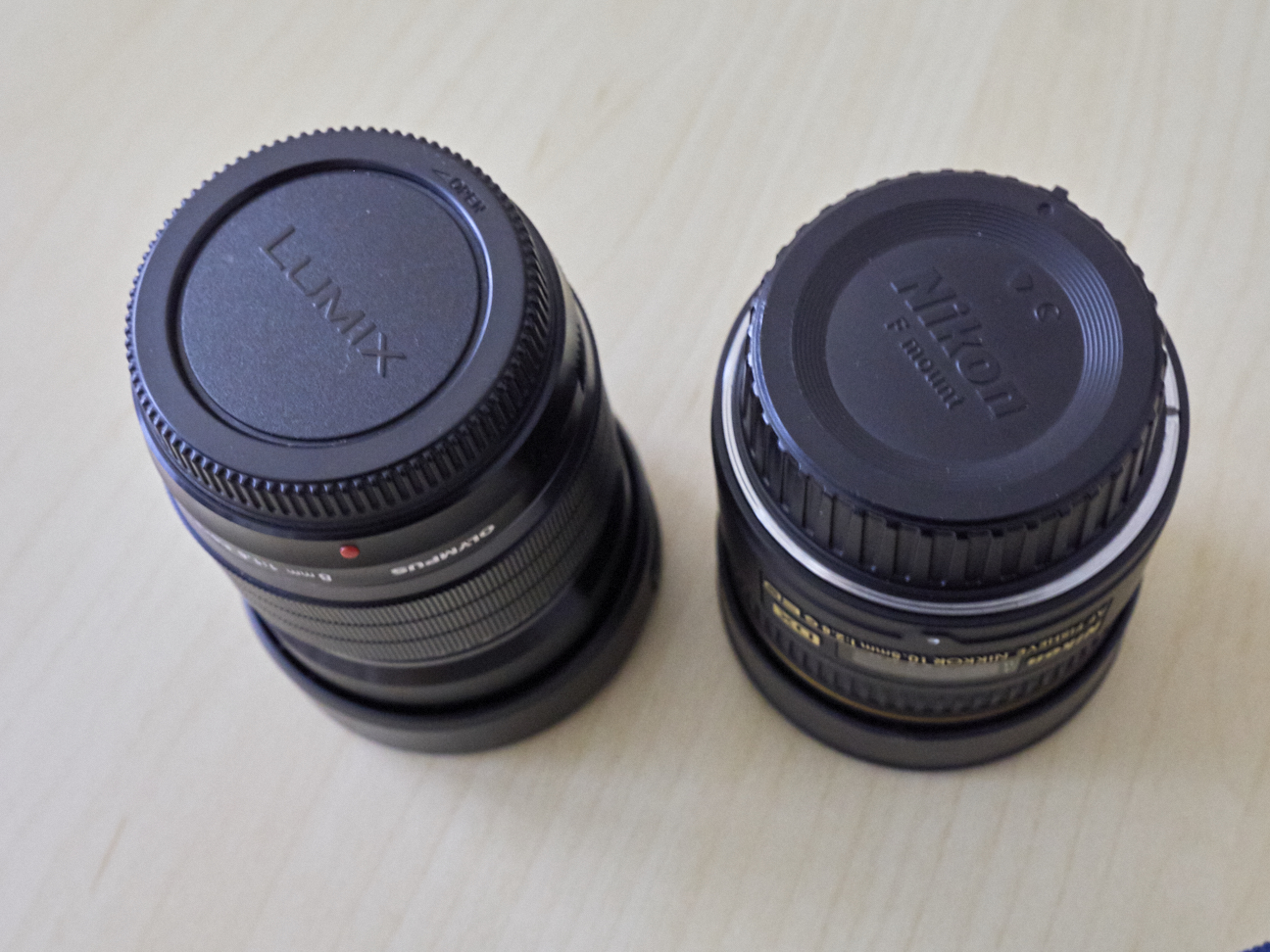
I have continued with the Panasonic S5 Mk II, which is 135 Format and heavier than I've had for a while.  That Olympus E-5 in the photo was rather heavy and so was the 35-100mm f/2.0.

Update 2024.12.01: I was thinking about how much has changed.  They were trying to find a good way to identify mirrorless camera systems. ILC, MILC, CSC, and more were used.  I remember going to a store in Dayton, Ohio.  I'd been to one of the same company's stores in Cincinnati, Ohio and they had a decent selection and no brand fanatics.  A salesperson greeted me and asked how she could help.  I said that I was looking for micro Four-Thirds equipment and she took me to the Sony equipment.  I said "no, I want to see micro Four-Thirds equipment.  Olympus and Panasonic are the brands." and she replied "It's all micro Four-Thirds." and I walked out of the store.

Many people back then couldn't differentiate between mirrorless cameras as a category and micro Four-Thirds as a sub-category since Panasonic and Olympus developed the idea and made it a reality.

Update 2025.05.01: Nikon has recently released the Z5 Mk II and the Z50 Mk II.  Both Nikon and Canon have come to the point with their mirrorless bodies that they feel as micro Four-Thirds felt in 2014.  Fujifilm has been there for years.  Pentax is still selling dSLRs.

Update 2025.10.31: Got a Panasonic G97, so that I can make use of my micro Four-Thirds lenses much better than I can with the GM5 because of IBIS.e 

Tuesday, September 20, 2016

Olympus E-M1 Mk II: Take my money now

I've been an Olympus user since around 1990, starting with an OM-1N.  I'd also had an IS-20DLX, D-300L (one of the first two Olympus digital cameras), C-2500L, E-1, E-5, and most recently, the E-M1.  I've shot a lot of high school sports with the E-1, E-5, and GH3 and skate park sports with the E-M1, Panasonic GH4, and GX8.

I attended an event to try a pre-production E-M1 and various lenses.  I wasn't happy with the compromise.  If you used the E-5 and was suddenly pushed to use the E-M1, you wouldn't be happy, either.  Thankfully, these things are optional.

The E-M1 has a tiny battery capacity--far less than the E-1/E-5's or GH3/GH4's capacity.  Add to that an electronic viewfinder that is always enabled, and the rear display that is accidentally activated too easily, and you have a requirement for several batteries per day.  I have 3 batteries for the E-M1 versus 2 batteries for the GH4.

The E-M1 Mk II has a larger capacity battery and a reworked grip, since that is where the battery resides.  (The external battery grip supposedly takes only one battery.)  This has a lot to do with 4K video recording but also with the enhanced auto focus processing.

The enhanced AF processing is important.  They're dedicating a quad core processor for auto focus.  They also claim 121 cross-type phase detection points and 121 contrast detection points.  That could help greatly.  Will that be as good as a dSLR?  Olympus will try to make it work.  I changed my methods to get focused shots, instead of depending on continuous/predictive AF and tracking that didn't really work.

On the other hand, Panasonic claimed that they didn't need phase detection pixels at all for the GH4, but their AF is a headache for me.  When I think I've got something in focus (sports don't slow down), I end up with something much larger in the background in focus far too often.

The E-M1 viewfinder was fairly good at 0.71x of 135 Format.  The Mark II viewfinder is supposedly sized at 1.48x and runs at 120 fps, which seems to be double the refresh rate.  The magnification is incredibly big, but the camera body isn't out and we may find that it isn't quite like that in real life.  Update: it's actually 0.74x apparently--slightly larger and/or more magnified than the original E-M1 viewfinder.

Increasing the mechanical shutter's maximum burst rate from 10 fps to 15 fps seems exceptional, but for me, the 200,000 shutter actuations (as good as the GH4) hits home.  I exceeded the 150,000 actuations with my E-M1 and had to have the shutter replaced.  At 10 fps, photos can be created very quickly and at 16MP, they take quite a bit of space.  At 15 fps and 20MP, that just makes things more intense.

The enhanced in-body image stabilization is rated at 5.5 stops, which allows the hi-rez 50 MP mode, good for still scenes.  Supposedly, the mode can handle some gentle motion.  Hopefully, it's as good as that of the latest Pentax bodies.

It looks like they've addressed most of my concerns, including the single SD Card slot, to make the E-M1 Mk II more like the E-5 successor that I expected three years earlier.  Then again, the E-5 was about 3 years late.

Of course, the Panasonic GH5 is equally compelling but for different reasons.  I wish I could replace my E-M1 and GH4 right now.

Update 2016.09.24: All of the previews I've seen so far seem as though the E-M1 Mk II is better than anything else near its size or specifications.  Don't put the marketingspeak in front of me, though.  I doubt salespeople from a company.  I'd love for it to be so amazing, but it has to work that way in my hands for me to believe it.

Update 2016.11.01: Okay, at US$1999.99, I'm not quite as ready.  If it had been $1699.99, as I had expected--E-1, E-5 price--it wouldn't have been quite as off-putting.

I'm sure that they can't get the image quality out of it that is worthy of that price.  That said, if I was still making money and needed one, I would pay for it at full price, perhaps with a little resentment.

Is the newer sensor with 121 AF points that good that it is worth the extra US$300?

Of course, I can just wait to see what happens--anyone can--and I believe at this price that a lot of anyones will be waiting to see.

Update 2016.11.10: I'm amused to see some comments about the body.  I swear that you could take photos from a Nikon D810, a Sony A7R Mk II, and a Canon 1Dx Mk II, crop them to a 4:3 ratio and some people would complain about the photos' quality because of the "tiny/toy sensor".

I suspect a lot of people know very little and judge only on hearsay.  Did Ansel Adams brag about the size of his film?

About 10 years ago, I asked people why they only considered Nikon or Canon--they responded with something like "oh, my mother's ex-roommate's brother's friend's uncle uses one." and I would laugh because they didn't try anything and they didn't research anything but it was "clearly the best".

A lot of the comments I see relate to slow and casual photography--flowers and such.  Yes, a used Sony A7 will probably outdo the E-M1 Mk II, with the correct lens.

However, working at 10 or 12 fps, micro Four-Thirds excels.  I will admit that my heart defect gets in the way now, but it's very easy to use the E-M1 or GH4 to get good, and occasionally great, skate park shots.   When I could move easily, there wasn't anything else that could keep up with me.  The speed of the focusing has a lot to do with it and the stepper motors used are often extremely fast, especially in the fixed maximum aperture lenses.  This also helps with video, of course.

From what I've seen of samples, the E-M1 Mk II outputs much better ISO 3200 shots--the maximum I use.  I tried the Nikon D7200 ISO 51,200 and 102,400 and they were useful in getting shots that I couldn't get any other way.  It looks like the E-M1 Mk II does a decent job at ISO 6400 but not enough that I would regularly use those photos.  However, other people have told me with the original E-M5 that they went all the way to ISO 12,800 and the output was fine.  YMMV.

As far as the Sony A7 Mk II goes, I see it like this: the A7 Mk II is great for photographing flowers but the E-M1 Mk II will be great for photographing flowers travelling on a lorry going 100 km/h.

Update 2016.11.19: I got to handle the E-M1 Mk II and 12-100mm f/4.0 lens today.

The lens was quite good--surprisingly good for an 8.3x superzoom.

Handling the E-M1 Mk II, I wasn't happy.  Yes, it has a bigger battery but the grip is not great, for me anyway.  The battery looked odd, as if it was pulled out of a dumpster and re-purposed.  I saw some comment that the grip looked misplaced on a retro-styled camera body.  I agree.  They should have gone with an E-1 or E-5 style body but they would have to introduce a 3rd line of micro Four-Thirds camera bodies.

Usage didn't seem any different, but there is more customization--such as swapping the power switch and the multi-function lever.

The dual card slot was on the far edge of the rear of the camera behind a door similar to the one in the current body.  It seemed an extreme position.

In fact, a lot of the E-M1 replacement looks as haphazard as the original--or any of the micro Four-Thirds Olympus models.  I have no idea what they're thinking.  I appreciate the internals though.  I still like the E-1 dSLR best but it was technologically out-of-step even two years after it was introduced and the company took too long to introduce a new flagship.

Actually, they can take my money for a lens instead.

Update 2016.11.30: The reviews are looking fairly good, as expected.  The nasty comments are also expected.  People with other systems aren't happy that Olympus gets a lot of attention.  They don't know anything of the 1970s when Olympus was bigger and better than Canon.

It's comforting to know that the C-AF mode can keep up.  I wouldn't be using it since I had already modified my technique years ago when I started using the Panasonic GH3.  Imaging Resource did a good job of working with the E-M1 Mk II, giving a little insight into actual use and the pitfalls.

Update 2017.02.13: Apparently, the E-M1 Mk II is very picky about UHS-II cards, not working with many of them.  Then again, I see posts about some cards being recalled.  There probably have been too many made with sub-standard components, in order to make extra profit.  That doesn't excuse Olympus for their failure to be compatible, though.

I've seen a lot of comments of how the E-M1 Mk II doesn't work as well as it should.  The production models don't seem to be as agreeable as the test models.  I can understand that.  Before the E-M1 was available, I was using some, with a group, and when I got mine, it seemed that things that had worked well on the pre-production versions weren't working so well on mine.  Firmware updates have solved a lot.

Update 2024.07.12: I never did get the E-M1 Mk II, but I'm looking at the E-M1 Mk III finally, as a good used camera body.  The True-Pic IX imaging processor should be much better than that of the version in the E-M1.  However, I'm also interested in the Panasonic G9, which is quite good.  Most of my equipment is gone and I only have a Panasonic GM5 at this point with a few lenses.

The interesting thing is that Nikon and Canon have gone mirrorless and they've been going through the same growing pains that Olympus and Panasonic endured.  Much of the industry is going mirrorless and it's much better for everyone, I suspect.

Thursday, May 26, 2016

Using the Olympus E-5 as an E-M1 substitute

I've been using Olympus equipment since 1990.  It always felt like the best combination of technologies came together.

I bought a couple of the early Olympus digital cameras and wasn't incredibly happy.  They worked but the time just wasn't right.  When I bought the E-1 in April 2004, nothing else felt right or seemed to produce the right photos, especially the Nikon and Canon alternatives in the price range.  I was annoyed about the 4:3 ratio that Olympus chose, but that mimicked 6x4.5 format cameras and I understood that.  It just didn't make sense to people using 3:2 ratio film.  Kodak may have been instrumental in pushing the shape, as they were in shaping Medium Format digital sensors.

I finally added the E-5 in 2011.  It wasn't the quantum leap forward I had hoped.  It seemed more like the Nikon D300 from 2007, instead of a body introduced in 2010.  It was better than the E-1 but not what I was hoping.  It worked better in so many ways but as I've already mentioned, it felt like a body from 2007.

Later, in 2012, I bought a Panasonic GH3 and 35-100mm f/2.8 lens.  It was somewhat better in lower light, with very good AF functionality down to EV -3 and later EV -4.  The ISO sensitivity seemed better but I suspect that the numbers weren't as accurate.

While waiting for the GH4 to replace it, I traded the GH3 for the E-M1.  I'd already used the E-M1 and it was better than okay, but didn't seem a replacement for the E-5, even though Olympus said that it was.

I've tried it with Four-Thirds lenses on occasion and stop fairly quickly.  It is more likely a easy way to re-use current components than to be a replacement for the E-5.  The size and the functionality is not oriented toward Four-Thirds equipment.  Having phase detect pixels was more a patch than a solution.

Yesterday, I wanted to photograph a graduation for a friend.  I brought the ZD 50-200mm f/2.8-3.5 which was my most-used lens.  I tried it with the E-M1 and this resulted in a lot of frustration.  It hunted and hunted and hunted.  I'd had more success with the E-M1 previously, and also with the GH4.  I retrieved my E-5 and it worked quite well.  So much for the E-M1's world's fastest AF--that doesn't apply to adapted lenses.  The E-5's predecessor was another with "world's fastest AF", but these things fade quickly, don't they?

75+ yards, not bad but dynamic range could be better

At the graduation, the E-5 was heavier but wonderful.  Sure, the older technology isn't quite as able to provide great photos I've been getting from newer sensors but getting the shot was important, especially from almost the other end of the football field, the 25 yard line.

I'm pleased to use the correct tool for the job.  Using equipment to advantage always helps.  It's just too bad we can't have a 16MP Sony sensor put into the E-5 to get the best of both worlds.

Wednesday, April 27, 2016

Nikon D7200 vs Panasonic GX8 vs Olympus E-M1 vs GH4

I consider the market for cameras between US$1000.00 and US$1999.99 to be the most active for active photographers.  Sure, there are people who take photos with equipment under US$1000.00 but many of them have one lens--the kit lens.  From my experience, they may take good photos but they don't really work their equipment.  I push my equipment past those limits, such as when I was out photographing in three hurricanes, or when I'm photographing at skate parks.

For many people US$1199.99 is a premium price point.  To me, it's roughly the minimum for a weather-sealed camera body.  True, you can get the Pentax K-50 still, and it is an excellent bargain at around US$400.  Even with the kit lens, it's a capable camera.  For me, the lenses I wanted weren't available for Pentax, and an adapter to use such lenses on micro Four-Thirds bodies wasn't all that capable.  I switched to the Nikon D7200, especially because it has two high ISO (51,200 and 102,400) sensitivities that work in a black & white mode.

Yes, my equipment must work in a variety of ways, especially when I'm photographing sports.

Since I bought my Olympus E-1 in 2004, I've had Four-Thirds equipment and now, those lenses can be used on my micro Four-Thirds bodies, the Olympus E-M1, Panasonic GH4, and now, Panasonic GX8.

That gives me four modern camera bodies:
  • Olympus E-M1
  • Panasonic GH4
  • Nikon D7200
  • Panasonic GX8

For reasons explained in the sections to follow, I rate them in the following order:

  1. Panasonic GH4
  2. Olympus E-M1
  3. Panasonic GX8
  4. Nikon D7200

Sure, you can get any of them to do general photography well, but when pushing the limits, this is how they work out for me:

Stills

For still photography, they're not as different as I had thought or had hoped.

By sheer physics and pixel density, the D7200 should be comfortably better with a larger sensor.  (I've been told for years that I couldn't work without a larger sensor.)  At this point, it isn't working out that way.  I suspect that Nikon needs to fix things with firmware.  e.g., photographing indoors at Woodward West (training camp and skate park), I found that the Panasonic GH4 was setting itself at ISO 200 and 400, while the D7200 was setting itself at ISO 14,400.  Image quality was degraded.  However, this is a very, very new body.  (Strangely, since using the Nikkor 10.5mm fisheye lens on the D7200, it seems to work better with all lenses.  Also, the firmware update didn't change much for me.  ISO 4000 is pretty much my usable limit in contrast to ISO 3200 for micro Four-Thirds with the GH4, E-M1, or GX8.)

In daylight, things are more equal.  The E-M1's face detection is amazing and for portrait work, I'm finding it and the Olympus 12-40mm f/2.8 amazing, even up against the D7200 and Sigma 18-35mm f/1.8 combination.  (Yes, I know that the Sigma and in general, larger lenses have the possibility to be better, but it isn't always so in real life.  I could get better results with the Olympus ZD 14-35mm f/2.0 though.)  In Live View, I believe that the D7200 can use face detection but Live View degrades performance greatly, and since the optical viewfinder is useless in this mode, you sort of have to use the D7200 as a heavy compact camera.  I would suggest a monopod or tripod.  This is the case with almost all dSLRs (the Olympus E-330 is the exception) but never the case with mirror-less bodies since they're always using Live View.

The GH4 could be great but I have trouble with the auto focus and face detection being slow and/or inaccurate.  I occasionally find when photographing people participating in sports that the focus is a bit off.  The GH4, like the GH3, will focus on a wall or fence behind a person, even though only a single focus point is selected, and focus has been locked supposedly with single point focus mode.  With face detection, it tends to work better, if I have time to wait.  The E-M1's face detection is much faster than that of the GH4.  Face detection on the GH4 and GX8 default to splatter mode using all AF points, if it doesn't lock onto a face.

The GX8 has similar auto focus behavior, quite naturally, although it seems somewhat improved and bit quicker.  I haven't noticed any degradation with the increased pixel density, nor is it noticeably better in any way, compared to the GH4 or E-M1.  I'm sure that you can measure the differences in a laboratory, but I don't photograph in a laboratory.

For Auto Focus consistency:
  1. E-M1
  2. D7200
  3. GX8
  4. GH4
However, there is more to photographing sports for me, anyway.  The camera must be responsive, comfortable, and keep up with the action.

The D7200 is a huge improvement over the D7100 in terms of the image buffer depth.  At 6 frames per second, the D7200 does fairly well.  Unfortunately, it's not enough for skate park shooting.  Also, a lot depends on the lenses, more than on micro Four-Thirds bodies, it seems.  I've been reminded that big glass takes time, but I had no problem working with the slower Olympus E-5 and SHG lenses with 77mm filter size.

Keeping up is only slightly easier with the GX8 and its 8 frames per second.  It is more responsive than the GH4 in some ways but overall, it is not quite as able to do the job.

The E-M1 is extremely responsive, and seems to anticipate my needs.  Equally, the GH4 single AF is predictive and looking ahead before I half-press the shutter release.

For overall stills shooting:
  1. E-M1
  2. GH4
  3. GX8
  4. D7200

Street shooting

For casual photographers who want to go out and just photograph street scenes, the E-M1 and GX8 would be great.  The GX8 and Leica/Panasonic 15mm f/1.7 lens are great together.  The in-body image stabilization of the GX8 should make it somewhat more effective than most Panasonic bodies, although I haven't seen much evidence of it yet.  I have also used the 15mm f/1.7 lens on the E-M1 and find it to be very useful.  I'm sure there are people who would prefer the less expensive Olympus 17mm f/1.8 but I believe the 15mm's image quality is excellent and it works well when I'm shooting video.

I've heard a lot of people complain that an articulated rear display, such as what the GX8 and GH4 have, is not very useful, probably because it draws too much attention.  (I question what people are doing that they need to remain hidden.)  The sliding display of the E-M1 is preferred by these people, apparently.  This is where the GX8's tilting EVF shows its advantage.  It's so easy to use and you don't have to have you eye placed so close to actually use it.  I don't use it so much but it can be extremely useful in brightly-lit conditions where the articulated or a sliding display would be engulfed in sunlight.

Obviously, the D7200 is too big to be inconspicuous but also the GH4 even though it isn't terribly big.  People are calling the GX8 huge, so possibly the world is full of small, male hands.

  1. E-M1
  2. GX8
  3. GH4
  4. D7200

Video

When video comes into play, the Panasonic bodies overwhelm the others.

While the D7200 is better than the D7100 is, it's still not as good as the Panasonic GH3 for video, let alone the GH4 or GX8.  The lens mount may count for more than the sensor size here.  There are a lot of lenses for Nikon, even if it you have to choose very carefully.  The lack of an articulated rear display really hampers use of the D7200 but it has more options than the E-M1.  If you're trying to get product shots with the D7200 on a tripod, you're set.  I think you'd do better with the D5500, and save money to use toward a macro lens.  At skate parks on a handle, either Nikon body would do fine but the D5500 has an articulated rear display but is limited to 1/4000th of a second shutter speed.

The E-M1 has been sufficient to record video but is not very good, nor very versatile.  It might as well be a point-and-shoot camera for video, even though the quality is sufficient.  Firmware version 4.0 has added some options making it less unsuitable for video, including image stabilization help.  The sliding rear display is not particularly helpful for video.  It might as well be a fixed display.

Perhaps obviously, with 4K video, the GX8 and the GH4 are good at video.  Panasonic seems to have given the video capabilities more work than those for still photography.   I appreciate that I can use 1080p clips from both and they match very well.  I have yet to make real use of 4K video.  4K TVs have yet to make real use of 4K video--except for the demos they display in stores.  I've had my latest 1080p skate park video displayed on 4K TVs at an electronics store and it looked good.  Sony's upscaling worked the smoothest, over Samsung and LG.  When I've taken 4K video for testing, it tends to overwhelm the TV's processors.

The Panasonic video options are amazing, and cater to the video professional/film maker.  After months with the D7200, I have not even tried Live View mode, so I have not tried video.  It has some updates to help it do video better than the D7100 did.  Since I can't look through the viewfinder to see the video being recorded and I can't tilt the rear display, the D7200 is useless to me for video.  The D5500 would be more useful for video than the D7200, as the display is articulated.  However, these are typical problems with using dSLRs for video, instead of mirrorless models.

  1. GH4
  2. GX8
  3. E-M1
  4. D7200

Battery Life

I would hope that mirror-less models would have more battery capacity than dSLRs but that hasn't been the case for me.  The D7200 has a 1900 mAh battery and the GH4, a 1860 mAh battery.  The GX8 and E-M1 each have batteries around 1200 mAh.  Needless to say, I have 3 batteries each for the GX8 and E-M1, with 2 each for the D7200 and GH4.

For stills, I've shot several hours on the GH4 with one battery, but it doesn't last quite so long with video.  I'm sure that the D7200 should last the longest for stills.  Using the Olympus E-1 during wrestling tournaments, 4 1500 mAh batteries would handle a 14 hour day.  The E-5 uses similar batteries and I've never had a serious problem with battery life.

The E-M1 seems to want to turn on the rear display for almost anything, which is possibly the reason that the battery can be depleted so quickly.  The 5 axis image stabilization probably contributes quite a bit as well, as the loss in converting electrical energy to motion is higher than it should be.  The GX8 hasn't shown me that it is great on battery life, even though the rear display can be hidden.

  1. D7200
  2. GH4
  3. GX8
  4. E-M1

Viewfinder/Rear Display

I love an optical viewfinder.  I never thought I'd be able to use some electronic thingee instead.  When I got the Panasonic GH3, I didn't feel much different about EVFs.  The EVF in the GH3 isn't awful, but the EVF in concert with the eye cup didn't work well for me.  Then, I traded it for the E-M1.

The Olympus E-M1, FujiFilm X-T1, and Panasonic GH4 can all claim the greatest EVF title.  They're big, bright, and useful.  The X-T1's EVF rearranges the information in portrait mode, which could be helpful.  I like the X-T1 a lot, but it isn't right for me, shooting sports and all.  The GX8 has apparently been given the GH4 viewfinder, which is a big step up from the GX7 and the rainbow tearing effect.

For me, the E-M1, GH4, and GX8 have viewfinders that make daytime use great and nighttime use better than an optical viewfinder can provide.  It's also good to have a preview of the photo where you don't have to guess much as to the result.

Even when auto focus doesn't lock to a target, you can see fairly well.  Naturally, refresh time is degraded at night but it works well enough.  Version 4.0 of the E-M1 firmware has a simulated optical viewfinder mode.  I haven't really tested this new mode but I suspect it speeds up processing by not having to represent a realistic preview.

 I suppose being able to get the most out of an optical viewfinder is using your experience to extrapolate from what you see to the final photo.  Using the Olympus E-1 and E-5, I was able to get what I wanted from the photo with only an optical viewfinder.  The D7200's viewfinder is very good and if you really need more, you can switch to Live View using the fixed rear display.  However, you have to be patient with Live View.  Even with the E-5, patience was required and Olympus, along with Panasonic made Live View a big deal.  The E-330 worked better because it had two sensors to keep Live View quick.

As I've mentioned, the GX8 and GH4 have articulated displays, which are very useful in architectural shooting and even when you need to check the image when the camera is on the tripod, as the display can be folded out and completely reversed.  The E-M1's rear display slides down and slides up, making it possible to shoot from low angles or over crowds.

GX8
GH4
E-M1
D7200

Settings

Here is another point where the old ways don't really work.  For a few years, Olympus has been using an interactive settings display called Super Control Panel.  On the E-5 (from 2010), it was an easy way to switch ISO sensitivity, White Balance, Auto Focus, Burst Mode, even the card slot.

The D7200 has an informational display on the rear display.  You can see but you cannot touch--there is no interaction.  For someone unaccustomed to the menu system, forget about making quick adjustments without a well-traveled mentor at your side.

The Super Control Panel on the E-M1 is very useful.  The Quick Menu on the Panasonic bodies is useful but takes some acclimation with the up/down motion to select items to be changed.

I know that people complain about Olympus' (so many little gear selections!) menus, and they have become much more complex since the E-1 but every company seems to have complex and/or confusing menus.  I can say, as a new digital Nikon user, that I have been confused by the menus, even with help from searching the manual.  Had Nikon implemented an interactive settings display, it would have helped greatly to expedite changes.  Looking at the now available D500, things should be sped up by replacing the mode dial with ISO and other buttons, so you don't have to negotiate the multiple, near identical buttons to the left of the rear display.
  1. E-M1
  2. GH4
  3. GX8
  4. D7200

Ease of use

Having used Olympus products since the days of film, it's difficult to believe that I reach for a Panasonic product first.

In my opinion, the GH4 is a better successor to the Olympus E-5 than the E-M1 is.  The controls work the way I expect, for the most part from the start.  Of course, things were set with the GH3.  The GH4 makes a big difference by omitting a top panel display but having a mode dial, a drive dial, and various buttons for settings such as exposure compensation.  This is all rather convenient and works quickly in practice.  Something else that makes the GH4 (and GX8) quick are three physical spots on the command dial for custom settings and the C3 spot includes a total of three settings.  The only problem is that I forget about the drive dial to the left of the EVF.  If they had combined the mode and drive dials in a stack, it would have been useful.

The E-M1 has a mode dial but there are no positions for custom settings.  There are buttons for HDR, drive mode, auto focus, and exposure mode on the top plate.  There is also a button for the exposure curve and another for video recording.  Unfortunately, the E-M1 is never quite that intuitive.  The first time I tried one, I spent a lot of time trying to change exposure compensation back to zero.  The front dial is set to exposure compensation by default, which is totally different than the E-5--not a good thing to do with the replacement.

The GX8 seems sparse on the top panel.  It has a mode dial like that of the GH4 with an extra position for panoramic photos.  There is an extra dial below the command dial for exposure compensation, probably to appeal to FujiFilm users who find the X-T1 so interesting.  The lack of the GH4's rear wheel makes the replacement more point-and-shoot camera like that I would have expected.  The four buttons have separate functions, which is useful.

The D7200 has a mode dial to the left of the viewfinder, along with a drive dial below the command dial.  The command dial has two positions for custom settings.  Strangely, like the other three, there is a full automatic position on the command dial, along with Scene and Effects.  Do the users labeled Enthusiasts use these sorts of modes?  There are also buttons for exposure compensation, exposure mode, and video recording on the top panel, but they are out of the way of the top display.  The auto focus controls are at the bottom of the lens mount collar.

Thankfully, the custom settings positions on the command dial helps switch a lot of settings quickly.  While the E-M1 has no such positions on the command dial, they have a two way switch on the back that allows the buttons to take on different meanings.

While the E-M1 is easiest to make a lot of changes quickly through the Super Control Panel, if I want to change to manual focus with an Olympus lens, I reach for a physical switch that isn't there.  Someone will question this, as many Olympus lenses have the push-pull clutch AF/MF mechanism, but with the 8mm fisheye lens, there is no such physical switch.

The GH4 is the body closest to perfection.  It isn't horribly small and there are plenty of physical buttons and switches.  I get a lot done and it works well with longer lenses, even those not intended for the micro Four-Thirds system.  I've found that I can even work the video recording button while wearing gloves.

The GX8 isn't quite as intuitive, but it shares a lot of great traits with the GH4.  Unfortunately, the video recording button is tiny and difficult, even without gloves.  The most serious problem with using the GX8 is the location of the SD Card slot, next to the battery.  It isn't made for my fingers.  however, the GX8 can take a 128 GB card, rather than the 64 GB card that the GH4 can handle.

I like the D7200 a lot.  It's big enough to balance some very big lenses.  The top panel LCD makes checking settings very easy.  The dual SD Card slots mean that I can keep shooting, rather than scrambling for another card in my bag, although the larger files tend to balance that a bit.  I suspect if I was still photographing high school sports for 14 hours in a day, I would be pleased to use the D7200, especially since the battery has so much capacity.  The D7200 is a wonderful workhorse.  If you have everything set and don't need to make changes often, it is a desirable body.  It is not easy to change settings, but it is made for a lot of work when you're ready

GH4
E-M1
GX8
D7200

Conclusion

If these bodies didn't work for me, I wouldn't have any of them.  Switching between them during a shoot can be interesting.

The D7200 is a great tool for landscape work (compared to micro Four-Thirds) with 14-bit raw files for extra dynamic range and a larger sensor for wider work.  While the body is somewhat big and weather-sealed, the construction does not feel as strong as the others.  I've bought an Easy Cover silicone case to protect the body from bumps, since it doesn't seem as strong as the others.  The body doesn't seem to work as well as the others when there isn't much light.

The GX8 is a great second video body.  It is big enough to be comfortable but could use better battery capacity.  The promise of Dual Image Stabilization will eventually make it formidable.  Having 4K video puts it ahead of other bodies around its price.  Being able to easily mix video with video from the GH4 makes it extremely useful.  The lack of numbers on the function buttons makes setup interesting.

The E-M1 is a very good stills body.  Face detection makes it quick for portraits and sports.  The 5-axis image stabilization makes any lens better at twilight.  If Olympus implements Dual Image Stabilization, it will be even more powerful.  Battery life is a serious problem and the camera's grip isn't comfortable to me.  While it is a stop gap compromise to replace the E-5, to me, it's more compromise than replacement.  If you ignore its ability to work with Four-Thirds lenses, it becomes a much better solution, though I'm still not sure about micro Four-Thirds lenses.

The GH4 is slightly small compared to dSLRs, but still comfortable.  I almost don't have to think to use it.  It's rare that I have to stop to make changes.  I can switch between stills and video quickly, especially with 4K photo mode.  As with the GX8, the video versatility is a lesson to other brands.  Of course, the GH4 exceeds the GX8 by quite a bit in versatility, covering many bit rates.

Alternatives are available, such as the FujiFilm X-T1 and Pentax K-3 Mk II.  For me, the X-T1 is too slow to respond for skate park sports.  I considered the K-3 Mk II but while I had the K-50, I couldn't get the lenses I wanted.  Pentax is working on that.

Update 2016.07.21: I gave away the Nikon D7200 and associated equipment, including four lenses.  It was good equipment but it wasn't for me, even though I used to love using a dSLR.

Right now, if I wanted to replace it with a similar sensor, I'd order the FujiFilm X-T2 and a lens or two.  For the sake of reality, I didn't see enough difference from 24MP and APS-C to make me think that it would be necessary.  Where I limit my micro Four-Thirds photos to ISO 3200, I limited my D7200 photos to ISO 4000.  You might make it to ISO 6400 with the Nikon D500, but I would be skeptical.

The Pentax K-1 might be a useful alternative, but finding lenses that take advantage of the body at this moment is a difficult process.  The K-mount has been around since the late 1970s, when I was selling equipment, but the lenses didn't really distinguish themselves back then.  The standouts were Nikon and Olympus, at least, using 135 Format film.  FujiFilm, as Fujica, had a good showing with screw-mount lenses but switched to the K-mount with the AZ-1.

I'd still like to see a Panasonic body with Olympus' AF, including Face Detection.  I still find the GH4 to be an amazing camera body with so much value in a small package.

Thursday, March 31, 2016

Nikon 10.5mm f/2.8 fisheye lens versus Olympus 8mm f/1.8 fisheye lens

I'm doing a quick entry here to start.  I just received a Nikkor 10.5mm f/2.8 DX format lens.  It's a used lens that was originally owned by LensRentals.com and sold by their liquidation division.

Buying a Nikon D7200 was mostly an experiment in order to get wider angle landscape shots more easily.  I've done that with the Tokina 11-16mm f/2.8 and Sigma 18-35mm f/1.8 lenses.  These are not particularly responsive lenses and from the start, they've made the D7200 feel unresponsive, especially for someone who photographs sports 99% of the time.  As I've slowed down because of my heart defect, I've been able to do more creative shots.  Still, I pick up the Olympus E-M1 and 8mm f/1.8 fisheye lens because of the difference in light gathering.

Oh, wait!  APS-C versus micro Four-Thirds can't even be close.  Well, I'm finding that real life is much different than examining a bunch of numbers and graphs.  People who don't shoot much have been telling me how much greater APS-C is.  The big difference I see between my GH4, GX8, E-M1 and the Nikon D7200 is that the Nikon body can record raw files with 14-bit depth rather than 12 bits.  Automagically, that increased the possibility of better dynamic range, color, and more.  Whether there is actually more is the real question.  I assume that there is.  Nikon has been good about wanting to deliver the best image quality.

In any case, I received the Nikkor lens about an hour ago and had lunch first, to give me some time to think.

To a certain extent, the difference in maximum aperture is offset by the higher ISO usability.  So far, I've found a maximum ISO sensitivity of ISO 4000 with the D7200 versus ISO 3200 for micro Four-Thirds.  Yes, you can go much higher and get something but for photographing sports, I have to be more careful.  Once it's fairly dark, neither is going to be okay without extra lighting.  However, auto focus on the D7200 goes down to EV -3 and the GH4 and GX8 goes down to EV -4.  I can't find a figure for the E-M1 but it has been decent in very low light, although it thinks a lot at that point.

Taking the Nikkor lens out of the box and wrapping, I was surprised how utterly small it is for a dSLR lens.  It's not much bigger than the Olympus micro Four-Thirds fisheye lens.  Yes, it's a DX format lens, so it can be smaller.  The best thing is that it can be used on the FX format camera bodies in DX mode.  (However, without weather-sealing and with a smaller maximum aperture, it isn't a surprise than the Nikkor lens is small.  If it had similar attributes, it would be much larger.)

Olympus 8mm f/1.8 versus Nikkor 10.5mm f/2.8 DX

Olympus 8mm f/1.8 versus Nikkor 10.5mm f/2.8 DX

As with all Nikkor lenses, I struggle to figure out which lenses are weather-sealed.  At full price of roughly US$775, I would expect that it would be.  That doesn't mean that it is, and from the description in the listing, I would say that it is not.  They mentioned some dust inside the lens--that did not affect image quality.  I've never had such a problem with my Olympus lenses, even though I'd used them out in hurricanes and in dusty conditions--severe circumstances.  Hopefully, the lens won't have a problem in bad weather.  I'm already hiding the lenses I have for the D7200 unless it is completely dry.  None of them are weather-sealed.

E-M1/Olympus 8mm f/1.8 versus D7200/10.5mm f/2.8

It looks a bit small on the D7200.  I suppose the small size was important to get it onto the D3300.

Hopefully, I'll be out shortly to actually shoot with it.

Nikkor 10.5mm on D7200
Olympus 8mm on E-M1
They both do very well.  I had to change the Nikon photo's white balance, probably because I'm still having new user problems.

Speed of operation is about as good as you can get on the D7200.  The E-M1 is just amazingly quick and much faster than the D7200.  It's not just 10 fps versus 6 fps burst mode but the fact that the E-M1 only has to deal with 16 MP, 12-bit files and the D7200 has 24MP, 14-bit files.  I thought that the Expeed 4 class processor would be much faster, though.

Update 2016.04.01: I'm pleased to say that the Nikkor fisheye lens seems to work quite well, even though it was sold as used.

I've found the problem with the white balance control, but geez, what a maze to find it!  Olympus' Super Control Panel is amazingly helpful.  Even Panasonic's Quick Menu is more effective than the D7200's informational panel.  Perhaps, the D500 without a mode dial would be more efficient without looking at the display, but the D7200 way is not working as well as I would like.

As far as I'm concerned, Nikon has technological advantages over Canon, but Nikon is behind everyone else for user interfaces for quick adjustments.  I've heard that Olympus' menus are the worst but my experience is that all brands have crap for menus.

Back to the fisheye lenses, I haven't done extensive testing yet, but it would be a good assumption that I can use the Olympus combination much longer into the dark and still get sharp photos.  I may test the Nikon combination tonight to see if it will actually focus down to EV -3 or thereabouts.   My previous experiences with the Sigma 18-35mm f/1.8 ended in failure.

Looking a bit closer, there is fringing.


Nikon
Olympus
The Olympus combination shows less fringing, but I wonder if there is software correction affecting the outcome, since micro Four-Thirds bodies fix things too often.  I suppose I'll try to put it in the GH4 or GX8 to see what happens.  I'm usually too busy shooting to test.

Sunday, February 7, 2016

Enhancing photos: How much is too much?

I'm a person who likes the truth.  What I photograph is what was there.  I don't add things to enhance the image.  I don't go for tricks, though I probably did that when i started.

While the Nikon D7200 has 14-bit raw files, I'm not sure whether the image quality and dynamic range actually have a huge advantage over micro Four-Thirds bodies in real life.

So, with all that in mind, the following photo has been enhanced by Macphun's Intensify application for Macs.


I'm not sure how I feel about the over the top enhancement, but it conveys what I was feeling, even though it is too much.


Tried this again, via Styles in Phase One to give an older, film look to the photo.  It's not bad, but I'm not sure how I feel about the manipulation.

Update 2017.01.01: I'm still messing with Macphun products, including their new raw development environment Luminar.

Original photo

Using Blue Sky filter

I have to experiment a lot but some of these filters, techniques provide useful results, allowing the viewer to see what is often hidden.

Monday, February 1, 2016

Is a mirror-less body's viewfinder placement that important?

I've seen a huge number of comments about rangefinder-like placement versus SLR-like placement of the viewfinder.  Many turn to heated arguments, for reasons unknown to me.  I suspect that it has to do with a person's original comfort (warm and fuzzy?) zone.

I've used a bit of everything but I eventually used SLRs more than anything else.  The only time I was truly uncomfortable was using a point-and-shoot camera where you look through a blank viewfinder and hope that what you want will be in focus.

To this day, I don't care for working with the rear display of a modern digital camera, when a proper viewfinder and focusing mechanism is available.

I use the following camera bodies:

  • Olympus E-1
  • Olympus E-5
  • Olympus E-M1
  • Panasonic GH4
  • Nikon D7200
  • Panasonic GX8

I had the Panasonic GH3 as my first micro Four-Thirds camera body and later, traded it for the E-M1 to ensure the trade-in value didn't drop when the GH4 was available.

For the most part, the only difference working with the bodies is whether I use an optical viewfinder or an EVF (electronic viewfinder).  In good light, I appreciate the optical viewfinder but in the dark, any EVF is more helpful, even when the refresh rate drops.

I agreed when someone mentioned the nose up against the rear of the camera being inconvenient.  It seems as though I have changed settings on the E-M1 because there is no cover over the rear display.  Beyond that, I don't see an advantage to one position over the other.

I use the E-M1, GH4, and GX8 almost daily.  Sometimes, I use two of them together.  As far as I'm concerned, they're just camera bodies--tools, weapons, as people say.  I suppose I'm very different than most.

On the GX8, I find the tilt more important than the placement, which is a strong reason as to why I bought it.  There are times when I must tilt the rear display and with the bright sun, I can't see much of anything.  The tilting EVF works very, very well.  I find it interesting that the people who like the tilting EVF hate the articulated rear display.  I appreciate being able to set the display to all sorts of angles to take architectural photos or skate park video.

I suppose my only warm-and-fuzzy preference is to have a viewfinder that actually helps me focus.

Wednesday, December 2, 2015

Got the Panasonic 25mm f/1.7 for US$99.00

Recently, Adorama and others had offered the Panasonic 25mm f/1.7 lens at a huge US$150.00 discount.  This is a lens that is priced at US$249.00 normally, which is already US$100 cheaper than the Olympus 25mm f/1.8 lens and quite a bit cheaper than the Panasonic/Leica 25mm f/1.4 lens and less than 25% of the Four-Thirds Leica-designed 25mm f/1.4 lens.  The box is about the same size as that Four-Thirds 25mm f/1.4 lens.
25mm f/1.7 box with Four-Thirds 25mm f/1.4

25mm f/1.7 is much smaller than Four-Thirds 25mm f/1.4

Curiously, there is a decoration ring included, somewhat like the Panasonic/Leica 15mm f/1.7 lens.  Unlike that lens, there is only one front lens cap, but you must remove the decoration ring to use the lens hood.  The lens hood is reversible, so you can store it on the lens.  The build is typically plastic but it doesn't feel so cheap.  The metal mount is a good thing.

I first mounted the lens to my Olympus E-M1 with firmware version 4.0 and it didn't seem happy with the lens.  It was slow to focus and take a shot, not so different from the way the Panasonic 35-100mm f/2.8 lens works on the E-M1.  The 10 frames per second burst mode seems more like 3 fps with each lens.

Mounting it to the Panasonic GX8, it seems quick and fully functional.

I need to get it outside to determine color and sharpness but I hope it's better than a US$99.00 lens should be, even though I don't expect a lot.  At this price, it's fine.  I wonder if I would have been happy with it at US$249.00.

If I need a sharper 25mm lens, I can use my Four-Thirds Leica/Panasonic lens, which is amazing any day.  Using the adapter, it is possibly faster on the E-M1 than it is on the Olympus E-5, which is not always the case with many of my Four-Thirds lenses on the E-M1.


The Panasonic 25mm f/1.7 and Leica/Panasonic 25mm f/1.4
Panasonic/Leica 15mm f/1.7 and Leica/Panasonic 25mm f/1.4

Update 2015.12.04: My first outdoor experience using the lens was at a skate park after dark.  While the skate park has lights and seems to be well lit, the camera doesn't see it that way.

Looking closely, barely any of this is in focus

I used the Panasonic/Leica 15mm f/1.7 for quite a while and it seemed fine.  We went to eat and on return, I took the 25mm f/1.7 and mounted it to the GX8.  It was responsive but practically nothing was in focus.  Without using it side-by-side with the 15mm f/1.7, I'll guess that the extra darkness played with the ability to focus, even though the GX8's AF works down to EV -4.  I took a couple of very still (no movement whatsoever) shots at the end and was disappointed.  Time will tell.  (Using it on the GX8 might not be fair since it's so new also but the GX8 is much better with other lenses.)

Update 2015.12.05: Using the lens on the Olympus E-M1 gave quite different results but this is, naturally, inconclusive.  More experience is necessary to see how the lens behaves.


100% magnification of the lamp


It looks good enough, very different from the previous evening at about the same time.  As I try it more, I hope it will justify its purchase.


Available light only, it did quite well

Update 2015.12.10: I got more photos out in the dark on the 6th and it seemed okay.  Everything was handheld with the Olympus E-M1.  I need to try it again with the Panasonic GX8 and for the first time with the GH4--without any image stabilization to see the results.

I've noticed something odd.  This is the only lens I've used with Phase One Capture One Pro that doesn't always report its characteristics such as focal length.

Update 2016.01.02: I used the lens with a wide angle/macro converter and it worked well enough.  Capture One Pro reported the combination as 15mm, which is an easy, inexpensive way to get a bit of a wide angle, if you're willing to put up with somewhat significant distortion.

25mm and wide angle converter

25mm f/1.7 by itself

GX8 panorama with 25mm and wide angle converter

For people who like tiny photographic equipment, it should be good with Olympus' 5-axis image stabilization.  The GX8's inbuilt image stabilization doesn't seem quite ready but I have steady hands.  I'm not sure why, but the IS indicator showed that there was no IS with the 25mm f/1.7.  (Yes, I know that the 25mm f/1.7 lens has no OIS.)  As with the lack of information in Capture One Pro, it seems as though the 25mm lens may need a firmware update or two.

25mm f/1.7 on GX8

Olympus 8mm f/1.8 fisheye on E-M1

Update 2016.02.17: I was surprised at how well the lens did yesterday during sunset.  I mounted the 25mm on the GX8 and also used the Olympus E-M1 with the 8mm f/1.8 fisheye lens.  If there was any lens flare, the GX8 must have extinguished it in firmware.

Update 2016.07.04: I was waiting for someone, and walking around a little town taking a few photos with the 25mm f/1.7 and Panasonic GM5.  It seemed okay but not quite as resistant to some ugly results.


Update 2016.07.30: I keep finding odd situations where the 25mm just will not focus properly with Panasonic bodies--I have three of them.  It still seems fine with the E-M1.  I'm not sure why the GX8, GM5, or GH4 would have problems with it.  It seems less of a problem with the GH4.  Could this be shutter shock, not a focusing problem when everything looks steady?

Update 2016.09.29: The new Olympus 25mm f/1.2 has been announced.  There are arguments all over the place, from the usual "it's an f/2.4 lens" to "it's too big and expensive for micro Four-Thirds.

Having the Leica-designed Four-Thirds f/1.4 lens, I don't feel much of a need.  It would be great to have a weather-resistant lens but it's not imperative to have, unless California's drought goes away soon.

There is a Panasonic/Leica 12mm f/1.4 that is weather-resistant and seems to fill a need for a wider lens.  At US$1299.99 (US$100 more than the 25mm f/1.2), it's somewhat expensive but fills a need for someone who can't use a zoom lens at night because of the f/2.8 maximum aperture.

For most micro Four-Thirds users, it seems as though economical lenses make sense.  In my case, I've spent my money on fixed maximum aperture zoom lenses with an exception here or there.  They do a good job, until sunset passes.  The few fixed focal length lenses I have sometimes help but in sports, I find them too inflexible, as I just can't get closer to the scene.

Anyway, there are so many native 25mm lenses available for micro Four-Thirds that anyone should be happy.  Add to those a few with a passive mount and you're set for normal view shooting.

Update 2024.10.19: During 2016, I gave away the Panasonic GX8 and the 25mm f/1.7 lens.  I wasn't happy with either and I was tired of the frustration.  The person who got it didn't have any equipment and did fine when I lent him a camera for photographing a baseball game.

Back in late 2021, I bought the Olympus 25mm f/1.8, refurbished for US$249.99, I believe, and it's been quite good.  It works better on the GM5 than the Panasonic lens ever did.

I recently got the Panasonic S5 Mk II with 20-60mm f/3.5-5.6 and 50mm f/1.8.  That nifty fifty is about as large as the GM5 and a 25mm f/1.8 lens.

Sunday, October 18, 2015

Four-Thirds and micro Four-Thirds family portrait

I've been working with serious digital equipment since 2004 when I bought an Olympus E-1, ZD 14-54mm f/2.8-3.5, and ZD 50-200mm f/2.8-3.5, and it at times has been a struggle.

Today, as you'll see, I have a lot more equipment, having added micro Four-Thirds equipment from both Olympus and Panasonic.  I also have the latest APS-C based dSLR from Nikon, the D7200.

I'm quite pleased to say that the E-1 is still working and the initial lenses are quite useful, especially after photographing out in three hurricanes.  The specifications of the E-1 aren't great for 2015, but there was some concern about the E-1 from the beginning anyway.  It worked just fine.

As of now, my equipment lists are as follows:

Four-Thirds

  • Olympus E-1
  • Olympus E-5
  • Olympus HG 14-54mm f/2.8-3.5
  • Olympus HG 50-200mm f/2.8-3.5
  • Olympus HG 50mm f/2.0 macro
  • Olympus SHG 14-35mm f/2.0
  • Olympus SHG 35-100mm f/2.0
  • Leica/Panasonic 25mm f/1.4

micro Four-Thirds

  • Olympus E-M1
  • Panasonic GH4
  • Panasonic GX8
  • Panasonic 35-100mm f/2.8
  • Olympus 12-40mm f/2.8
  • Panasonic/Leica 15mm f/1.7
  • Olympus 8mm f/1.8 fisheye
  • Panasonic 12-35mm f/2.8
  • Panasonic 25mm f/1.7

Of course, the Four-Thirds lenses can be used with the Olympus MMF-3 adapter, which is also weather-sealed to match the Olympus ZD HG (high grade) and SHG (super high grade) lenses.

There was a flirtation with the Panasonic GH3, and I got the MMF-3 because there just weren't many native mount high quality lenses, and I wasn't exactly thrilled with thrilled with the 35-100mm f/2.8 lens.  Truly, the 35-100mm f/2.8 seems to have been the product of another, lesser company, even differing from the Panasonic 12-35mm f/2.8 lens.  The GH3 is technically great equipment.  It was just a pain for me to use, especially with sunglasses.  The GH4 changes most of that and improves and expands the video capabilities.  I pull out the GH4 first.

Most of my video work has been done with the Olympus 12-40mm f/2.8 lens on the GH4.  This is not a stabilized lens and it isn't on a stabilized body, but I've done well with the combination.  I've not had much success with the 35-100mm f/2.8 lens but used it at a recent skate park competition and it was sufficient.  (At a previous competition, the video is practically bouncing, after the latest lens firmware update.)  The 12-35mm f/2.8 works well enough but that extra 5mm of reach with the Olympus lens makes a huge difference.  You can tell me that 24-70mm f/2.8 is sufficient on a 135 Format camera, but when it comes to video, it isn't.  A 3x or 4x zoom would do wonders here, even if it didn't have a constant maximum aperture.  The Panasonic-designed 15mm f/1.7, approved by Leica to wear its name, has been good, even in the dark and the Olympus 8mm f/1.8 fisheye lens has been useful in such conditions.

Four-Thirds behind micro Four-Thirds


Even though the Panasonic GH4 may seem large, it's smaller than the Olympus E-1, which was right-sized, for me, at least.  The grips of the dSLRs and the GH4 are very good, while the E-M1 is uncomfortable and the GX8 is good.  The E-M1 is dwarfed by both dSLRs.

Each of the bodies is weather-sealed, and most of the lenses are, also.  This apparently added bulk (as did the heat handling) to the GX8 over the GX7, but the handling is better with the size increase though the battery power is not.

One of the dSLRs and two of the MILCs (mirror-less interchangeable lens cameras) have sensor-based image stabilization, and the GX8 has the Dual I.S. to coordinate with the lens' OIS, when available.  I wish Panasonic added Power OIS to the 15mm f/1.7 for better work in bad lighting.  The new 42.5mm f/1.7 has it.  I'm still looking for great lenses and haven't found any for micro Four-Thirds, but these will do, and the MMF-3 will allow me to use the ZD 14-35mm f/2.0 and 35-100mm f/2.0 when necessary.

Batteries: Nikon D7200, E-M1, GX8, GH4, E-5

The E-M1 and GX8 batteries at 1220 mAh each and the GH4's battery has 1860 mAh of capacity.  The E-1 battery has 1500 mAh and the E-5 battery, 1620 mAh.  For comparison, the diminutive D7200 battery can hold 1900 mAh.

The GH4, like the GH3 can last quite a long time, and I only have two batteries, one I used to use on the GH3.  For the E-M1, I have three batteries, and I've got two for the GX8.  The E-5 batteries last quite a long time, probably because there is no electronic viewfinder.

Strangely, having got the Nikon D7200, I'm still finding the micro Four-Thirds equipment quite useful while learning the digital Nikon way of doing things.  People have commented in the past that using Canon or Nikon equipment was the only way to go.  There are advantages, but I haven't experienced any of them yet. Since the sensor of the D7200 has a similar pixel density to the 16MP sensors in the GH4 and E-M1, I couldn't expect much better image quality.

If Panasonic could work with Olympus to implement Olympus' auto focus and face recognition for stills, it would be a huge improvement to still photography in the GH4.  Adding their 5-axis image stabilization would be difficult, given the heat dissipating orientation of the body for video.  They'd probably have to increase the size of the body to make it all work safely.  This would make the resulting camera body practically perfect, for me, anyway.

Update 2015.11.22: I saw an amazing deal on the new Panasonic 25mm f/1.7 lens for US$99.00, which seems to be US$150.00 off the regular price.  Regardless of what I might think of the lens at full price, it's quite good at the discounted price, I hope.  I am a little skeptical.  I had the Panasonic 45-200mm f/4.0-5.6 at one time and I got that at the same price.  I didn't have much luck with it, and gave it away.  However, Panasonic has been doing better, at all levels.

Update 2015.12.02: The Panasonic 25mm f/1.7 isn't bad, especially for US$99.00.  It works quickly on the GX8 but not so quickly on the E-M1, and I have yet to mount it to the GH4.

As I have the Leica-designed Four-Thirds 25mm f/1.4 that was important to the Leica Digilux 3, but also for the Panasonic DMC-L1 and Olympus E-330, I have an amazing quality normal lens.  Risking a US$1199.99 lens in the rain isn't a good idea but the 25mm f/1.7 lens at US$249.00 might not be as much of a risk.