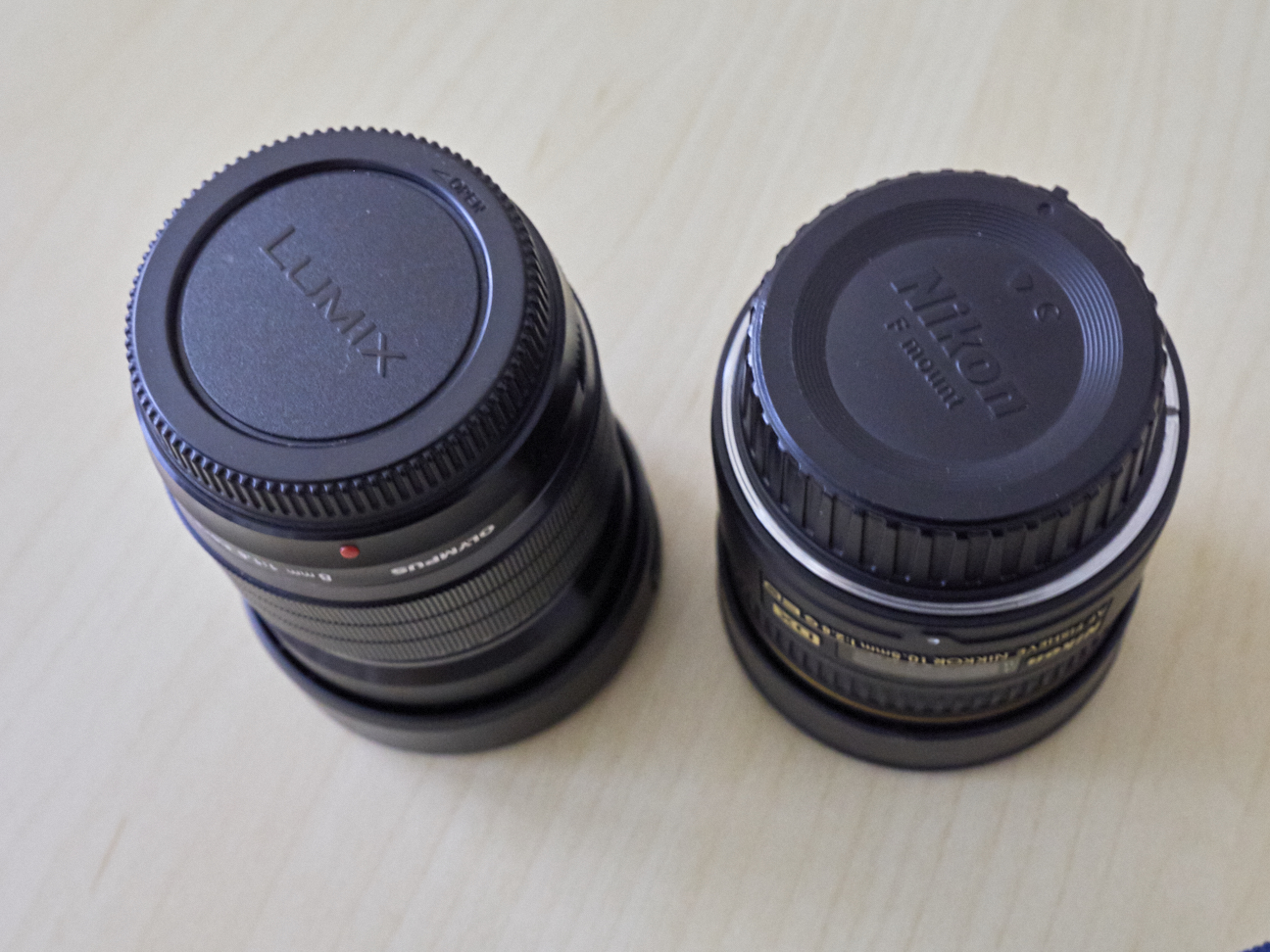
I'm doing a quick entry here to start. I just received a Nikkor 10.5mm f/2.8 DX format lens. It's a used lens that was originally owned by LensRentals.com and sold by their liquidation division.
Buying a Nikon D7200 was mostly an experiment in order to get wider angle landscape shots more easily. I've done that with the Tokina 11-16mm f/2.8 and Sigma 18-35mm f/1.8 lenses. These are not particularly responsive lenses and from the start, they've made the D7200 feel unresponsive, especially for someone who photographs sports 99% of the time. As I've slowed down because of my heart defect, I've been able to do more creative shots. Still, I pick up the Olympus E-M1 and 8mm f/1.8 fisheye lens because of the difference in light gathering.
Oh, wait! APS-C versus micro Four-Thirds can't even be close. Well, I'm finding that real life is much different than examining a bunch of numbers and graphs. People who don't shoot much have been telling me how much greater APS-C is. The big difference I see between my GH4, GX8, E-M1 and the Nikon D7200 is that the Nikon body can record raw files with 14-bit depth rather than 12 bits. Automagically, that increased the possibility of better dynamic range, color, and more. Whether there is actually more is the real question. I assume that there is. Nikon has been good about wanting to deliver the best image quality.
In any case, I received the Nikkor lens about an hour ago and had lunch first, to give me some time to think.
To a certain extent, the difference in maximum aperture is offset by the higher ISO usability. So far, I've found a maximum ISO sensitivity of ISO 4000 with the D7200 versus ISO 3200 for micro Four-Thirds. Yes, you can go much higher and get something but for photographing sports, I have to be more careful. Once it's fairly dark, neither is going to be okay without extra lighting. However, auto focus on the D7200 goes down to EV -3 and the GH4 and GX8 goes down to EV -4. I can't find a figure for the E-M1 but it has been decent in very low light, although it thinks a lot at that point.
Taking the Nikkor lens out of the box and wrapping, I was surprised how utterly small it is for a dSLR lens. It's not much bigger than the Olympus micro Four-Thirds fisheye lens. Yes, it's a DX format lens, so it can be smaller. The best thing is that it can be used on the FX format camera bodies in DX mode. (However, without weather-sealing and with a smaller maximum aperture, it isn't a surprise than the Nikkor lens is small. If it had similar attributes, it would be much larger.)
 |
| Olympus 8mm f/1.8 versus Nikkor 10.5mm f/2.8 DX |
 |
| Olympus 8mm f/1.8 versus Nikkor 10.5mm f/2.8 DX |
As with all Nikkor lenses, I struggle to figure out which lenses are weather-sealed. At full price of roughly US$775, I would expect that it would be. That doesn't mean that it is, and from the description in the listing, I would say that it is not. They mentioned some dust inside the lens--that did not affect image quality. I've never had such a problem with my Olympus lenses, even though I'd used them out in hurricanes and in dusty conditions--severe circumstances. Hopefully, the lens won't have a problem in bad weather. I'm already hiding the lenses I have for the D7200 unless it is completely dry. None of them are weather-sealed.
 |
| E-M1/Olympus 8mm f/1.8 versus D7200/10.5mm f/2.8 |
It looks a bit small on the D7200. I suppose the small size was important to get it onto the D3300.
Hopefully, I'll be out shortly to actually shoot with it.
 |
| Nikkor 10.5mm on D7200 |
 |
| Olympus 8mm on E-M1 |
They both do very well. I had to change the Nikon photo's white balance, probably because I'm still having new user problems.
Speed of operation is about as good as you can get on the D7200. The E-M1 is just amazingly quick and much faster than the D7200. It's not just 10 fps versus 6 fps burst mode but the fact that the E-M1 only has to deal with 16 MP, 12-bit files and the D7200 has 24MP, 14-bit files. I thought that the Expeed 4 class processor would be much faster, though.
Update 2016.04.01: I'm pleased to say that the Nikkor fisheye lens seems to work quite well, even though it was sold as used.
I've found the problem with the white balance control, but geez, what a maze to find it! Olympus' Super Control Panel is amazingly helpful. Even Panasonic's Quick Menu is more effective than the D7200's informational panel. Perhaps, the D500 without a mode dial would be more efficient without looking at the display, but the D7200 way is not working as well as I would like.
As far as I'm concerned, Nikon has technological advantages over Canon, but Nikon is behind everyone else for user interfaces for quick adjustments. I've heard that Olympus' menus are the worst but my experience is that all brands have crap for menus.
Back to the fisheye lenses, I haven't done extensive testing yet, but it would be a good assumption that I can use the Olympus combination much longer into the dark and still get sharp photos. I may test the Nikon combination tonight to see if it will actually focus down to EV -3 or thereabouts. My previous experiences with the Sigma 18-35mm f/1.8 ended in failure.
Looking a bit closer, there is fringing.
 |
| Nikon |
 |
| Olympus |
The Olympus combination shows less fringing, but I wonder if there is software correction affecting the outcome, since micro Four-Thirds bodies fix things too often. I suppose I'll try to put it in the GH4 or GX8 to see what happens. I'm usually too busy shooting to test.