Showing posts with label Verizon. Show all posts

Friday, January 6, 2017

Verizon Wireless' LTE Advanced technology

A few months ago, I saw a press release from Verizon Wireless saying that they supported LTE Advanced (true 4G) in two cities near me, giving much, much, much faster speeds.  You know how they were ridiculing Sprint for being good around Kansas City, and all that?  Then, they started using technology that was even better than what they had to trounce Sprint.

I've been using a Verizon Wireless hotspot for over two years, after the previous hot spot couldn't connect to Sprint for more than 6 hours--something Sprint couldn't explain--but my phone on Sprint was working perfectly.  Back around May, I got the latest, greatest hotspot from Verizon that would support LTE Advanced, XLTE, and allow international roaming.

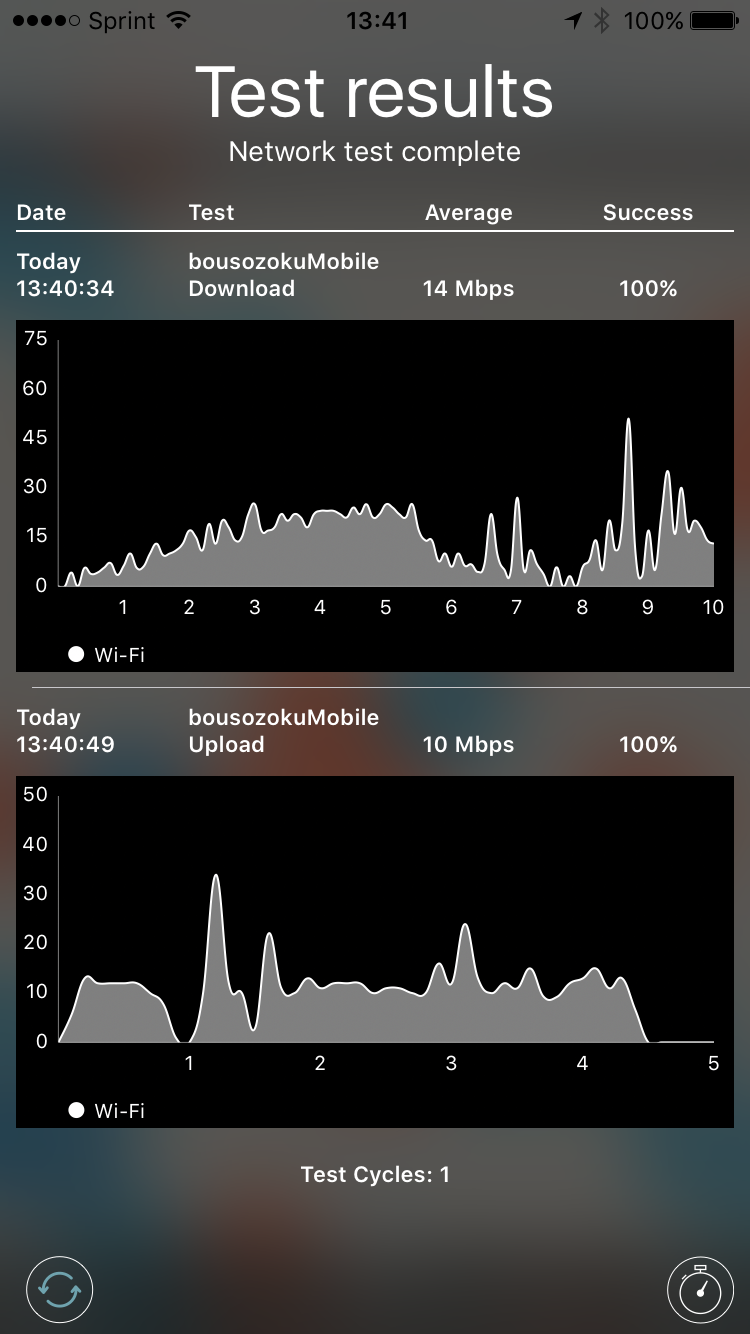
I was in Modesto, CA today, waiting for someone, and I decided to download something to my phone because iTunes app updates are limited to 100MB over the air.  Beyer Park has a tower and Sprint's service is the best there, of all Modesto.  I hoped that it would work out that way with Verizon--only much bigger.  I regularly get 40-50 Mbps with Sprint there.  I'm sure I read that Verizon Wireless was suggesting hundreds of Megabits per second.


I was so disappointed.  I do better at home without LTE Advanced.  I tested it with three apps and my download of 1.2 GB took a very long time, unfortunately.

I'm guessing that it's similar to when Verizon Wireless was first implementing LTE.  A friend lived in a small town that they claimed had LTE.  She tried to show me something.  After a few minutes of churning and getting nowhere, it dropped to 3G and instantly the results were shown.

Does that make it a lie or an exaggeration?  In advertising, I believe it's known as fraud, but it looks like an overstatement to claim a city name without covering the whole city.

Update 2019.03.05: Sprint apparently has LTE Advanced in most locations now, as well as having 3 band LTE in some locations.  It really is amazing to see 100 Mbps on a phone.  5G may be coming, but we still don't have Voice over LTE available, so that they can ditch GSM and CDMA services.

Thursday, September 8, 2016

Time for a Phone Upgrade? (Oops! Did it!)

I dislike when people use "upgrade" when they mean switch.  However, it's become part of common use English, unfortunately.

It's been almost two years since I switched phones.  I was unhappy with Sprint but the Verizon salesperson tried to sell me a more expensive plan, I guess to help his quota.  This upset me and, having done my research, I explained the plan he should have been suggesting, and it was like someone was talking to him in the ear piece--everything he said from that point was robotic.

The iPhone 5c was a good phone and I miss it, but the two band LTE wasn't enough with Sprint and since Sprint offers three band LTE many places I go, the extra bandwidth is useful, especially when their service is bad.  It still doesn't help with those areas where Sprint still hasn't added LTE and, in California, those places are many.  They decided to spend the money to help the area around their Overland Park, Kansas headquarters where almost no one pays.

In any case, seeing 68 Mbps not far from home is great.  Verizon has LTE Advanced service around here, but not here.  I've seen around 40 Mbps at home and it might be even better not far from here.  I wonder if I could see over 100 Mbps with a newer phone in one of those LTE Advanced service areas.  My problem at home is that I'm on the edge of a roaming area for Sprint--about 6 blocks from the center of town.  They have refused to add a tower near the shopping area that would help.  They occasionally turn up the power on the tower near the skate park but they don't have enough capacity to make it work well.

The iPhone 7 Plus is actually faster than some of the latest 12 inch MacBook models using Core M processors.

 Since the iPhone 7 pre-orders will be available in a few hours, I'm wondering if I should consider it.  I looked at the Sprint website a bit earlier and it said that I was eligible for an upgrade.  However, they didn't mention iPhone 7 at all.

I usually stay away from the latest Apple hardware but the iPhone 6 has been good.  I considering the iPhone SE but I remember how I struggled with seeing small details on the display.  The iPhone 6s would be fine, I'm sure, but don't I want the extra power and extra battery life?

I believe that the iPhone 6s is unnecessary and the iPhone SE is too small for my eyes and the iPhone 6s Plus is too big for my pocket.  (If you're wondering, Android 6.x didn't work well on my 2013 Google Nexus 7 tablet, so I doubt I want it on my phone, even though the LG V20 looks desirable.)

Who knows?  If I wait, I'll lose the chance to get an iPhone 7 pre-order.  If Sprint's web site never shows it, I'm thinking that the Apple web site will show Sprint as an option.

Sprint really wants my iPhone-related money.  They changed their Sprint Zone app on iOS, at least, to display whether a person is ready for an iPhone upgrade.

While the desktop web site timed out a bit, the mobile app + mobile web site seemed to be working quite well.  I'm still trying to figure out about my leased phone, since it says that there needs to be a trade-in.  I'm two months from the end of the lease, and after two years, I really don't want to keep the phone, even though it works just fine.  Verizon quoted me something around US$35.00, which is much less than I could get elsewhere, if I put work into it.

I'm still thinking about it.  Pre-orders have been live for more than 1 day.  Supplies are becoming somewhat scarce.  Apple have changed the selections--AT&T and T-Mobile versions cannot be used on Verizon or Sprint because they supposedly don't include CDMA functionality.  You can go the other way with an unlocked phone on Verizon or Sprint.

Update 2016.10.10: Okay, so I looked at the diminishing battery life on my two year old iPhone 6, plus the fact that I'm having occasional trouble charging it and decided that paying around US$1.50 per month for an 18 month lease isn't a bad thing in order to replace the phone.

The 32GB model was a bit short on capacity and the 64GB model now has 128GB, so that's what I ordered.  According to Sprint's information, they had the Gold models ready for immediate shipment.  Compared to two years ago, that's quite the reverse.  The silver was the only easily available model.

I tried one at a Target store the other evening and it was quite powerful on a game I already use and one I have considered buying--namely, Asphalt 8 and Warhammer 40,000 something.  The phone was impressive.

Less impressive was the new, immobile Home button.  Unlike the trackpads on the latest MacBook Pro series, it doesn't feel as though it is moving at all.  I realize that the depth isn't available but then, the haptic feedback is supposed to provide this feeling of depth.

I also ordered a couple of different color cases from Ballistic.  The price for each was only US$19.99, which was incredibly inexpensive, considering I paid US$34.99 for my last Ballistic case.  While I won't see much of the gold, one of the cases is completely black, while the other is gray and white.  Sure, I could get something really colorful but the 6+ feet of drop protection is more important to me.

Thursday, December 25, 2014

FreedomPop for home

I've been using a phone or a mobile hotspot for my computer's internet connection from late 2006.  It started with a Samsung A900--Lex Luthor's phone in Smallville.  It was a lousy phone but the 3G connection was reliable, and the speed was better than my 3 Mbps DSL connection.

Lately, I've been using a Novatel Wireless MiFi device with Verizon.  Service was really good at my last location, but just acceptable here.  I gave up on Sprint around March of this year when the Sierra Wireless (now Netgear) device wouldn't connect for 6 hours.

Earlier this month, I was coming close to my full monthly allotment of 10 GB on the 10th day into my billing period.  Uggggh.  I'm currently about 4 GB ($40) over it.  I haven't noticed anyone else using it, but DirecTV seemed to be using a lot, even though I wasn't streaming anything.  I've been working on creating videos lately, but there wasn't that much I was uploading.  In any case, paying loads for extra use, and not knowing how it was happening was difficult.

I looked for FreedomPop after seeing an article about it.  Freedom Hub Burst is a home product similar to a mobile hotspot but without the mobile part.  It needs an AC electrical outlet.  They've been using ClearWire/Clear connections for quite a while.  The only problem with this is that I have some spotty service with Sprint at home.  Both ends of my apartment have LTE but my living room and part of my bedroom are a transition zone between 3G and LTE, so I end up with 1xRTT on my phone too often.

At $21.99 for 10 GB per month, it seemed reasonable, compared to $10 per 1 GB for an overage on Verizon.  Normally, FreedomPop hasn't been charging for the service, but this home service is a bit different, and I'm okay with it.  Like buying a phone with prepaid service, I needed to buy a device.  They supposedly included an extra USB-attached mobile modem but it wasn't included in the box.

Setup

Receiving the package on Christmas Eve seemed gift-y.  Opening the package and not finding useful instructions didn't.  Actually, there was a little pamphlet that fell between the cracks, and I found it afterwards.  It would have helped a lot but I already had a connection, read the instructions, and managed to find the page to get everything set.  Looking at the pamphlet, it neglects to tell you the default password for the connection to the device itself, so how do you connect without a current connection?

Connecting

It has been simple enough to get online, once I set everything.  Speed is reasonable, though not extremely fast, nearly 5 Mbps.  Perhaps, the LTE will improve as Sprint/Clear finish their deployment in this area.  Response time seems minimal and it feels like a good connection.  Unlike my phone, I can leave the device near a window on the edge of the apartment where the connection is better.

Having an extra 10 GB for about the same as 2 GB overage isn't bad.  I can connect the TV and Blu-Ray player to it and they can update firmware to their CPU's content, even when I'm not home.  I'm thinking that I shouldn't connect my DirecTV receiver, as it will take advantage of the connection in big ways.  Now, my mobile hotspot can once again be mobile, and I can even update those extra iPhone apps without having to look for a WiFi connection elsewhere.

Update 2015.01.13: Saturday, I received a WiMAX/3G modem, like the one Sprint discontinued quite a while ago.  I couldn't download the connection manager software from FreedomPop, so I downloaded it from Sprint.

It connected but then told me that there was no free 4G service available and that 3G service wasn't free.  I only have one question--why send me this unusable piece of technology, to clear the warehouse?

Update 2015.03.27: The other day, the company offered me an upgrade for the useless WiMAX modem.  For $29.99, I could get a Franklin brand LTE modem.  It sounded great, but then, they wanted me to take a premium 2 GB data package for $21.99 per month.  It's not horrible, when you consider AT&T and Verizon and I could cancel later.

However, they're counting on someone missing that, and I missed the data rollover option that they slipped into the WiMAX modem package, and they've been charging me $3.99 + tax until I checked practically every option on the web site.

Sunday, December 14, 2014

Sprint "Cut Your Bill in Half" deal only on plan, not your device. Is that a surprise?

It's apparently not quite the deal you'd expect, and of course, it depends on Verizon Wireless and (the new) AT&T's bad plans.

Re/Code

CrackBerry

Consumerist

 DSL Reports

I'm not sure that there is a real story or not.  I don't expect miracles anyway.  The big two have been working a little bit more to be balance plans with service.  However, if you get great coverage where you are--watch out for fake coverage maps from any of the big 4--Sprint should be a good deal.  Now that Nextel is all but dead and the 800 MHz frequency band is available, there is a huge chance that Sprint could be dominant in certain markets.  There are Spark areas like Milpitas, CA where Sprint is using 800 MHz, 1900 MHz, and 2500 MHz combined.

Verizon has dual frequency bands with their XLTE but who knows what device you need to make it work right now.  I've searched multiple times to see if my current mobile hotspot will take advantage of it but they're not telling apparently.  I'd prefer enhanced throughput.

Update 2014.12.30: I've been a Sprint customer since September 2000.  I've seen great service and weird, poor service.  Lately, it's very good everywhere but home.  While I'm feeling just more than neutral about Sprint, Verizon (my mobile hotspot) doesn't really make me feel better, and the stories about AT&T and T-Mobile keep me away.  YMMV--Your mileage may vary.  Do your research.

Update 2015.11.19: The deal is back, mostly.  There are more conditions, but I suppose it's a good deal, if you happen to have great coverage where you live.

Speaking of which, Sprint also made a big announcement about 77 locations for their LTE Plus service, which seems to be what they were calling Spark last year.  (They were also mentioning LTE Advanced but I'm not sure if they meant that LTE was more advanced than their 3G service or they've actually put the newer technology into place.)  If everything is working well, you can get tremendous speed.  In fact, they had the service in town for a while.  I was seeing 38 Mbps, up from 1-2 Mbps and then, a month later, it was gone and the old service had been restored.  (I believe that they took the equipment back to their city of Overland Park, Kansas to help themselves.)

It was quite a bit better than the 7 Mbps that I normally see on my Verizon mobile hotspot, and Verizon still hasn't announced where they have their enhanced two frequency service--only that it exists.

Sunday, December 7, 2014

Got an iPhone 6 last night and stayed with Sprint

As you might have read already, I live in an area where the LTE installations haven't been finished.  While much of the town is on LTE, I live on the edge of LTE and a roaming zone.  In fact, my bedroom seems to be a transition area between 3G/EVDO and LTE, so I end up with 1xRTT too many times for too long.

Verizon First

I went to see Verizon, but after seeing the local reseller's Yelp ratings, I went to a city 15 miles away where there was an official company store.

They currently have a $150 switching rebate, and I had found that the data sharing plan of 12 GB had been upgraded to 15 GB.  This is important as I already have a mobile hotspot with the company.  Service is better than Sprint but not great, as though it's bordering on overloaded.  We apparently don't have enough towers in town.

I waited about 15 minutes until there was an available associate.  We talked, and he explained the rent-to-buy plan.  It sounded fine, and then, he talked about the data plan--6 GB for $120, along with talk and text messaging, which we didn't even discuss.  I told him that I'd really have to think about that, since it would drive my total expense up by $40.

Then, I said "I thought there was a 12GB 15 GB sharing plan" and he seemed to tap his headset, and looked surprised "Oh, why didn't I think of that?" and as if he'd been given information by someone behind the curtain, he remarked "That would be $160."  That pretty much ended the conversation but I asked if he was on commission, and he said yes, and had someone get his card for me.  I figured that he would get a little extra each month by not suggesting the cheaper plan.

Sprint Next but not Nextel

I went to one of the two Sprint kiosks in the mall just after that.  The first was busy, so I went to the other.  I said "Give me a reason to stay with Sprint.  I'm ready to pay my ETF." and we started a discussion.

Within only a couple of minutes, he mentioned an extra discount for long time customers on the lease plan.  This also supposedly doesn't include a contract.  They get to keep the phone at the end of the lease or you can pay an extra $200 to keep it.  I was a bit confused, but it still sounded okay.  Except for prepaid service, is it ever 100% straightforward?  Since I wanted a 64GB iPhone 6, it cost a bit more.

Naturally, with these plans, you leave without paying anything.  They put certain things on your initial bill, like the !@#$ $36.00 activation fee--yes, they need to pay for the rigamarole to handle all the crap of paperwork.

My plan is a bit old, so they had trouble deciding which reason to use to make the lease work.  They need to add "Hella Old Plan" to the list.  Eventually, everything was fine, and they also sold me a Otterbox glass screen protector and a Griffin case.  Amusingly, my old address from 2000-2008 was there, and now, with one of the receipts sent by e-mail, they showed me Indiana taxes, where I haven't lived for months.

What's bad about the lease discount is that I had to stay with my current service plan.  They have a better, cheaper plan now.  Actually, last year when I got the iPhone 5c, they add an Unlimited Everything plan or some such that was the same price but had no limits.  Still, I don't talk on the phone enough to need my current minutes.

Oh, and I didn't have to pay the ETF, so far.  Hopefully, it won't show up, since I was told that it wouldn't happen.

They asked me if I wanted insurance, and I told them AppleCare+ but I'm not sure that it will arrive or not.  They didn't charge me for it, but then, they didn't charge me right away last year.  I didn't want Asurion to handle it, as they want lots of money each month, and they have no problem refusing service.

In any case, the iPhone 6 is much better than the iPhone 5c.  That's a surprise?  I suppose not.  I'm thankful that the iPhone 6 is a bit more efficient than the iPhone 5s.  I was concerned about buying a first-generation 64-bit processor from Apple, so I didn't buy the iPhone 5s.  The phone keeps up with me, except when service is poor.  Given that the iPhone 5c is a two band LTE device and the iPhone 6 is a three band LTE device, I should have great performance in certain areas where the Nextel 800 MHz frequency band has been re-purposed.

Most apps I use seem to have been updated for iPhone 6, as well as iOS 8.x and they seem fine.  However, there seem to be so many bug fixes, with apps being updated every few days.  Asphalt 8 takes advantage of the new abilities and has some extra special effects.  I'm not seeing anything else like that from other apps, but everything else seems smooth.

As it has only been a little over 24 hours, I don't know how the battery life really is.  I was in a habit of charging whenever possible--in the car, in the house, and I have a Sony charging kit with a 10,000 mAh battery.  I'm not comfortable enough to let it go overnight without a charge, though I suspect that it will be fine.

The display seems so good.  I wish that they'd picked a more standard size, such as 1280x800 but had 1334-by-750-pixel resolution at 326 ppi.  That's big enough to play 720p video, finally.  Seeing "Full sRGB standard" makes me happy.  I can't tell you how many times I've looked at photos I've taken and the color range and dynamic range is lower than expected, leaving my photos not looking their best, requiring imagination.

TouchID seems to work well.  I was carrying on a conversation with the salesperson while trying to set up the phone and I wasn't synchronizing my movements well, but the TouchID setup was very patient.  It works fine and it's good to be able to put my thumb on the Home button to unlock the phone.  I'm not ready to use Apple Pay.  Let someone else live through the problems.

The thing I don't like is the size of the phone.  It's not horribly big, but it is a big difference.  When I'm playing games in a landscape position, it's great.  When I'm trying to use it as an internet device in portrait orientation, it's a little uncomfortable to use with one hand.

What else?  I'm planning to buy another Ballistic case, so I don't have to worry about dropping it.  The current Griffin case was labeled with "3'" but does it actually work after a drop of three feet?  The glass screen protector from Otterbox seems fine, but for such a price, it should be fine.

Oh, the speakers are in the way of my hands.  Yes, I know that doesn't make sense.  Playing games or watching videos in landscape orientation, I can barely hear the sound at all.  If they'd be a little less obsessed with thin and light, they'd likely have made it so headphones aren't necessary.  Maybe, I can charge my Bluetooth-connected Motorola S9 headphones and hopefully, the synchronization of sound is better than way back when with the second generation iPod touch and iOS 5.x.

Update 2014.12.12: I found Best Buy-only Ballistic cases for iPhone 6 and iPhone 6 Plus.  They were $34.99, $39.99, and $49.99.  I bought one of the $39.99 priced cases that was labeled Tungsten Tough.  You won't find these on the Ballistic web site.  It's a similar situation to the Klipsch speakers that are made for Best Buy.  I suspect that there is a higher profit margin.  The case has what seems to be anodized aluminum in back.  The drop rating was 7+ feet.  The case for $49.99 added water resistance, a screen protector, and an 8+ rating for drops.

I'm not sure if I'll miss the clip (it didn't turn the case into a viewing easel), as it has hung on to my pocket when I didn't quite have the case far enough into the pocket, but the company's protection is great, so a 7+ rating should handle a fall from my pocket easily.

Update 2015.02.10: I have to say that the situation with Sprint in California isn't as good as it should be.  I understand that it is a long state, but seeing "No Service" should never happen, and it happened too often on my trip from Northern California to San Diego.

The compensation is that when LTE was available, it worked very well.  I've found too many transition zones, just like in my apartment, where they still haven't got overlapping towers.

Update 2015.11.06: Sprint provided better technology and therefore, a better connection.  After 1 month, they took it away, and things are back to the way they had been.  Where they have good service, the phone works just fine.  Elsewhere, the service is poor and the phone works poorly.  I was told I needed to have the phone serviced.  I told the @sprintcare team that I didn't know that humor was a new service they offered.

I almost wish that I had not got the new phone so I could switch to T-Mobile, which has improved their service.  Even paying more to Verizon might have been worth it.  I've been with Sprint since 2000 and the last couple of months have made me wish that Sprint would go out of business.  I actually mentioned that to the @sprintsavings people on Twitter.

The phone has been good.  Now, with iOS 9.0.2, it seems even better, if still a bit buggy.

Tuesday, April 1, 2014

Verizon, don't !@#$ with me, okay?

It's been a month.  I'm in for the long haul with a company I barely trust.  The positive about it is that they're not as bad as the new AT&T/SBC.  Almost two years ago when I got a refurbished mobile hotspot shipping from AT&T in Texas, I was charged for the three days it was in the mail.  Verizon isn't that bad.

Now, here is a huge tip.  If you change your plan because you want to not exceed the data allotment, make the change retroactive to the beginning of the current billing cycle so that it claims the whole amount for the whole month.  Do not let the change be immediate.

Why?  I got overages, even though I changed from 5 GB to 10 GB and only had 9 GB used.

When I made the change on the web site, instead of seeing 10 GB as the limit, they gave me 3.871 GB, even though I hadn't yet crossed 5 GB.  They divide the number of remaining days to calculate how much data you should receive, rather than just dumping the full amount into it and they use pro rata calculations for the price to you equally.

Therefore, at the point where I crossed the 4.86 or whatever + 3.871 GB, I was in overage land.

I'm still not sure what I'll be charged but I certainly have a headache about it now.  Then, there is part 2.

Sunday, after the overage message, I called customer service.  Someone friendly answered my question and explained how I was over.  She told me that I should switch to the 12 GB plan instead of the 10 GB plan and that would eliminate the overage.  Besides, it was only $70 instead of $80, so I would be saving money and getting a bigger allotment.

I had seen the "Share" plans and they all had a $20 fee for the line.  I asked precisely "are there any other charges, other than for the government?"  She said that there were no other charges and that an extra 2 GB of data would be $10 instead of the 1 GB per $10 with the current 10 GB plan.  I agreed.

Part 3 came today in an e-mail about the changes.  $70 + $20 = $90.  What?  That's not cheaper than $80.

I called customer service and tried to calmly explain the situation.  I'm back on the $80 plan with no $20 fee for the line.  It may be older but I don't have another Verizon device and it seems rather expensive if you have more than one.

I'm wondering now if the person got a commission for the switch to a new plan that would "help" me.  I had a similar experience with a cable company (Time-Warmer or BrightHouse Networks, which took over the area), and I called back and told them that they could rip out the changes or rip out their cable lines to my house because I wasn't paying extra.  Oops.  They liked to play games, though.

I can' imagine how this is going to look when I get the bill, but whatever.  It's difficult any time you start with a new contract.  It's just too bad I couldn't have bought the device outright and gone contract-less.

Besides all that, I sent the rebate form without the labels from the box.  Damn.

Thursday, March 6, 2014

Do carriers boost the mobile hotspot data usage numbers?

Back in mid-2012, when I was looking for a mobile hotspot, I noticed that at almost unusable speeds, I was tearing through the Verizon Hotspot's 10 GB data limit.  It didn't make any sense.  Except for the trip from the Verizon store, I didn't have access to LTE.  At home, I was barely able to get e-mail.  Yet, most of the allotment was being used very quickly.

Saturday, I bought one of their newest hotspots and I'm already more than 33% through my monthly allotment of 5 GB.  The firmware update was surely included in the usage, since obviously, that wouldn't go to the company.  (Why put out a device that is updated when you can charge for the update indirectly?)  I had 12 GB with Sprint, and even when I had 5 GB, it didn't go this quickly, though they seem to count all of their overhead as part of my usage.

3 full days

Since there aren't a lot of alternatives here, I will be using the mobile hotspot, either the hardware device from Verizon, or the software functionality on the iPhone 5c from Sprint.  I'm guessing that I'll be close on data at the end of the billing period.

The salesperson told me that Verizon charges $10 per 1 gigabyte over the limit, which doesn't seem horrible.  I expected something more like $1 per extra megabyte.

To be clear, I had already stopped the automatic update of tablet applications.  People often seem upset than Apple take so long to authorize an update to an application, but the other side is annoying.  I see developers on Android updating their applications daily.  I don't develop mobile software, but unless there is an emergency, why not get several updates into the app every week?

Of course, Google applications on (Mac) OS X can't be stopped.  These days, I rarely find that Chrome hasn't been updated ahead of a notice on a news site, unless of course, I don't have a connection while I'm out.  Picasa is the Google exception, and the company has major problems there.  The Update menu item doesn't work.  It never finds an update, even when there is one.  When there is an update, I receive a pop-up dialog box asking me to run the installation.  I do that, and when I go to one of normal user accounts (as opposed to Administrator), it asks that I download and install it there, also.  Obviously, it's the same software across user accounts, download it once.
1 full week

Update 2014.03.09: I'm about 40% through my monthly allotment in about 1 week.  That's scary.  I hope it isn't repeated the next month.
2 weeks

Update 2014.03.16: I'm about 80% through my monthly allotment, with half a month to go.  I can only wonder as to what is using all the data, since I'm not watching videos.  It looks as though Verizon doesn't count the same way as Sprint did.  I would rarely go beyond 6 GB in a month.  I'm going to end up using my Sprint phone as a hotspot, which could last me the rest of the month, but who knows?

Funny that ABC News was running a story about prepaid phone calls and how AT&T and T-Mobile charge you for the operational length of the call, rather than the talk time of the call.  They said that Verizon only charged for the talk time.  I hope that they're not making up for it here.

Update 2014.03.17: I've apparently used 0.765GB in almost exactly 48 hours.  This will be the second time I've tried to update this blog entry with the addition of the graphic.   Well, the graphic was still being held by Google, even though Blogger did not update this blog entry--small favors.  In any case, I can only imagine that Google Maps is responsible for using so much data.  I watch videos on my Unlimited Data phone, not through the hotspot.

Update 2014.03.19: I turned off the Mifi hotspot just after I read the total usage.  When I went to the local affiliate to pay my first bill, I asked them about the current number and he had just switched from that page, but he said that it seemed to be what I mentioned.  I was half-hoping that it would have still increased with it completely off, to prove that there was a problem.

Since I've been using the phone on Sprint as a hotspot for two days, usage has been minimal.   I also noticed that MacRumors was mentioning a problem with iOS 7.1 and hotspot functionality, but since I didn't use it prior to 7.1, I am probably not having any issue.

Update 2014.03.21: I've been using my phone as a hotspot and it's been a bit troublesome if I stop the hotspot functionality.
The next morning after turning off the MiFi hotspot

2.5 days after the first Sprint measure

It seems very different in usage but that may be because it's so slow most of the time, and in frustration, I leave the computer or tablet without achieving much, though it might be some other reason.  I still find it humorous that Sprint wants to confuse the issue by measuring in KiloBytes.  Maybe, it confuses them, too.  It's sadly amusing that on their Sprint-labeled Speedtest.net page, they mistakenly identify the results in MegaBytes per second instead of MegaBits per second.  I'm sure Sprint would have more customers if their data services were 8 times as fast.  With the Tri-Fi hotspot, I often had trouble getting e-mail.  Isn't that pathetic?  I always thought that a dedicated device would be so much better than a phone doing double duty but not so with the Sierra Wireless/Netgear devices, especially since they offer cradles to boost the signal gain.

I caved and changed from 5 GB on Verizon to 10 GB per month.  It's an extra $30, which is better than $10 per 1 GB or $50.

It's still easier to remember the phone than the mobile hotspot when I leave town for a quick trip.  It's still important to watch the usage, as I could suddenly exceed 10 GB.  e.g., I have the Asphalt 8 game on the phone and the Nexus 7 tablet.  It's 1.5 GB on one and 1.3 GB on the other.  Since they'll likely charge for their overhead, that 2.8 GB will probably balloon to 3.5 GB easily.  Try finding some free WiFi source to let you update that much easily.  I know of places but I'll have to drive 25-45 miles to go there.

How does adding an extra 5 GB get to 3.871?

Gaaaaaaaaahhhhhhhh!

 I had not used 5 GB and I changed to 10 GB so, they gave me a lot less than 5 GB.  For the sake of clarity, I should have had it start on the next billing period, don't you think?
I think Verizon may have a problem

I tried to call customer service but the sound was so awful, I couldn't really hear the menu options well.  Was that a tactic to get me to change my phone to Verizon?  I don't remember the problem in 2012.  I don't make many phone calls, so who knows?

Update 2014.04.04: I needed to back date (retroactive) the plan to the first day of the period.  They took my change on the 21st day of the month and used pro rata math to give me 3.871, which knowing my situation, no one knowledgeable and in their right mind would have done because it caused an overage.

Update 2015.01.31: This hit hard today, though I haven't been keeping track of my usage strictly.

Most of the month I've been using a FreedomPop home internet connection over LTE.  If I go over 2 GB on Verizon, it's pretty much the same as 10 GB on FreedomPop.  When I went over by 4 GB, uploading my new video work, I had to do something.

So, I didn't use the Verizon mobile hotspot until the 21st really.  I was updating the computer and phone and it showed 2.2 GB, which is a lot from 10 GB monthly.  Today, I got a message that I was over 75%--or over 7.5 GB.  In the last 3 days, I've been working on a few videos from skateboarding, and a musical performance the other night.  I find it difficult to believe that I used 6 GB, and only have about 1.4 GB remaining.  Thankfully, that was after the latest group of videos were finished and up on YouTube.  I was uploading to YouTube and Vimeo, so that's part of the problem, but Vimeo let me upload the full load of the second video and told me that it wasn't HD because I need to pay extra for more than a certain small amount.

In any case, it's going to be back to zero on the 2nd, but in the meantime, I have to be a bit more frugal.

Saturday, March 1, 2014

No more Sierra Wireless/Netgear mobile hotspots

Is this odd that it follows my "No more Panasonic lenses" blog entry?  It's been a week.

I've been fighting with my Sierra Wireless Tri-Fi mobile hotspot for quite a while.  I got it in June 2012, after auditioning similar LTE devices from AT&T/SBC and Verizon Wireless.  (N.B. you can't buy Sierra Wireless-named devices now--Netgear bought the company, so everything is labeled Netgear now.  At the Sprint store there was another Netgear mobile hotspot with a cradle, this one a tri-band (Spark) LTE device.  If it needs a cradle to work correctly, it's a poor design.  Don't buy it!  By the way, I'm not against Netgear networking equipment otherwise.  In fact, I use it.)

At the time when I bought the hotspot in 2012, there wasn't much LTE coverage, and what was there was already overwhelmed.  WiMAX was more likely to be available.

AT&T/SBC enabled HSPA in town, not HSPA+ but merely the so-so topology that was similarly constrained like EVDO Rev. A or B.  Since most people were accustomed to GPRS or EDGE, it was reasonably fast.  Today, it's likely bogged down with all the extra traffic, and there is no LTE.

Verizon offered LTE in town a couple of months after I took their device back to them but at the time I got the device, their 3G data speeds were worse than Sprint (getting e-mail was a problem), and their LTE speeds weren't great in an area that had already matured.

Today, the reality hit the fan.

I couldn't get a connection with the mobile hotspot at all.  The device sat there between 15 and 30 minutes and wouldn't connect.  I went to the store, which is about 2 miles from home.  I tried to check-in with Yelp on the phone and even that didn't work outside or inside the store.  (They're upgrading the towers for LTE, but if the phone doesn't work well, what's the point?  The Sprint store and Verizon affiliate store are very close to the tower but so are the shopping centers.  At Christmas, I could hardly get any service.)

In the store, I waited and waited, as Saturdays are busy.  When someone talked to me, I tried to be calm.  In the end, he told me to call customer service, and demand that my contract be canceled and that the ETF be credited so that I would pay nothing.

I drove near the Verizon Wireless affiliate, near the tower, so I could hope to make a clear call.  I called and navigated the menu system to "end contract" or some such menu item.  Janelle answered within the 30 seconds that they stated and we did a little dance.

In the end, she ended the contract, credited the account, so that I would pay nothing.  I also had her turn on the Personal Hotspot feature on the phone, so I could at least get e-mail.  She was extremely pleasant and took care of me well.  They've increased the prices for the hotspot add-on.  I think the 6 GB hotspot add-on was $49.99, instead of $29.99 for 5 GB previously, and I selected the 2 GB add-on for $19.99.

I walked into the Verizon Wireless reseller after the call.  They had one beat-up mobile hotspot on display.  When I got to talk to someone, I learned that they only had two others in the store.  I chose the Novatel Wireless device.  I'm trying to be a good American, okay?  The other device was the ZTE (890L?) mobile hotspot I tried in 2012, and I would rather have a newer, less intensive chipset for better battery life, especially since the batteries were half the size (1800 mAh vs 3600 mAh) of the Sierra Wireless unit I'd been using.  I read my initial blog entry and I had problems with that ZTE brand device but lots of firmware changes have probably fixed everything.

About $120 got me out the door, will 2 years of walk-in-trade-in insurance on the device.  $60 for insurance seems okay considering that it would have been $8 per month with Asurion, which would be $192 over 2 years.

Sprint LTE in Trotwood, OH


Verizon LTE in Richmond, IN
When I arrived home, I got connected with the computer.  I got 12.79 Mbps down and 4..25 Mbps up.  Unfortunately, it hasn't worked since then.  It went to do an update and it froze at 48%.  I powered off and powered on, and selected the update and it was downloaded completely, and took a very long time to do the actual update.  It still isn't working for me.  I just checked the tablet again.

Thankfully, while I was terminating the Sprint mobile hotspot, I had the representative enable the Personal Hotspot feature and that is working exceptionally well, as I would expect the connection to be.  Unfortunately, their add-on prices were enormous and I only went to 2 GB, Sprint overhead and all.  It's an emergency substitute and of course, when the Verizon mobile hotspot is close on data.  Verizon charges $10 for an extra Gigabyte which seemed very reasonable, as Sprint has been a pain for overages, not that I've had any for a long time, but they really promote you going with a heavy plan.

So, now, back to the Verizon store to see what the !@#$ problem is.

Who knows?  I took my laptop computer, my 2013 Nexus 7 tablet, and the MiFi mobile hotspot.  Everything worked perfectly in the store and here at home now.  I hope there are no further problems.

It's still fine, although it hasn't been quite as fast.  I suspect that as the evening progressed, more people headed to this side of town where more restaurants and shopping exist.  When the winter storm hits, I would imagine speeds will be increased--or not decreased as much as when things are busy.

I also returned to the Sprint store to tell them how much better the iPhone 5c handled hotspot duties than the dedicated hotspot device.  Isn't that sad that the device wasn't better?  They were surprised also.

Update 2014.03.02: The lack of the Tri-Fi hotspot seems to have left the iPhone 5c in a better state of communication.  It seems to be faster and smoother in communication with the towers.  Could the Tri-Fi have been interfering with this (and the previous iPhone 4s) phone over 1.5 years?   That's just scary that one device could be so disruptive, especially since it was meant to be so helpful by granting access to three different topologies/technologies.

3 full days
1 full week


Update 2014.03.04: As I wondered back in 2012, I wonder if Verizon cheats on their usage numbers.  It has been 3 full days, and I've already used over 1 GB (20%) without any video.   I've always felt that Sprint charges me for their overhead, as well as my traffic, but this seems ridiculous.  I didn't check to see how much the firmware update cost me, but I'm sure they didn't do that for free.

I tried to write a review of the Tri-Fi mobile hotspot and I was careful to only use the truth, but Sprint don't approve of service-related talk.  How can you discuss an item's connectivity without touching on how well it connects?

Update 2014.03.29: Thankfully, the Novatel Wireless MiFi-5510L has performed well.  Its touch-capable buttons are not very responsive, but what counts is the connectivity between the computer, tablet, and the internet.  That works.  Even the iPhone 5c as a mobile hotspot is quite good, though it can be stubborn connecting to the computer, another Apple product, at times.

I extended the Verizon plan to 10 GB, and at the switchover on the 21st, instead of saving 10 GB, it gave an odd, seemingly-unrelated number.  I checked earlier and it was just over 9 GB, even though it had several days away.  It is now completely off and disconnected.  Verizon's $10 per 1 GB isn't so much but I'd rather not use it since I also have the phone for overages, and for those trips where I forget the mobile hotspot device.  That gives me the original 12 GB I had on Sprint, but with two devices which hopefully will not be down at the same time.  Since Sprint didn't discount anything, I expect the cost to be about the same.

Sprint is testing the waters with LTE in town, so the phone seems to be much better even on 3G/EVDO.  At some point in the next few days, LTE will supposedly be deployed on Sprint towers.

Thursday, January 9, 2014

T-Mobile US: The other major carriers are shit

It's easy to be a loudmouth.  Sometimes, you're right and other times, you're wrong.

John Legere and company have made T-Mobile better and that's evident in their recent numbers, where they've gained both prepaid and postpaid customers.  It was the best they've done in eight years, if I remember correctly.

At CES, Mr. Legere complained that the other major carriers are basically shit--their plans, their policies, their service.

I don't disagree 100% but there is a huge difference in T-Mobile and the rest--coverage.

When T-Mobile covers as much as any of the others, and they can keep everything as wonderful as they say things are, then I'll believe them.

It's a lot like the Europeans who live in a country the size of one of the states of the U.S.A. who say how easy it is to put everything into place.  Sure, it's easy to cover when you have an area that you can drive in 6 hours north to south or east to west.  Try covering an area that takes three 15 hour days to drive east to west.

I agree that Sprint has been terrible.  It's struggled a lot while having to deal with Nextel issues, and it went from being the number one 3G data provider to number three.  Once again, coverage matters.

I might have been with T-Mobile years ago, but when I asked about the service, I got a "No, we don't have 3G service yet." in response.  They've come a long way, and so has the new AT&T since its Cingular days.  I'm remembering 38 metropolitan areas were covered when Apple was readying its iPhone with 3G data capabilities.  When the first iPhone became available, Cingular had to upgrade their GPRS/EDGE data because it wasn't good enough.

As far as I'm concerned, it will still be 2016 before issues are settled and LTE will be good for the majority of users.  That is a long time and there will be a lot of B.S. and chest-thumping until that time.

By then, there probably won't be any feature phones and data usage will have increased to match the capabilities on the network, and we'll still be complaining.

Update 2014.03.08: RootMetrics put out a report citing their summary for the U.S.A., with a combination of areas they measured.  It's not all-inclusive but it certainly says something about what is real in mobile phone and data services.  It doesn't look as though T-Mobile was on top.

Monday, December 16, 2013

Sprint LTE: +70 = 300 markets

Sprint has officially announced another 70 markets for LTE here.

I'm not sure why Salem, Ohio (or most of the new markets) is important.  I see plenty of tourist destinations, so maybe the Sprint executives are making certain that they have adequate service where they travel.  At this point, I suspect adequate is all they'll get.

While trying to use 3G anywhere near the local shopping centers, all I got was the digital equivalent of static.  What was normally lousy data service was reduced to a lack of service.  For all the data capacity upgrades they've implemented in the past 1.5 years, they still need to increase capacity (probably) 4 times to handle a heavy load.

When LTE is available,  and customers find that LTE is faster, they'll buy devices to match, and use the extra speed to capacity, and we'll be back at merely adequate service again, but this time on LTE.  Maybe, it will return 3G performance to something reasonable--or maybe, it will exceed LTE's performance, given that a lot of the abusers will not be using 3G/EVDO.  I could swear when I've been at several businesses, we had procedures for capacity planning.  Why Sprint is unable to do this well is beyond me.  Surely, using income from data plans and data options (US$10 smart phone fee, anyone?  That should have gone directly to capacity upgrades.) would help fund maintenance and upgrades.  For all the concern about hiring talent at the top levels, the U.S.A. doesn't seem to be concerned about properly operating a business, but only concerned about extracting the most money.

Of course, Sprint could increase the price of their plans but that would likely push so many customers away that they'd be out of the postpaid business in short time.

Regardless, I'm happy to see that they're making progress, filling that map, although Verizon will surely use the same (green?) map from the first half of 2013 to accentuate their differences.  Verizon know that the other three have made quite a bit of progress in the second half of 2013, but that doesn't encourage customers to switch.

Update 2014.01.03: I am continually impressed with the company's progress in this area.  They have apparently spread LTE to all sorts of tiny (30-100 people) towns such as Fort Recovery, OH and Arcanum, OH while completely missing the boat with small cities.  I even noticed that they have data speed upgrades (read LTE, from my experience in other such marked areas, although in Indiana it seems to be that they're putting in old equipment to move the area from 1xRTT to EVDO, probably Rev. 0) in open areas without an associated town of any kind.  I certainly hope that they're working on this town because service was unusable during holiday shopping and it hasn't recovered much, as though most of the capacity is gone.  It's too bad that the technician isn't forced to use the service.  If he was, the work might be a bit more thoughtful toward the customers' needs.  (I'm currently trying to save this blog entry--after 7 tries, it's still not able to be saved.)

Update 2014.01.21: I got a text message from Sprint today:

I'm actually somewhat hopeful that things are changing, even though bandwidth seems severely constrained at the moment.  On Monday, I was in the small city of Eaton, OH using their LTE, which has yet to be announced.  Instead of the 7 Mbps I was receiving previously, I only got 2.48 Mbps, and there was a hole where 3G/EVDO showed up and that wasn't there previously.  It almost looked as if they'd re-deployed equipment already.

The creep of LTE starts to engulf small towns

Of course, the text message I received says to me that out of 4 towers in town--there should be at least 5 but they've ignored a large area south of town--should be equipped but I'm not exactly convinced.  I was expecting everything from the noted area on the coverage map east to the Ohio state line to be covered, but that may be more hope than reality.

Wednesday, December 11, 2013

The new AT&T/SBC can't afford to be in business

I find the new AT&T/SBC rather rude, obnoxious, and downright ugly, but other than that, they're wonderful.

Randall Stephenson, the CEO of the new AT&T/SBC, seems unhappy to have customers, especially those with smart phones.  Speaking at a conference, he told the audience how the carriers could no longer afford to give large subsidies.

I fully expect that the company would hold onto Early Termination Fees, which the carriers have been using as a hedge against someone not finishing their contract.  Of course, if you get a US$599.99 phone at US$199.99 and your ETF is only $350, they might be losing something, depending on when you would cancel your contract.  It's more likely that they're gaining money because people will be happy with their phone for several months to a year, and as new models are released, they want to switch to the new one.

Randall Stephenson has a habit of attacking the company's smart phone users.  First with an attack on iPhone users after the company got an exclusive, and they were in no shape to provide 3G data services because their network was far behind the times and didn't even provide decent 2G data services.  Those users who paid $599 for the original iPhone (later refunded part of it when Apple announced a price drop, and people complained loudly), were dragging down the company's profit by requiring an upgrade to their network.

When Android users stepped on board, Mr. Stephenson once again complained about the expenditures.

Surely, if the company doesn't want to be in business, they should stop.  If the stress of his US$22 million per year, or whatever it is currently, is too much for his delicate sensibilities, he should take up basket weaving.

When AT&T Wireless was still in business, they seemed to be on the up-and-up, but SBC/Cingular/The New AT&T seems to deceive wherever possible and doesn't like their customers.

They make fun of their customers in the advertising and complain about them quite often.  They boast network statistics that aren't always accurate or precise.  "More Bars in More Places" comes to mind, or the bit about the most 4G coverage, when they had increased the speed of their 3G services and had no LTE.

I've witnessed their "More Bars in More Places" when I lived in the Orlando, Florida area.  My first phone call was dropped 6 times in 10 minutes with 3 towers visible from my house.  In June of 2012, I went to the trouble of trying a 4G mobile hotspot from AT&T first.  I bought a refurbished model from their web site, and the three days it was in shipment, they charged me for data usage and typical expenses.

When I activated the mobile hotspot, it required an update, which was not free to be downloaded.  How it left the warehouse or refurbishment without the update, I have no idea.  Customer service was pleasant enough about the situation and had some difficulty removing the charges, but they fixed things for me.  Nowhere in my area did they have LTE nor did they have their enhanced HSPA+ and their almost unused 3G data service was about the same speed as my current Sprint service was, even though it was loaded with 3G customers and AT&T wasn't.

I ended up cancelling, returning and running away as quickly as possible.  They continued to charge me various fees after the fact, and I called repeatedly to remind them that I no longer had the device.

So, if the customers are too much for the company to bear, should they charge the customers more--more for their phone (initially), more for their service, more for their ETF?

I suspect T-Mobile (in metropolitan areas) will have more business than they can handle, but they're willing.  Verizon will pick up customers who don't mind the inconvenience of switching between voice and data for the time being.  Sprint might even get some customers looking for unlimited data and a superior LTE experience, once Spark (tri-band LTE) is fully functional.

I must congratulate AT&T on being able to keep customers, while disliking them and abusing them.

At to that, this article on AT&T eliminating a technology, and trying to push up prices to any wholesale customer looking for the internet backend (backhaul) to support their retail internet data services.

It's funny to me that BellSouth (before SBC/the New AT&T absorbed them) was charging me a "recovery" fee for universal access--sharing their lines--when they resisted any sharing of their lines.

I'm thinking that the only thing that BellSouth ever did for me, before they were absorbed by SBC, was to offer me faster DSL service for the same price.  They were charging $37.95 per month for 1.5 Mbps, which was an unlikely speed.  Some time one year later, someone called to get me to buy a higher speed, and during the discussion, they told me that they could lower the price by $5.00, to the new price (which should have occurred automatically, don't you think?) or to double the speed to 3.0 Mbps down.  Of course, I went for the 3.0 Mbps.  Funny though, that in November 2006, I started to tether my Sprint phone and found that tethering was faster than BellSouth's 3.0 Mbps DSL.

I guess the new AT&T is just having a tough time, and they're trying to pass it on to everyone else.

Here's something else: They've been selling phone records to the CIA.

Friday, October 11, 2013

Thinking: iPhone 5(s|c) or LG G2 or HTC One or LG Optimus G

I'm still thinking about a new phone.  Next month, will be the end of my two year contract.  I've been eligible to trade up since July.  One thing that keeps me thinking is service, billing, and support.

When I was looking for a mobile hotspot I tried AT&T, Verizon, and finally, decided on Sprint.  Why?

AT&T billing--they charged me for data when the device was being shipped
Verizon service--they had the worst service where I live now
Sprint--it wasn't as bad as Verizon, and I'd been a customer since 2000

Given that Softbank put a lot of money into Sprint, the LTE rollout should be accelerating, if that's even possible.  Also, decommissioning Nextel's network frees up the lower 800 MHz band, plus the 2.5 GHz band will be freed from WiMAX as they replace WiMAX in areas where it's already running.  WiMAX has worked fine for me, and LTE shows promise.

Sprint has started pre-orders for the LG G2, the successor to the LG Optimus G, a phone I really liked.  At a resolution of 1280x768, it was quite capable of showing video clearly.  Since the G2 has a resolution of 1920x1200 (or is it 1080?), it can show media in full HD resolution, which is awesome in a handheld device.  They've also added the Google Nexus 5 to their pre-orders.  It's based on the G2 but with various differences.  I like that it will have priority and a straight path to system updates.  I just wish that Sprint were selling a 32 GB version.  The 32 GB G2 is US$50 more at US$199.99 with 2 year contract and the 16 GB Nexus 5 is US$149.99.  They're US$100.00 cheaper for new customers.

LG has tried to fix Android to work better for their customers, as has HTC and Samsung and even Motorola made some laughter with their attempt.  Having tried the original Nexus 7 tablet, I'm not sure that Android can be fixed, and that's why I'm hesitant to return, having had 3 Android-based products that really didn't work well for me.

Apple is not without their problems.  They want you to like what they like, as with Mercedes-Benz years ago, but guess what?  Mercedes-Benz changed.  Apple won't.  They know better than we do about what we want.

The best thing about Apple is that I know that an app will work for me.  If I'm on a newer operating system on a device with reasonable RAM, an app will work.  My iPhone 4S, and previously my second generation iPod touch, proves that to me every day.

I've been watching developers struggle with 64-bit apps on the iPhone 5s.  I'd probably avoid it, unless there is a point where the mess is resolved.  However, the supplies are constrained and I probably couldn't find one until the new year.

The iPhone 5c felt great, worked quickly, and was better and faster than my current phone, plus it has LTE capabilities.  Since it's almost completely an iPhone 5, the technology has been worked out.  It would be good to have LTE data speeds (where available, disclaimers apply) although I suspect that LTE will be bogged down by all the people switching at once.

I'm still not sure about the HTC One.  I really like the style and the fact that there are two speakers on the front, but I really dislike the fact that the company might not survive.  Who will provide me with software updates, if the company is gone?  Unfortunately, no matter how many colors they have available, I think people know about a sinking boat and are ready to look somewhere else.

Service, software, and more keep me thinking.  I'll probably let my contract run out, something I've not done since 2002.  I used my Star Tac for a total of 4 years, 2 of which were without contract.  Two years after I replaced it, it still was able to power on.  If I went a couple of days without charging a current phone, I bet it would be completely dead.  Of course, software-wise, my iPhone 4S would be completely dead by 2015.

Update 2013.10.30: I've really been giving the iPhone 5c more thought.  It's priced nicely for what's basically year old hardware with extra LTE bands thrown into it.  Besides that, I don't need to learn all new quirks and foibles, as I would with LG or HTC Android-based phones, which work differently.  That's not to say that I've decided, but it does push me in a certain direction.  The HTC One has a lot going for it and so does the LG G2.

One thing may delay my decision: cases.  I checked four different stores for a Ballistic or Otterbox case for the iPhone 5c and found none.  You can order them through the manufacturers' web sites, and Otterbox has a pick your combination selection, but I need to coordinate that carefully.  No case, no phone.

Update 2014.11.14: One year later or so, the iPhone 5c has been good.  The HTC One M7 has been replaced with the M8, both of which are brilliant.  I've also had a 2013 Nexus 7 tablet from about the same time and I don't regret not having an Android-based phone.  The operating system needs work, even at version 4.4.4, though I find iOS 7 and 8 to be rough also.  It feels as though it will be 30 years before things will be really good.  Of course, if Google and Apple actually tested their operating systems with real people, they'd be surprised at how much they'd find to improve.

LG has changed a lot with the G2 being the basic platform for the Nexus 5.  Overall, they feel like a company that you can trust.  The G3 is quite amazing, but as with Samsung, promoting a device through a power-hungry display seems a problem.

Saturday, March 30, 2013

The problem is in your equipment

How many times have we heard that or something similar?  The service providers never ever have a problem with their equipment.

This is mainly about cable TV, satellie TV, and mobile phone providers.

My mum had a problem with Comcast, so she called their number and was told that there wasn't a problem.  Right before see cancelled service with them, she was having a problem where the box would not change the channel for several minutes.  Eventually, she got a Comcast technician (twice) to the house and they replaced all of the equipment and it still happened.  The company still acted like jerks when she went to return their equipment.

I had been trying to get her to sign up for DirecTV and she came close but she learned that she had to have an e-mail address for one of the $5.00 discounts and refused since she didn't have a computer.  Suddenly, she decided to go with Dish Network, for whatever reason.  Someone arrived on the coldest day in that January to install the equipment.

Similarly, there were problems out the wazoo.  (Yes, wazoo is a technical term.)  She lost signal for quite a while.  A couple of months before her death, they were interested in helping her.  It seemed as though they were losing customers and started to care.  For two years when she called, they would give her the run-around and often, they would hang up on her.  The first actual Dish Network employee inspected everything and said that it wasn't a good location for an installation because of the trees.  The dish's position on the back of the house probably didn't help.  The supervisor who was going to double-check the inspection never arrived.  However, it was the first time anyone had ever admitted the problem was somewhere but the television.

I've had minimal problems with DirecTV during downpours and sleet but it's been fairly reliable.  I need to pay the extra for the HD receiver/recorder so I can take advantage of the HD television I have.  Even if certain channels aren't broadcast in HD, it would be good to see the whole display, rather than having some of it off the sides.

My issue is with mobile phone/mobile hotspot providers.

I've been with Sprint since September 2000, and I had a year with Aerial (-->Voicestream->T-Mobile) before that.  Almost 13 years is quite a long time.  Since I've been in a small town, the customer service people have told me that the problem is in my phone, even after I tell them that the problem has existed over 4 phones.  I moved here with the LG Musiq active.  I bought the LG Lotus later, and then, the LG Optimus S, an Android-based phone.  In late 2011, I bought an iPhone 4S, which is still my phone.

In all that time I've had the timeouts and otherwise poor 3G service.  If the problem is in my phone, why do they sell bad phones?  I don't have access to change the phone enough to do anything useful.  It's all their show.  I get that it's a small town, but don't you do your best everywhere?

When I was in Christiana, Delaware last July, I couldn't make a decent phone call--everything was extremely distorted, but the 4G/WiMAX worked beautifully on my mobile hotspot.  When I was in the Orlando, Florida area around Thanksgiving, my mobile hotspot worked brilliantly at the motel, and nothing worked well at my friends' house.  So much for being too successful!

I grew up with "the customer is always right", so what happened with service providers of all kinds?  If cable TV or satellite TV wants my money, shouldn't they provide the best experience?  Equally, if Sprint wants me to remain a customer, shouldn't they improve things where my phone is.  They collect the information so they can see the problems, although I suspect they delete some (or limit collection) of the problem information so that they don't have to deny it legally.

My problem here is that, given the small town, there is no good alternative, other than moving.  I'm also not seeing great changes in other larger cities 50-75 miles away, even with the expansion of LTE placements.

Wednesday, January 16, 2013

Sprint LTE seems to work

I was in the Indianapolis area today, and as I had checked the Sprint coverage page last night, saw that they had gone live with LTE.  The funny thing about their data maps, unlike their voice maps, is that they don't show relative signal strength.  It's all covered in orange, when in reality, it might not be covered at all.

My current home coverage is like that.  It' shows up as a blanket of 3G goodness when, in fact, I often get unusable service.  The voice coverage shows me on the edge of great voice signal strength.

I took my mobile hotspot (Sierra Wireless Tri-Fi, as they call it), into the pizza place where I went to eat lunch, along with my laptop computer.  It connected slowly, then disconnected, then connected again.  As I was trying to actually use the connection, the hotspot disconnected from the computer.  C-R-A-P.  This is the second device, as the first one was confused about whether it was fully charged or not, and disconnected regularly.

My guess is that the disconnections happen when the towers are overloaded.  Despite their assurances, I think their capacity upgrades only minimized the horror and they needed 6 or 7 more to put things back to where they were before they started selling Apple's iPhone.  They've been selling smart phones like crazy.  Apparently, nearly half of people in the U.S.A. are using smart phones.  I saw almost great speeds on Christmas Day, so it makes sense.

There was a handy Sprint store around the corner, so I stopped to talk.  I casually asked why it wouldn't connect to LTE and the representative told me that the towers were only about 30 % of the buildout.  That seems consistent with Verizon and AT&T boasting LTE coverage when there wasn't much.  Sad, isn't it?  Still, some is better than none, as long as it works.

After I'd finished my regular shopping, I headed to Sam's Club for gasoline and to see if there was anything else I desperately needed.  $3.079 wasn't bad for regular, since I'd seen up to $3.219 on the way there.

I tried the mobile hotspot again, and it showed the 4G symbol.  Since I knew Indianapolis didn't have WiMAX, I was quite pleased to be connected to LTE for the first time with the device.  I'll upload the screenshot but the PING came back as 70 ms, with a download speed of 4.65 Mbps, and an upload speed of 3.81 Mbps.  Considering the technology, it's slow, but if I'd checked my 3G connection, the LTE speed would look wonderful.  I'm hoping to see much better.  I tried Verizon's LTE in West Carrollton, Ohio and the download speed at that time was ~5.8 Mbps but it was a more mature buildout by that time.  I considered it too slow for the money Verizon charged, and considering that I had minimal coverage in my own town at the time, it didn't make sense.  Since then, they added LTE but it's only good if you happen to be where it works.

Now, I'm thinking that Sprint may try to compete with Verizon since the two have this town sewn up.  T-Mobile doesn't even have 3G service here and there is no MetroPCS or Cricket.  AT&T has 3G service but that could collapse at any moment once their customers upgrade to 3G data phones.  It's not likely they'll have LTE here until the end of the century.  I don't even think that they had EDGE here until 2006 or 2007.

If nothing else, the pizza and breadsticks were good.

Update 2013.11.11: It's going on 10 months since I wrote this.  I see Sprint covering more of the state of Indiana, but service in Indianapolis is anything but exemplary.  Downtown, near where they showcased LTE for the SuperBowl, I've seen service as low as 0.75 Mbps and the other day, it was running at 1.0 Mbps down.  I also got 2.88 Mbps in the suburbs where the buildout didn't seem to be finished.  However, service in the mall was better near the Sprint kiosk, and often dropped to 1xRTT elsewhere.

I'm on my third hotspot now, and this one doesn't seem to be better.  Why doesn't the equipment for their towers work well?

I'm interested to see how Verizon is doing.  About a year ago, I went to visit someone in a small town to deliver a few things.  She was showing me her Verizon Samsung Galaxy S III and I noticed that LTE was lit.  She tried to look up something and it paused for over 1 minute, switched to 3G/EVDO, and returned results finally.  So much for more coverage.  Putting LTE on one tower just doesn't do more than stake a claim.  It has to work.

Oh, and I just had pizza and breadsticks there again the other day.

Saturday, November 17, 2012

Holy shhh...WiMAX!

Having just written about 4G or faux G this week, it's interesting to see WiMAX work well here in the Orlando, FL area.

I ran a test at speedtest.net last night and got over 10 Mbps (I've even recorded over 13.5 Mbps).  This is exceptionally good considering that I'm inside a motel room and the 3G connection is fluctuating between 3G and 1xRTT.  10 Mbps is also faster than I've seen from Verizon LTE, by about 4.8 Mbps.  What Verizon has here, I really don't know.  Sprint apparently doesn't have LTE here, as that would have connected.  I may find it somewhere else in the metropolitan area.  Hmm...Oviedo, FL certainly doesn't have access to WiMAX--it barely has 3G service in my friends' house.

It's great to see a download that would take hours, take just minutes instead.

I must say that it's great (sarcasm) to be home where the service barely works at all--and Sprint doesn't think there is a problem.

Monday, November 12, 2012

Give me the real 4G!

It seems that people are so starved for data (or merely terribly impatient) that 4G mobile data can't come soon enough.

I consider how few companies had a 3G presence in the U.S.A. in late 2006 when I got my first 3G data-capable phone and things seem much less advanced for 4G than faux G today.

Given that AT&T and T-Mobile hammer home this message that they have 4G everywhere, and that even LTE itself is not truly considered a 4G technology by ITU, the U.S.A. has very little coverage that's not close to old technologies.  HSPA+ can deliver great speeds but supposedly it's inefficient or they wouldn't be trying to replace it.

I remember looking back to the iPhone launch in 2007 and AT&T had little in the way of 3G coverage.  Verizon's more recent advertising ridiculed AT&T's 3G coverage.  When AT&T realized that it looked ridiculous, they stopped naming places where they had 3G and started telling everyone that they were covered for data access.

I used WiMAX the other day, and if you don't know, WiMAX was the initial 3.5G data technology that was used by Sprint/Clear/ClearWire in the U.S.A. and had thriving networks in several other countries before LTE was available.  WiMAX in the U.S.A. was hampered by some really terrible frequency that allowed it to reach a good distance outdoors but not work much indoors at all, unable to penetrate walls with any consistency.

In my experience, I haven't seen much difference between the speed of WiMAX and LTE in this area.  Both hovered around 5 Mbps download speed for me, on Sprint and Verizon, respectively.  Once Verizon completes their rollout of LTE, that will likely change, as they'll have a similar number of towers, plus a faster technology.  Of course, Sprint isn't sitting still and with the boost of Softbank, maybe they'll have some decent LTE coverage by the end of 2013.  Maybe, we'll all have some decent LTE coverage by then.

My mobile hotspot supports WiMAX and LTE, plus 3G, so I'm mostly prepared except that Sprint will add a lower frequency once they decommission the last of Nextel's iDEN network, which operates at 800 MHz.  Unfortunately, the mobile hotspot doesn't cover Sprint's lower 3G frequency either, so when things get rough, the tough have to pack it up and forget the internet.  (I was wondering why my phone had better connections than my dedicated, data-only device.  Now, I know.)

I wonder how 4G coverage will change 2G coverage.  There are still places where I see no 3G coverage but I understand that AT&T are re-purposing their 2G towers for 4G spectrum in metropolitan areas.

This weekend, I'll likely be on the move and I should pass through Atlanta (stuck on I-75 isn't much of a place to test), where Sprint already has LTE active in some state of service.  Whether I'll actually find coverage or not will be interesting.  I'm likely to find WiMAX coverage in the Orlando area (10-13Mbps on I-drive!).  WiMAX was a mixed bag in southeastern Pennsylvania, Delaware, and southern New Jersey.  At my motel in Wilmington/Newark/Christiana Delaware, WiMAX was the only reliable technology.  Voice calls were absolutely horrible but I was getting 4+ Mbps from WiMAX in the same location.

If I look back to my entry into 3G data in the second half of 2006 to now, it took probably 4 years for 3G to be strong enough to be considered everywhere.  Can we wait until 2015 or 2016?

Update 2013.10.26: It's nearly a year later and AT&T is claiming to have the fastest and most reliable LTE network.  Verizon seems to have the most coverage, although putting LTE on 1 tower is not really coverage, is it?  Sprint has started their LTE network and they've changed greatly by being 70 some percent owned by Softbank telecommunications of Japan, and Sprint bought Clearwire, of which they were already a majority shareholder and customer.  T-Mobile has accelerated their network buildout by buying MetroPCS and their LTE network.  Still, it's mostly Verizon and AT&T at this point.

Wednesday, September 12, 2012

Apple, I'm so not surprised at your iPhone/iPod announcement

Today's announcements were hardly a surprise, despite a company long concerned about secrecy.

As I wrote in an earlier entry, I'm not too concerned with what this announcement brought.  I'm not switching phones after only one year, since any new phone is not going to cook, clean, do the dishes, and pay the bills for me.  Only the most fanatical would pay an early termination fee at this time, yes?

Does anyone remember that there were electronics-related announcements last week?  Probably not.

I'm glad to see the iPod nano get some love.  It hardly looks the right shape or size to be a watch this time.  They went through tall and skinny at the start, and moved to wide and dumpy, then to square, and back to tall and skinny with video playback.  It seems a good choice for a lot of people, especially runners who don't want to be bothered by a phone while they're running.  There was a time when we all left the phone at home and just enjoyed the time away from it.

The iPod touch got a needed upgrade, but is it enough?  It used to be that the iPod touch was more powerful than the iPhone, but that's no longer the case.  It has the longer display without the newer processor, likely making it a poorer performer than with the last generation although it's been behind the times for a while.  Hopefully, it's the A5x processor that the third generation iPad has, instead of the A5 processor that powers the iPhone 4S.  I've found my 4S to be slow graphically in some situations.  Pushing more pixels with the new display, the processor certainly wouldn't be faster.

Everyone I'm sure is ready for a revamped version of iTunes.  They announced version 11 but are they just cosmetic changes or will it be fluid and more versatile?  When I moved from a 1.33 GHz PowerBook to a dual core 2.13 GHz MacBook, I didn't really see much improvement with iTunes and it was still an assemblage of messes.  I know the problem of communicating across the wire and coordinating files, but Apple always assumed that the iTunes user was wrong and they knew better.  They never asked, and never explained anything.

What I'm waiting to see is how the critics on both sides react.  I don't want to see how the fanatics will react because it's a given that they'll be ridiculous.  Will companies with devices based on Android feel the need to change further?

I'm interested to see how LTE-enabled phones work.  I just saw a message that the U.S. bound Sprint and Verizon versions of iPhone can work with LTE networks overseas but the AT&T version will not.  Considering the mess of network deployment and that it's all still a mass of confusion, will anyone win in 2012?

Saturday, June 23, 2012

Mobile Hotspots and Me

I've been using a mobile internet connection since late 2006.  I got a new mobile phone, the Samsung SPH-A900 or Blade.  (This was later Lex Luthor's phone on Smallville.  I felt so evil.)  The one feature that intrigued me was the "phone as modem" capability.  I did some checking and got it to work using Sprint's 3G EVDO technology.  It was faster than the 3 Mbps DSL line from BellSouth that I'd been using, except in PING response speed.

Once I had things set, I discontinued my DSL service and never looked back.  Then, I moved again to a rural community (to help with my parents) where Sprint had no 3G service.  Often, their 1.5G speed was worse than dial up.  They were slated for 3G service the month before I arrived, but something wasn't working and the technicians didn't understand what was happening.  In the middle of a freezing, snowy January they figured it out.  I would go from 2 Mbps to dial up speeds about once every 6 weeks, call customer service who told me that there was nothing wrong, but they would send me PRL updates, etc. and the phone would work better for 6 weeks.  There was "nothing wrong with their network" over an LG Musiq, LG Lotus, LG Optimus S, and finally the iPhone 4S.  I didn't draw the same conclusion about their network.

In these last 3 years, it's become slightly more stable, and with an iPhone having EVDO Revision A technology, I'd seen downlink speeds of 3 - 4 Mbps fairly regularly and I'd once or twice seen downloads through Firefox exceed 500 KB/sec.  Someone in the neighbourhood apparently got connected to Sprint recently and my numbers dwindled to unusable--shutting off the phone unusable.  Besides that, Apple's iOS 5.x mobile hotspot is unstable.

Back on June 6th, I decided to do something about the situation.  I ordered a Sierra Wireless Elevate from AT&T.  I'm not very trusting of the company since they were Southwestern Bell + PacBell + AmeriTech + BellSouth and who knows what other baby Bells.  I went against my feelings.

The device arrived on the 8th and it arrived with the SIM card installed and I just needed to tailor it to my needs.  Despite the slick marketing, it wasn't very fast using HSPA/HSPA+.  Granted, it was much better than unusable but for all their hype, it was barely faster than Sprint at best and it rarely achieved the best time, despite a lack of users.  Once they had as many users as Sprint, they'd be in trouble.  Then, they gave me the first bill and I was a bit shocked that they charged me for data usage while it was being shipped to me.  It wasn't that the money was so high, but that I was paying for time when I didn't have access to it.  Several times, it wasn't connected for whatever reason and a power cycle (power off/power on) was necessary.  This was a refurbished unit, so it should have been working much better.  I returned the whole thing and cancelled the contract.  I must pay for the usage but supposedly, I shouldn't have to pay for anything else--supposedly.  The usage was rather high.  In 10 days, I'd used slightly more than 2.5 GB--half my monthly allowance, and overages were $10 per 1 GB.

I went to a corporate Verizon store in the same town and bought a hotspot.  This was made by ZTE.  I was uncomfortable with all the complaints about the latest Novatel Wireless MiFi LTE device.  Verizon has a 10 GB plan for $80, as well as the typical 5 GB plan for $50.  This ZTE device (#890L) has been out about a month, so it might not be so foolproof, and I'm definitely a fool.  By the way, all of these devices support LTE, where you can find it available.  The ZTE device does not keep track of data used, so you're on your own to look for overages.

Unfortunately, I didn't take the computer with me, so I didn't get to experience LTE right away.  However, I wouldn't be returning to a house with LTE available so, did it really matter?  When I returned home, I set it to charge and connected and personalised it.  It worked fine but Verizon's EVDO/3G service is slower than Sprint's and it's just as overloaded as Sprint's.  Oops.

I had a download of over 800 MBs waiting that I wasn't going to ignore and since I was on the last day of the billing cycle (last day to start?), I tried downloading.  It showed 2 hours, 15 hours, 3 hours, 1 day, and levelled off at 6 hours and change.  Whoa!  I went to another location closer to the main road and it was just as bad.  (Since I wrote this in June, Verizon Wireless has implemented LTE service in town. I don't know if it's good or bad, but a friend has a Samsung Galaxy S III and it shows up as having LTE service available.  I guess I should have been more patient.)  I headed back toward the town where I bought the device, where LTE was active, and the download finished the final ~700 MB in 20 minutes.  I tried speedtest.net just after that and it recorded something a bit over 5 Mbps--not blazing speed in my experience, though there was a peak of 25 Mbps for maybe half a second.  That's not exactly what I'd expect from the nation's fastest 4G network but better than what I'd seen from their 3G network, of course.

One problem I've noticed with the ZTE 890L is that connected to EVDO/3G and using battery only, once disconnected it needs a power cycle to be usable again.  It doesn't happen connected to a power outlet.  Another odd thing I've noticed with the Verizon network in town is that they seem to be on EVDO Revision 0 instead of Revision A, even though they claimed years ago that their whole network was faster than Sprint's because they were on Revision A.

My exploration and experimentation is complete.  Sprint had the best speed in town and perhaps after their capacity and data speed upgrades, they'll be faster than Verizon here.  They'll probably be faster than AT&T, if AT&T actually get some customers and therefore, get the congestion.

I ended up returning the Verizon device about a week from when I bought it.  I'm now using another Sierra Wireless device from Sprint with a huge (over double the size) 3700 mAh battery for long life (and long charging) that cost $99.99 after rebate.  They call it "Tri-Fi", as it supports EVDO/3G, WiMAX, and LTE; the latter two being considered casually as 4G technologies.  I like that it keep track of data during the session, as well as overall usage.  I'll see how it works in a WiMAX environment since I'm planning a trip to Philadelphia.

Update 2014.03.02: This ended badly overall, and I've changed again.